Is Johnson & Johnson a Buy After Change to $9 Billion Bankruptcy Plan?
The multinational pharma giant will pivot after the latest ruling on its plan to settle a major lawsuit. Is it time to buy the dip?
You've reached your free article limit
You've read 0 of 1 free Pro articles.
You know what they say about "strike three." The mighty Casey found out the hard way, at least partially due to overconfidence. Maybe ol' Casey had a little something in common with Dow 30 member and healthcare giant Johnson & Johnson JNJ.
Shares of JNJ were trading lower headed into the opening bell on Tuesday after a federal judge rejected the firm's third attempt to have a subsidiary that it created declare bankruptcy in order to settle tens of thousands of lawsuits that claim the firm's talc-based powders had caused cancer. Johnson & Johnson has scheduled a press conference for Tuesday morning to address this reality and provide more detail.
Johnson & Johnson had planned for Red River Talc, the subsidiary in question, to declare bankruptcy and then be funded with a rough $9 billion in order to settle with claimants as an alternative to actually going to trial. Supposedly, the plan had the support of 83% of these claimants, which is above the required 75% to move forward. However, as reported by Bloomberg News, Judge Christopher Lopez of the U.S. Bankruptcy Court in Houston rejected the plan, stating that the claimant poll had been flawed.
Judge Lopez felt that the time claimants had to vote was "unreasonably short" and was done in a manner to simply reach the 75% minimum. Johnson & Johnson has indicated that the firm will not appeal, but would return to the system to actually litigate the cases individually, while reversing about $7 billion of the reserve from the bankruptcy resolution. This apparently, at least for now, was strike three for the idea of bankrupting a subsidiary as means to settling these suits. Strikes one and two both occurred at bankruptcy court in New Jersey where Johnson & Johnson is headquartered.
The Firm
Johnson & Johnson has operated through two segments since spinning off the Kenvue KVUE consumer health business in May 2023. One segment, Innovative Medicine, focuses on immunology, infectious diseases, neuroscience, oncology, pulmonary hypertension, cardiovascular and metabolism. The other segment, MedTech, focuses more on orthopedic, surgery, cardiovascular and vision. Innovative Medicines distributes therapeutics directly to retailers and wholesalers. MedTech distributes to retailers and wholesalers as well, but also directly to hospitals and principally for use in professional settings.
Fundamentals
JNJ has been a cash flow beast. For the quarter ended in December 2024, the firm generated operating and free cash flows of $6.983 billion and $5.371 billion, respectively, For the 2024 calendar year in its entirety, JNJ generated an operating cash flow of $24.266 billion and free cash flow of $19.842 billion. But, out of that free cash, the firm repurchased $2.432 billion worth of common stock, paid out $11.823 billion in cash dividends and made $15.146 billion in cash acquisitions.
At year's end, JNJ ran with a cash position of $24.522 billion, inventories of $12.444 billion and current assets of $55.893 billion. Current liabilities ended that period at $50.321 billion, including $5.983 billion in debt due to mature in less than a year. That puts the firm's current and quick ratios at 1.11 and 0.86. Not terrible. Not great. I'd like to see a stronger quick ratio, to be honest.
Total assets at that time printed at $180.104 billion, including $81.818 billion in goodwill and other intangibles. At 45.4% of total assets, that's a bit much. I would not call that level of intangibles unheard of, but I certainly would not like to see it go any higher. Total liabilities ended the quarter/year at $108.614 billion, including $30.651 billion.
My Thoughts
Obviously, this is embarrassing for Johnson & Johnson. The firm pays a nice dividend per share... $4.96 over 12 months for a yield of 3%. The firm is not really abusing its buyback program, but either it has to make fewer cash acquisitions or cut back on that dividend. With those cash flows, there really is no excuse for not having a stronger balance sheet. I don't mean to say that the balance sheet is a disaster. It is not. That said, that balance sheet is certainly nothing to boast about and, with those cash flows, it should be fortress-like.
The firm will report its Q1 results in about two weeks. Wall Street is looking for an adjusted EPS of roughly $2.64 versus $2.71 for the year-ago period on revenue of $21.65 billion. That would be good for year-over-year growth of 1.2%. Additionally, with this whole talc thing hanging over the firm, earnings may not be the focus of that post-release conference call.
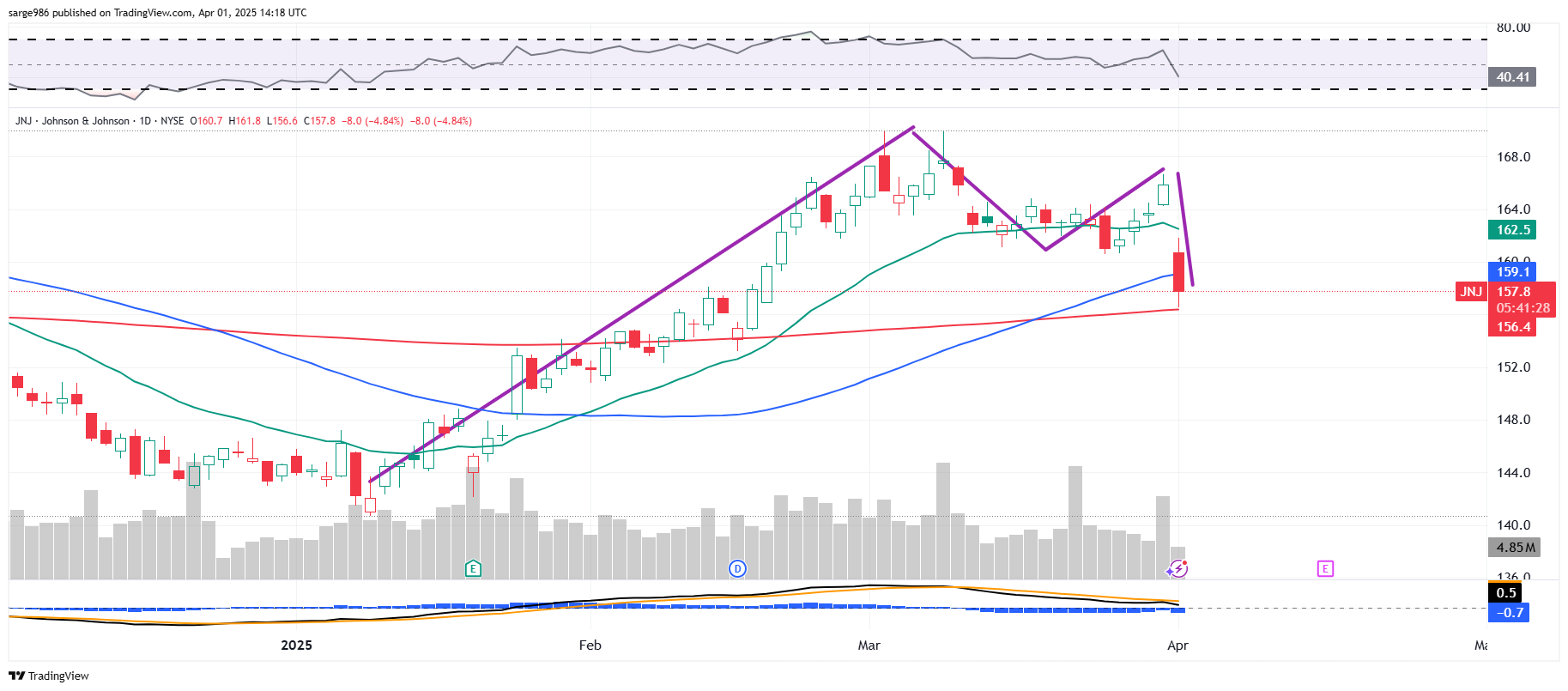
JNJ stock may have just formed a sloppy "double-top" pattern of bearish reversal. On Tuesday morning, the stock lost its 50-day SMA, which is rough enough, but has so far found some support at its 200-day SMA. The daily MACD is bearish. Relative strength is rapidly weakening. If the stock loses that 200-day line, prices in the low $140s are very possible.
I do not see this as a "buy the dip" opportunity.
At the time of publication, Guilfoyle had no positions in any securities mentioned.