Is Palo Alto Networks a Buy After Getting a Cybersecurity Gut Punch?
With Palo Alto’s post‑earnings drop pushing the stock toward key trendline support, is opportunity calling? And how's CrowdStrike taking it?
You've reached your free article limit
You've read 0 of 1 free Pro articles.
Cybersecurity software-providing giant Palo Alto Networks (PANW) released its fiscal second-quarter financial results on Tuesday evening. For the three-month period ended January 31, Palo Alto posted adjusted EPS of $1.03 (GAAP EPS: $0.61) on revenue of $2.594 billion. These top and bottom-line results beat expectations while the revenue print was good enough for year-over-year growth of 14.6%.
Yet the stock is selling off sharply.
Sifting through the nitty-gritty, Next-Generation Security ARR (annual recurring revenue) increased 33% to $6.3 billion and remaining performance obligation grew 23% to $16 billion.
On the period, Palo Alto Chairman and CEO Nikesh Arora commented in the press release... "We saw continued strength in platformizations, a trend that is accelerating due to AI - customers are keen to both modernize and normalize their cybersecurity stack, aligning them to our approach. We also saw steady and strong adoption of AI security, which we expect will be a long-term trend. We are excited to welcome the employees of Chronosphere and CyberArk to help us drive our growth in the future."
Solid Quarter, With a Side of 'Baloney'
As total revenue grew 14.6%, sales of subscriptions and services grew 13% to $2.08 billion and sales of products increased 22% to $514 million. Total cost of revenue landed at $685 million (+14%), leaving a gross profit of $1.909 billion (+15%) on a gross margin of 73.6%, up from 73.5%. On an adjusted basis, gross margin improved from 76.7% to 78.2%.
GAAP operating expenses grew 6.8% to $1.512 billion, leaving GAAP operating income of $397 million (+64.7%) as GAAP operating margin improved to 15.3% from 10.7%. Once adjusted, operating income gained 22% to $785 million and operating margin widened to 30.3% from 28.4%.
After accounting for interest, other income & expenses and taxes, GAAP net income printed at $432 million (+61.8%). This works out to $0.61 per fully diluted share, up from $0.38 for the year-ago comparison. Once adjusted, net income was up 29.3% to $732 million, working out to $1.03 per fully diluted share. That compared to $0.81 for the year-ago period. The adjustment made was primarily made for the purposes of share-based compensation.
This was a very solid quarter. It stands up on its own merits, but enough with the baloney. I've said this seemingly forever. Palo Alto has been publicly traded since 2012. Non-startups should not be adjusting for share-based compensation. If you've been doing it every quarter for years or even decades, then it is an ordinary operating expense. Stop pretending this is special.
A Major Reason for the Selloff
For the current quarter, Palo Alto sees revenue of $2.941 billion to $2.945 billion, which was well above the $2.6 billion that Wall Street was looking for. Next-generation security ARR is seen at $7.94 billion to $7.96 billion, while RPO is seen at $17.85 billion to $17.95 billion.
Adjusted EPS is projected at $0.78 to $0.80. That was well below the $0.92 Wall Street consensus and is a major reason for Wednesday's selloff.
For the full fiscal year (entering the third quarter), revenue is seen at $11.28 billion to $11.31 billion, which falls short of the expected $11.53 billion. Adjusted EPS is projected at $3.65 to $3.70, again, well below the $3.85 that had more or less been priced in. These projections include the impacts of the CyberArk and Chronosphere acquisitions and in my humble opinion, may be intentionally conservative.
'Fortress' Fundamentals
For the period reported, Palo Alto generated operating cash flow of $554 million. Out of that number came traditional capex spending of $170 million and $118 million in additional capital expenditures, leaving free cash flow of $384 million. The company did not return capital to shareholders during the quarter.
Turning to the balance sheet, Palo Alto ended the quarter with a cash position of $4.536 billion and current assets of $8.369 billion. Current liabilities add up to $8.009 billion, but $6.248 billion is labeled as deferred revenue, which is not a true financial obligation. There is no short-term debt on the books. Forget the headline current ratio, the current ratio adjusted for those deferred revenues comes to a herculean 4.75.
Total assets amount to $24.979 billion, of which $8.18 billion comes in the form of goodwill or other intangibles. At nearly 32.8% of total assets, that's a little elevated, but certainly not outside of modern norms.
Total liabilities less equity comes to $15.586billion, including another $6.181 billion in deferred revenue. No long-term debt either.
This balance sheet is a fortress.
My Thoughts of Palo Alto... and CrowdStrike
Looking over the analyst calls for the day, I see a lot of reiterated "buy" or buy-equivalent ratings alongside a bevy of price target changes to the downside. Nothing sticks out as shocking. If the guidance is accurate, the lower price targets are warranted. If Palo Alto is being cautious, as I suspect, then this is an opportunity.
I do not see the advent of AI as being as disruptive to elite-level cybersecurity firms as other software service providers. Increased needs for effective cybersecurity will only accelerate as AI gets smarter and faster.
I sold my smallish, long position in PANW in its entirety and a portion of my more significant CrowdStrike (CRWD) towards the start of the software meltdown. I am trying to decide if I should buy back my PANW and add a few shares back to my CRWD on this weakness. CrowdStrike reports in two weeks.
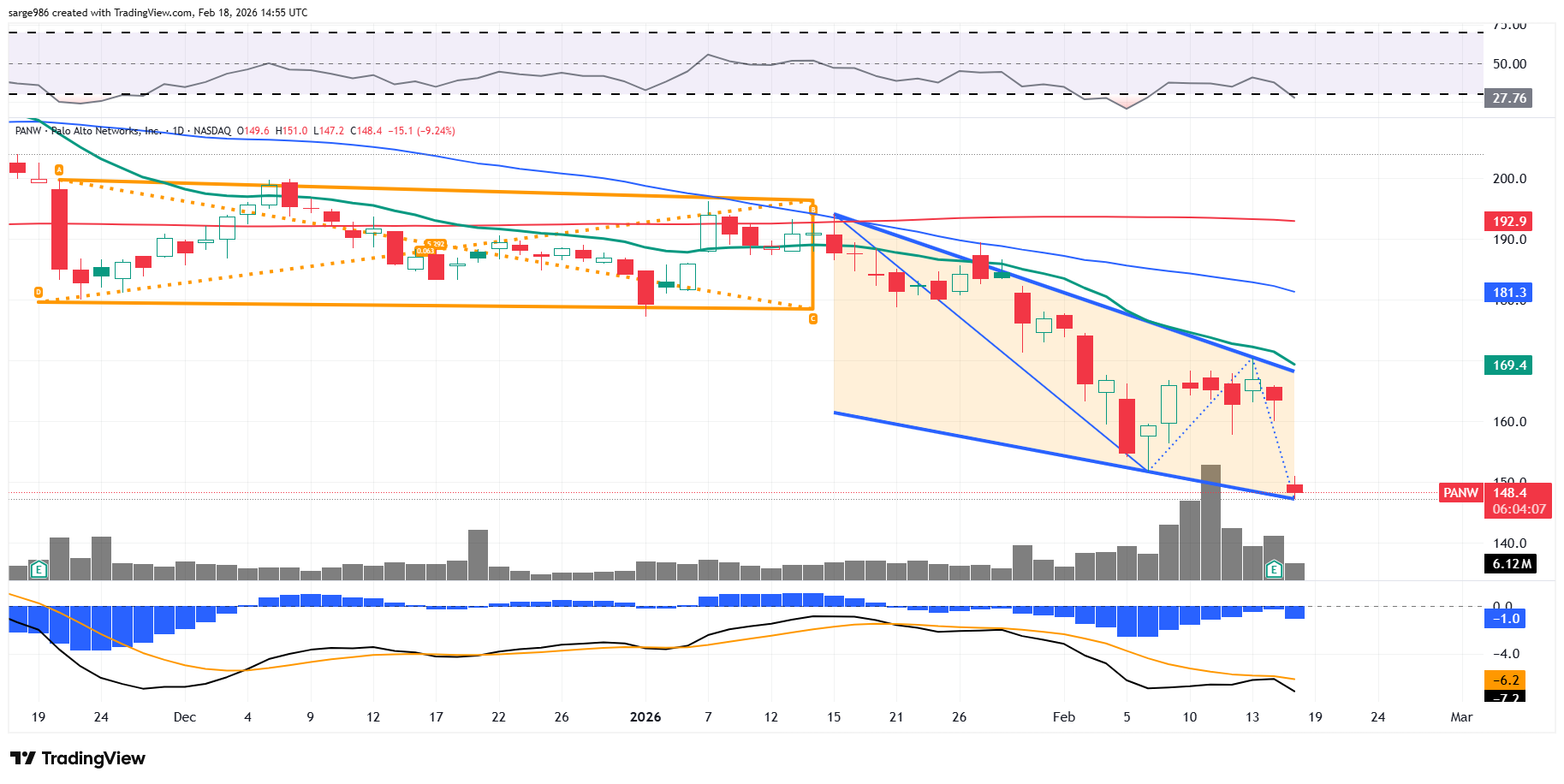
Readers will see in the chart above that PANW came out of a flat base in mid-January and went right into a falling wedge pattern of bullish reversal. The stock is testing the lower trendline of that wedge Wednesday morning and could be worthy of a speculative trade from the long side, despite a truly weak-looking daily MACD (moving average convergence divergence) and an oversold-looking RSI (relative strength index). Should that lower trendline crack, I would not wait for the 8% rule to be triggered to exit.
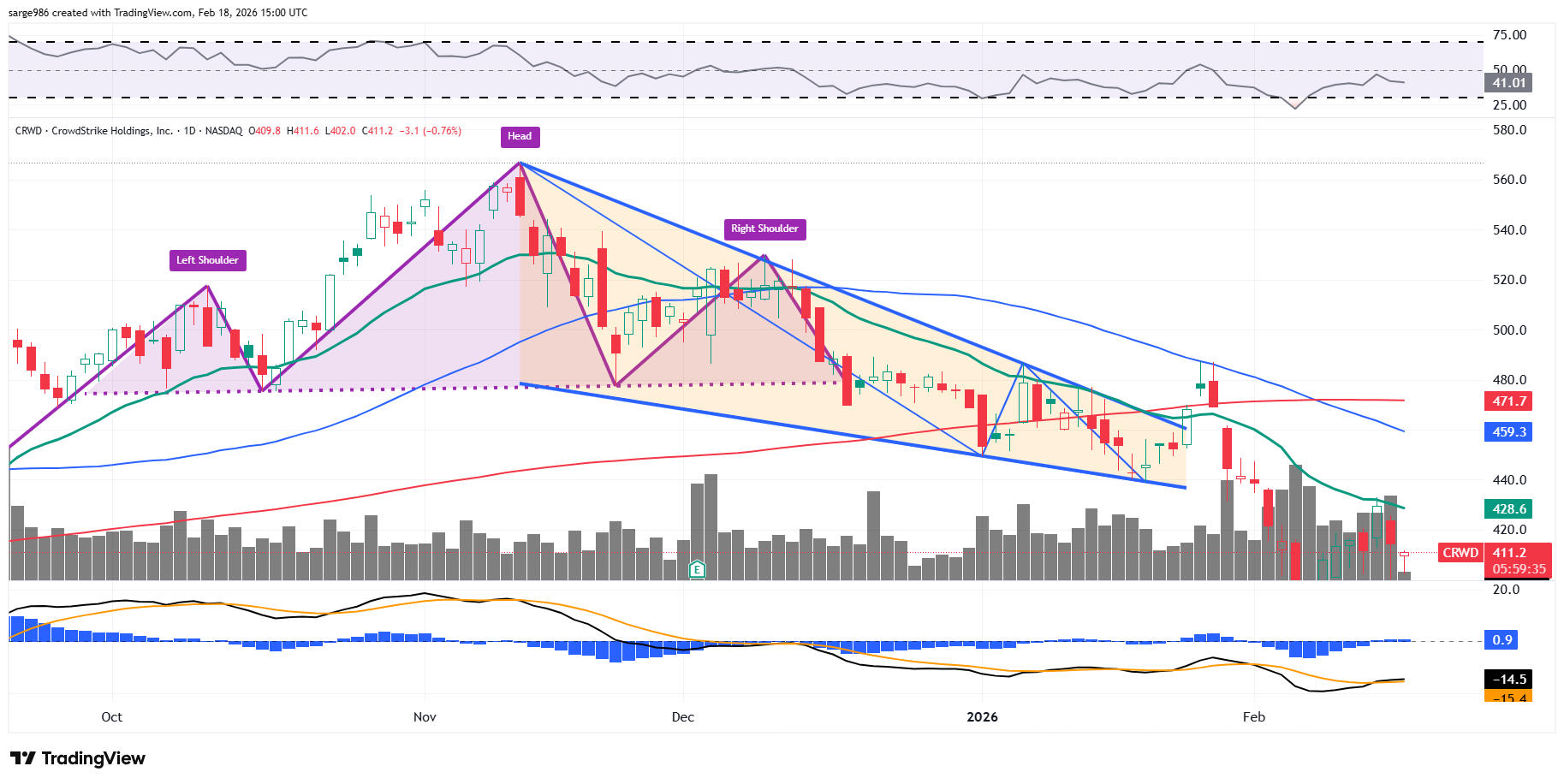
As for CRWD, we see in the chart above that the stock completed a head-and-shoulders pattern of bearish reversal that worked like a charm that morphed into a falling wedge that only managed to produce increased volatility. That said, the stock's daily MACD is starting to show some life, and the RSI is better than bad.
The best case for this stock would be to complete the halfway home-looking potential for a double-bottom pattern of reversal of trend ahead of earnings in early March.
At the time of publication, Guilfoyle was long CRWD equity.