Is Nike the Next Dow Component to Be Removed?
Nike shares just hit a six-month low, and are on four-year losing streak. Is the brand losing its relevance?
You've reached your free article limit
You've read 0 of 1 free Pro articles.
Just over a month ago, I warned investors to avoid owning shares of athletic wear manufacturer Nike (NKE) . I cited Nike’s underperformance compared to the broader market, as well as changing fashion trends.
Since that article first appeared, Nike shares have fallen by nearly 10%. Over that same period, the broader market, represented by the S&P 500, has gained about 1%. The S&P 500 reached an all-time high this week, while Nike shares hit a six-month low.
Earnings Mask Overseas Weakness
Last week, Beaverton, Oregon-based Nike beat earnings estimates by a wide margin. Revenue also came in ahead of expectations. But those solid figures masked a sharp decline in sales in China, where Nike’s revenues dropped by 17%.
Nike’s performance, or the lack thereof, speaks for itself. Its shares have fallen 22% year to date. The stock has fallen for three consecutive years, losing 29.8% in 2022, 7.8% in 2023, and 30.3% in 2024.
Barring a miracle, 2025 will mark a fourth consecutive losing year for Nike shareholders.
Nike’s Charts Point to Further Downside Ahead
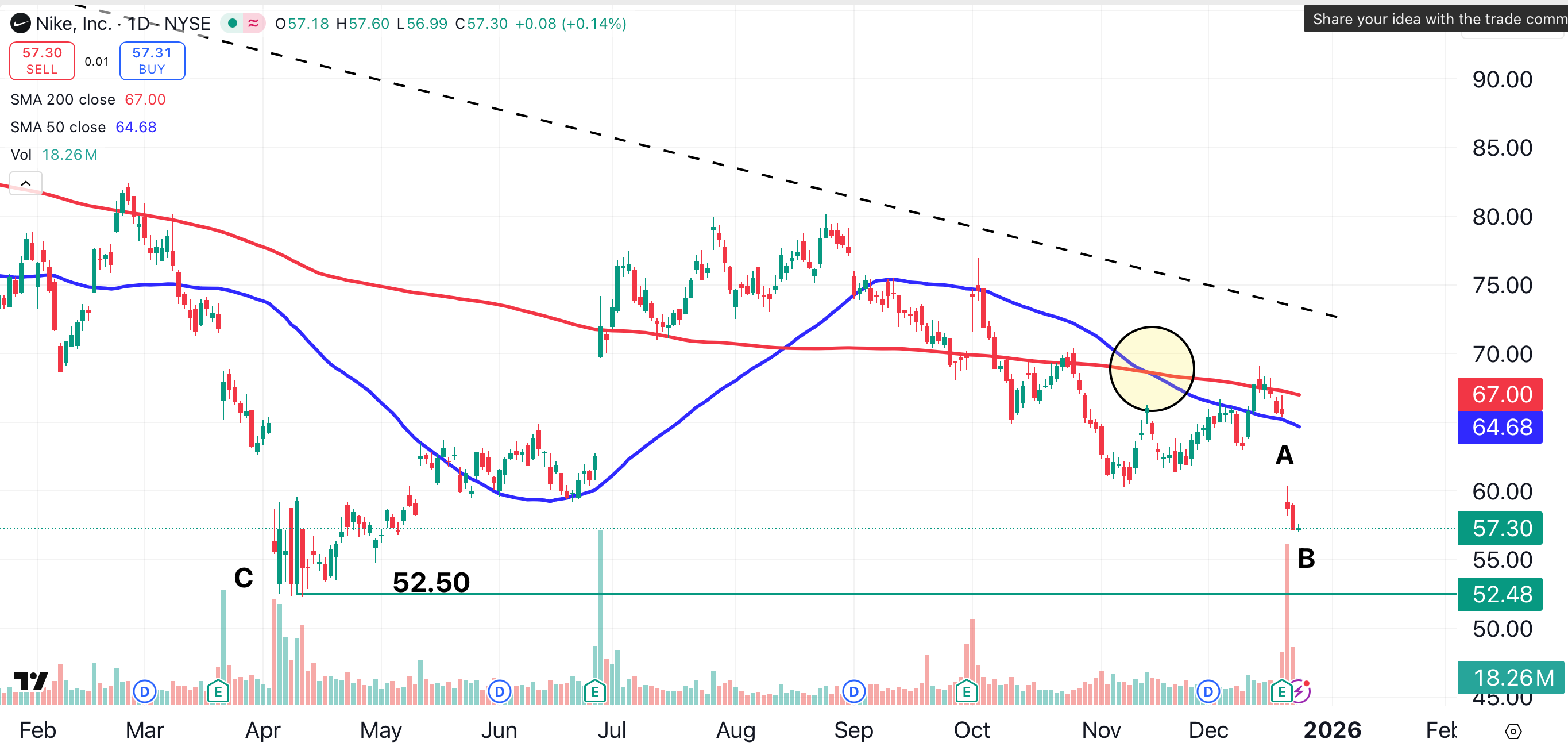
On the daily chart, Nike gapped lower last week after reporting earnings (point A). The decline occurred on heavy volume, an indication that institutions may be selling (point B). The next support level for Nike is $52.50 (point C). The stock bounced from that area in April.
Nike’s 50-day moving average (blue) and 200-day moving average (red) experienced a bearish crossover last month (shaded yellow). Both moving averages were falling at the time, another bearish indicator.
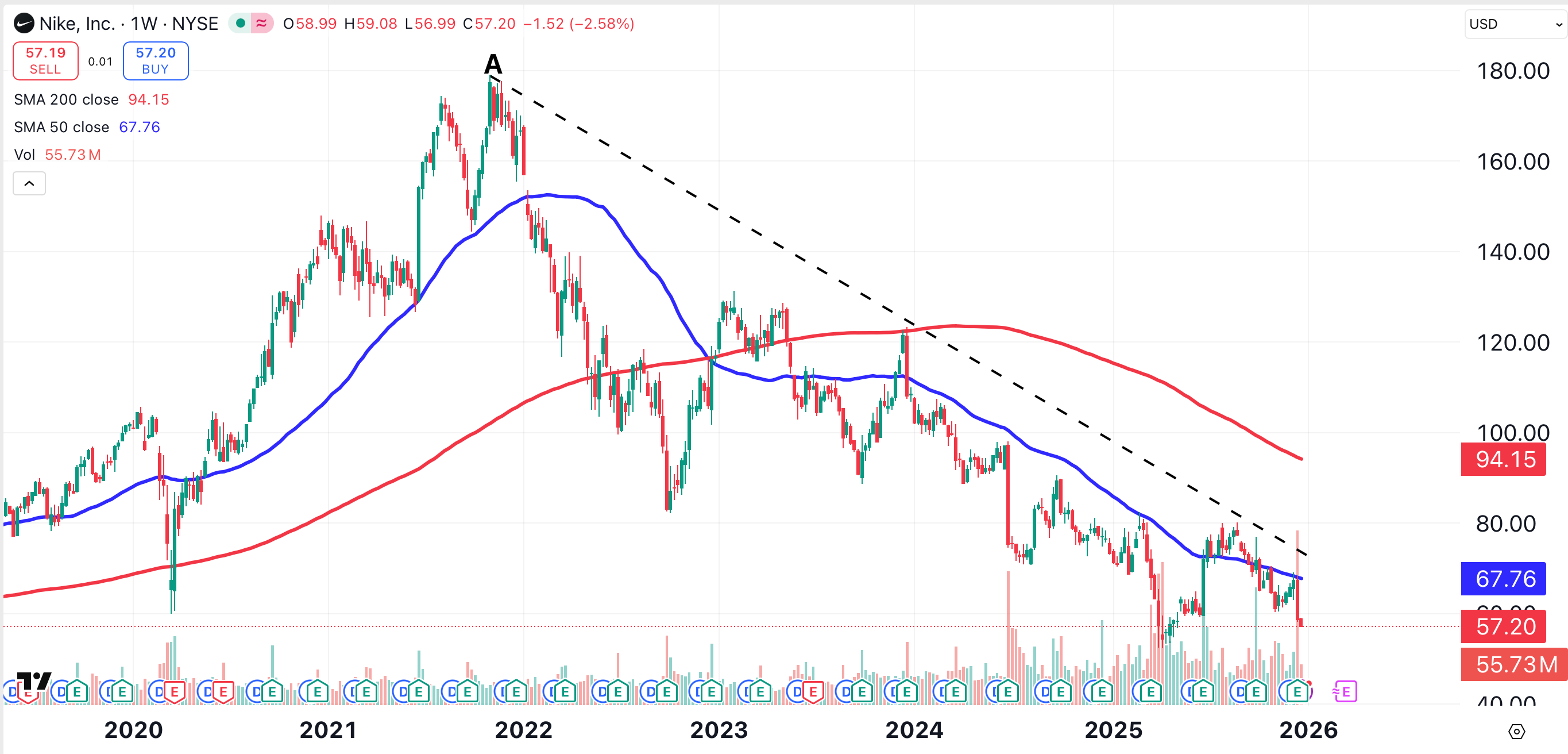
Zooming out to the weekly chart, we see that Nike’s recent troubles are merely the continuation of a trend that has been intact for four years (black dotted line). On the weekly chart, we can see the stock’s peak in November 2021, just below $180 (point A).
At that time, the stock had just reached an all-time high. Since then, Nike shares have lost 68% of their value.
Dow Jones Is No Panacea
Nike currently enjoys its status as a component of the Dow Jones Industrial Average, but that’s no guarantee of future success.
Many former components of the DJIA have been unceremoniously booted from the index. The list includes names like Walgreens Boots Alliance (WBA) , AT&T (T) , Sears, Eastman Kodak (KODK) , and Bethlehem Steel.
All of the above names were removed from the DJIA index due to underperformance. With four consecutive years of negative returns, could Nike meet the same fate?
Bottom Line
Suppose a product is a constant in your life, and that product represents something meaningful and important to you. It might be difficult to accept that the product doesn’t hold the same meaning for younger generations.
Could that be happening with Nike? I doubt that young people today want to wear the same clothes that their parents and grandparents wore. Those who are hoping for Nike to return to its former glory may have a long wait ahead.
At the time of publication, Ponsi had no positions in any securities mentioned.