Is it Time to Buy the Intel Dip?
The beleaguered tech firm posted decent earnings, at least relative to expectations.
You've reached your free article limit
You've read 0 of 1 free Pro articles.
On Thursday evening, beleaguered semiconductor designer/manufacturer Intel INTC, once the industry champ, now the butt of industry jokes, released the firm's first quarter financial results.
They weren't that bad. Honest. Well, they weren't that bad, relative to expectations, once adjusted. For the three-month period ended March 29, Intel posted an adjusted EPS of $0.13 (GAAP EPS: -$0.19) on revenue of $12.667 billion.
All of these numbers outperformed the consensus view despite the fact that year-over-year revenue growth landed at -0.4%. The stock is trading lower on this news, most likely due to the weak guidance, which we will get to. Adjustments were made for share-based compensation, restructuring charges and acquisition-related costs.
Question: Should a firm in business since 1968, and public since 1971, that has been a member of the Dow Jones Industrial since 1999, really be adjusting for share-based compensation? If you're public for 54 years, those are called routine operating expenses. Just sayin'.
Operations
As revenue generation contracted 0.4% to $12.667 billion, the cost of sales increased 6.5% to $7.995 billion. That left a gross profit of $4.672 billion, which was down 10.4% from the year-ago comparison as gross margin dropped from 41% to 36.9%. GAAP operating expenses decreased by an impressive 20.9% to $4.973 billion. That left a GAAP operating income/loss of -$301 million, up from -$1.069 billion a year ago. Operating margin for the period improved to -2.4% from -8.4%.
On an adjusted basis, operating expenses dropped 15% as operating margin decreased from 5.7% to 5.4%. After accounting for interest, taxes and other income and expenses, GAAP net income/loss attributable to shareholders printed at -$821 million, down from -$381 million. This works out to a GAAP EPS of -$0.19, down from -$0.09 for the year-ago period. On an adjusted basis, net income was down 24% from a year ago, as EPS dropped from $0.18 to $0.13.
Segment Sales Performance
- Client Computing Group: Revenue contracted 8% to $7.6 billion
- Data Center and AI: Revenue increased 8% to $4.1 billion
- Intel Foundry: Revenue increased 7% to $4.7 billion
Guidance
For the current quarter, Intel is now projecting revenue generation of $11.2 billion to $12.4 billion. At the $11.8 billion midpoint, this is well below the $12.25 billion that Wall Street had in mind and in line with the very lowest estimates that I had seen coming in.
The firm sees a GAAP gross margin of 34.3% and an adjusted gross margin of 36.5%. The firm also expects Q2 EPS to print at -$0.32 on a GAAP basis and at $0.00 on an adjusted basis. Wall Street had been looking for an adjusted $0.05. Obviously, this guidance is not what the street expected and had to be priced in overnight.
Fundamentals
For the period reported, Intel generated operating cash flow of $813 million. Net capex spending printed at $4.487 billion, the firm spent $6 million on finance lease payments as well. This left free cash flow of -$3.68 billion. That's right. For the quarter, Intel generated free cash flow of -$3.68 billion. The minus sign is not a misprint. However, this is a tremendous improvement from -$6.178 billion for Q1 2024. Yippee. Obviously, the firm is nowhere close to being in a position to return capital to shareholders.
Turning to the balance sheet, Intel ended the quarter with a cash position of $21.048 billion and inventories of $12.281 billion. This leaves current assets of $42.134 billion. Current liabilities add up to $32.174 billion, including short-term debt of $5.24 billion, but no deferred revenue, which I find both odd and maybe concerning. The firm's current and quick ratios stand at 1.31 and 0.92, which is not awful, but I would like to see a stronger quick ratio. With no deferred revenue, there is nothing to adjust. That said, the cash position is more than adequate for the firm to easily meet its short to medium-term obligations.
Total assets amount to $192.242 billion. Of that, goodwill and other intangibles add up to $28.261 billion. At 14.7% of total assets, this is no problem at all. Total liabilities less equity comes to $85.829 billion. Of that, long-term debt comes to $44.911 billion. At some point, the firm will have to produce positive cash flow and start whittling down that debt-load without issuing at least an equal amount of new debt. That eventually becomes counterproductive unless interest rates drop.
Wall Street
Basically, nobody cares. At least not on Wall Street. Since these earnings were released on Thursday night, I have found nine sell-side analysts rated at four stars or greater at TipRanks (out of five stars) that opined on INTC. All nine of these analysts reiterated "hold" or hold-equivalent ratings. Four of these analysts chose not to set target prices. Three others reduced their targets.
After allowing for those changes, the average target price across the remaining five analysts is $21.40 with a high of $23 and a low of $20 (twice). The stock is trading just below $20 on Friday morning, down more than 7%. I don't think naming analysts matters much when there are no outliers and it seems these individuals track the stock only because their employers have assigned the stock to them.
My Thoughts
I do not currently have all that much exposure to semiconductors. I recently lost some money on a trade in Advanced Micro Devices AMD. I recently made it back on a trade in equipment provider Lam Research LRCX. I'm still long that one.
I haven't had exposure to Nvidia NVDA or Intel since I realized that the sell-off was for real. I had been long both stocks earlier in the year. They were both part of the great "narrowing" of my book that I had discussed with readers. So, do I want to get back into Intel? Nvidia, maybe. We'll see how those earnings go. Intel though?
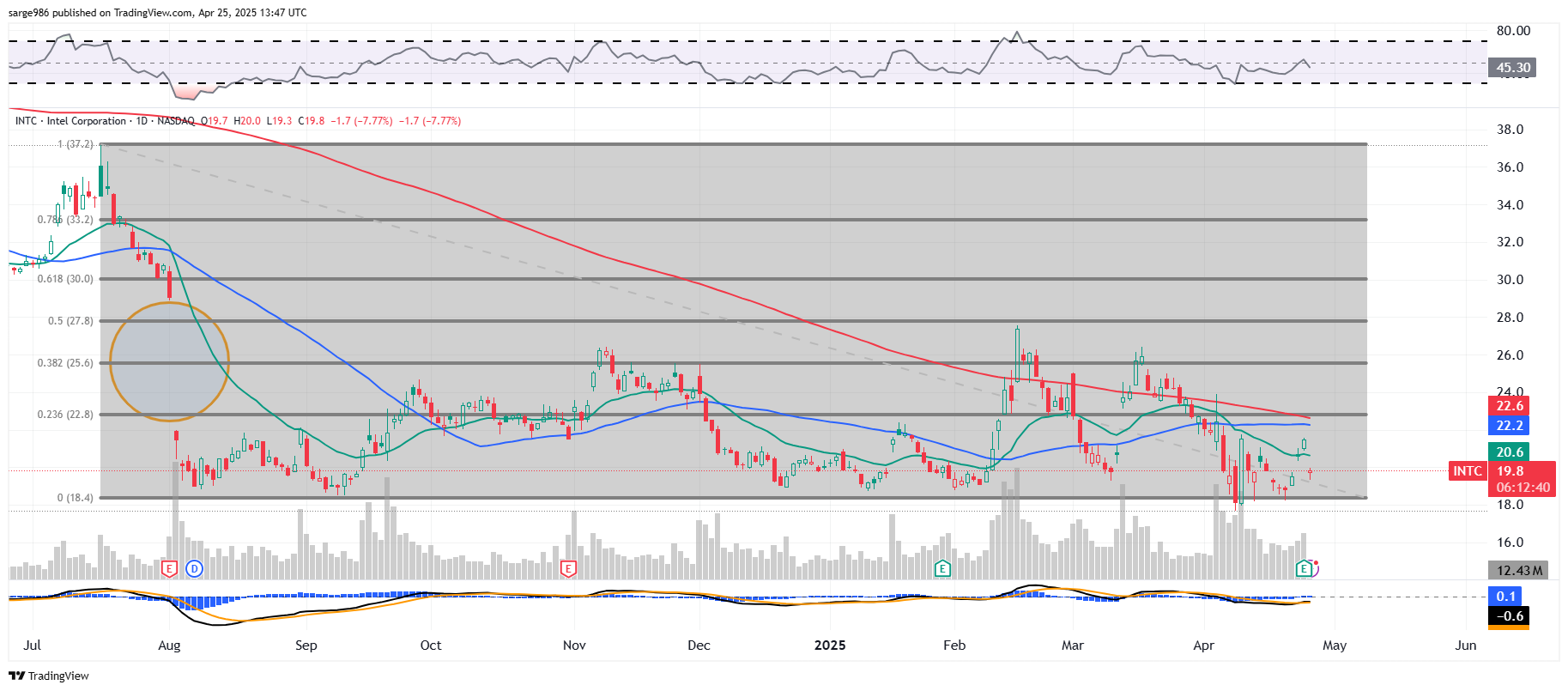
Readers will see that INTC has tested support in the same general area many times since last summer. I may enter at or close to that $18-ish support level, but I wouldn't risk much there as there is some danger, which I will show you in a second. I would rather grab some of these shares on momentum should the stock ever take back its 50-day SMA, 200-day SMA and 23.6% Fibonacci retracement level of the July through April sell-off. Why don't I really want to initiate at that support level?
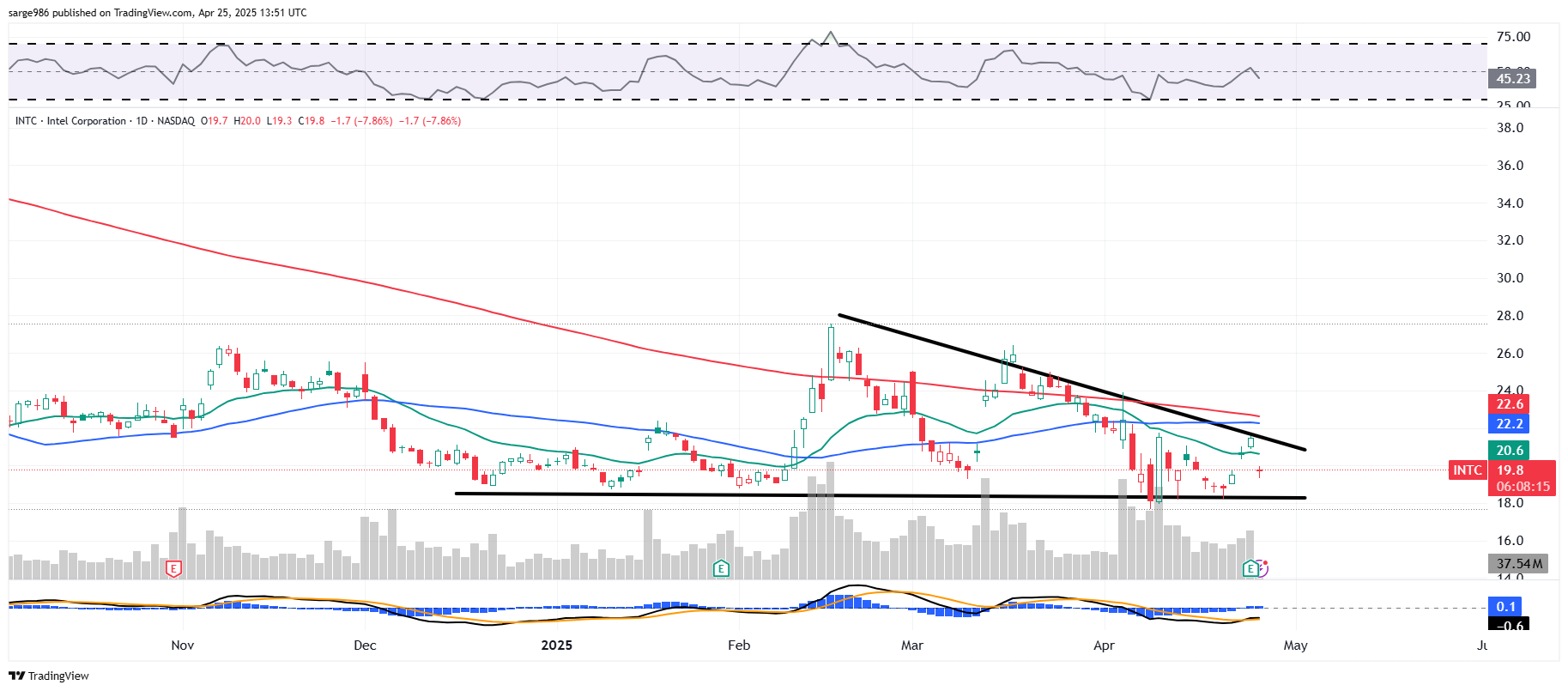
Intel is developing what looks like a descending triangle. Remember the ascending triangle in Friday morning's Market Recon? I told you that was a bullish setup. Well, as readers have already likely deduced... descending triangles are bearish technical setups.
At the time of publication, Guilfoyle was long LRCX equity.