Is it Time to Buy the Abbott Labs Dip?
Here's what I'd do with the name after a disappointing financial release.
You've reached your free article limit
You've read 0 of 1 free Pro articles.
On Wednesday morning, Abbott Labs (ABT) released the firm's third quarter financial results. For the three-month period ended September 30, the firm posted an adjusted EPS of $1.30 (GAAP EPS: $0.94) on revenue of $11.369 billion.
While sales were good for year-over-year growth of 6.9%, the revenue print came in a little light versus expectations. Organic sales growth was up just 5.5% or 7.5% excluding the declining sales of COVID test kits. Additionally, while the adjusted earnings print did just meet expectations, the GAAP number fell about a dime short per share of what Wall Street was looking for.
Business Line Revenue Performance
- Nutrition generated sales of $2.153 billion (+4.2%)
- Diagnostics generated sales of $2.253 billion (-6.6%)
- Establishment Pharmaceuticals generated sales of $1.511 billion (+7.5%)
- Medical Devices generated sales of $5.448 billion (+14.8%)
Geographic Revenue Performance
- U.S. generated sales of $4.299 billion (+2.3%)
- International generated sales of $7.07 billion (+9.9%)
Guidance
Abbot reaffirmed the midpoint of previously issued full year 2025 guidance for its adjusted EPS of $5.15, though narrowed the range to $5.12 to $5.18. If realized, this would amount to double digit annual growth in percentage terms. This is actually a penny a share better than the $5.14 that Wall Street was looking for. Full year organic sales growth is seen at 7.5% to 8%.
Fundamentals
You're not going to like this anymore than I do, but Abbott Labs is one of those firms that doesn't release all of their key financial data at once. While the firm did file an 8-K with the SEC and in that press release the firm did report earnings, there was no meat with those potatoes. No veggies either. What I am telling readers is that not only did the firm not release a statement of cash flows with earnings which is not good, but is heard of, they did not even release an update to the balance sheet which is pretty close to unheard of.
This is not new. This is the way Abbott operates. For the second quarter, Abbott released their 8-K with the earnings-related info on July 17 and then did not release a 10-Q with all of the other highly important information until July 30. Almost two weeks later. As a trader and investor, I see that as completely unacceptable. However, I do not make up the rules, and this is not outside of the rules.
The fact is that the firm does not have anything to hide. For the first six months of the year, operating cash flow and free cash flow were $3.464 billion and $2.478 billion, respectively. That's annual growth of 22% and 20.6% in that order. At that time, Abbott ran with a current ratio of 1.82 and a quick ratio of 1.30, which is quite healthy. The firm had a cash position at that time of $7.282 billion, just $507 million in short-term debt and $12.93 billion in longer-term debt. The balance sheet has nothing to hide. This is just the way the firm operates, which is sub-optimal for rigorous investors.
The Chart
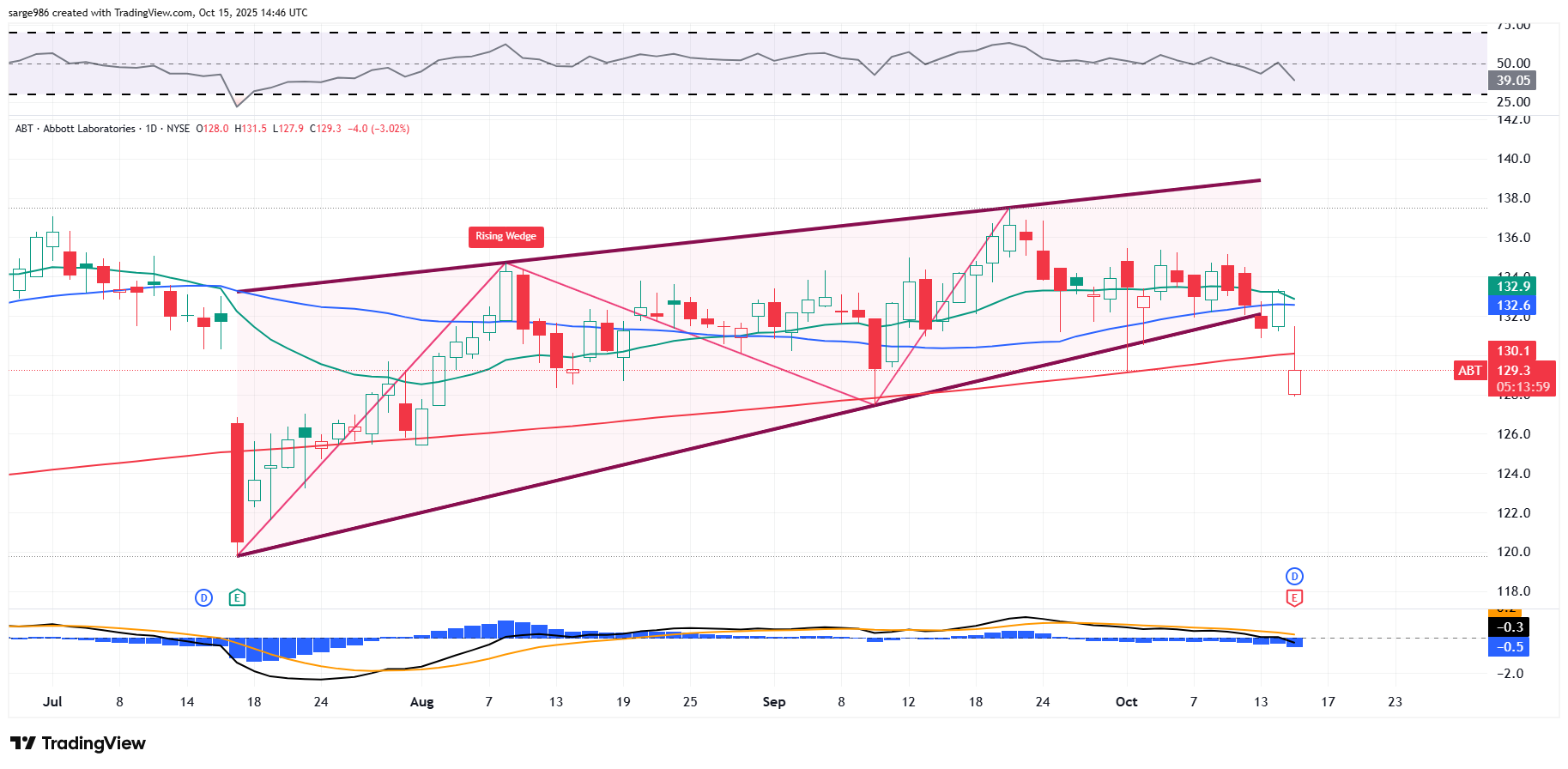
Readers will see that ABT broke through the bottom trend line of a rising wedge pattern of bearish reversal just ahead of earnings. On Tuesday, the shares managed to hang on to both their 21-day EMA and 50-day EMA despite the downward pressure. On Wednesday morning, ABTT has given up its 21-day EMA, 50-day SMA and 200-day SMA. You're welcomed to disagree, but I think this is an awful time to buy the dip in ABT and an excellent time to make a sale if long the shares.
Last time, ABT lost the lower trendline of a rising wedge pattern (June), the stock gave up 11%. Losing the 21-day line means losing the swing crowd. Losing the 50-day line means losing some of the pros. Losing the 200-day line means losing a lot of the pros and the ones that hang around will be pressured by their risk managers to reduce exposure.
On top of that, relative strength is weak and the daily MACD is postured short to medium-term bearishly. The July 18 low of $119 becomes the next level to watch for a potential add or initiation. Other than that, I will be staying away from this one unless I see the black line (12-day EMA) inside the daily MACD) move above the gold line (26-day MACD). Otherwise, there are better places for me to put my dough.
At the time of publication, Guilfoyle had no positions in any securities mentioned.