Investors Should Watch These 'Improvers' in Global Automaker Rankings
The transition to new-energy car models is advancing, though European producers are generally slipping as their Asian competition gain ground.
You've reached your free article limit
You've read 0 of 1 free Pro articles.
Chinese automakers already have a healthy head start when it comes to the production of zero-emission vehicles (ZEVs) including electric vehicles (EVs). But it is a gap with their competitors that they are extending, according to a new report.
Chinese dominance in the EV field has come as a result both of China’s strong position in battery making and government policy to stimulate the sector. Chinese producers now sell 11 million EVs each year, more than half the global total.
Investors may want to track the companies that are improving their position in alternative-energy vehicles. Even if they’re playing catchup, automakers such as Tata Motors (NSE:TATAMOTORS) are bolstering their roster of models in a way that bodes well for future share-price movements.
You can find the new edition of the annual Global Automaker Rating here. This is the third year that the International Council on Clean Transportation (ICCT) has compiled the report.
Ten Custom-Built Metrics
To compile their ratings for the 21 largest vehicle manufacturers by sales, the ICCT used 10 custom-built metrics to evaluate their efforts and strategies in transitioning their vehicle fleet to ZEVs and toward decarbonization.
Companies are then classed as “Leaders” among the top tier of the ratings, “Transitioners” in the middle tier, and “Laggards” in the bottom tier.
Mumbai-based Tata Motors is the first major automaker to jump from the “Laggard” category to the “Transitioner” group. The Indian automaker has made that change thanks to its introduction of new EV models and by ramping up its battery recycling and repurposing efforts.
Sadly, Tata Motors delisted from the NYSE in 2023, citing easier access for international investors to Indian equities. So it’s only available via the National Stock Exchange of India and the Bombay Stock Exchange, listed on both.
Bottom-Tier Improvers
The bottom tier is made up exclusively of Korean and Japanese manufacturers, companies that generally resisted the early call to develop ZEVs.
However, the Japanese producers Honda Motor HMC (T:7267) and Nissan Motor NSANY (T:7201) also “showed noticeable progress,” according to the report. Honda has introduced its first battery EV in the United States, while the report credits Nissan for clarifying its targets for ZEVs.
From their bastion home base, Chinese manufacturers are now making headway in global markets, according to the research. Geely Automobile Holdings GELYY (HK:0175) and SAIC Motor (SH:600104) have both already reached their target for EVs to make up at least 50% of sales, a threshold they crossed a year ahead of schedule.
That has seen Geely and SAIC rise to No. 3 and No. 4 in the ranking, above BMW BMWYY and Mercedes-Benz MBGAF, which outscored the Chinese duo in the previous report.
“This consistent progress by Chinese manufacturers shows the long-term strategic benefits of early, sustained investment in electrification,” the compilers state in releasing the report. “In contrast, automakers in the U.S. and E.U. face the dual challenges of catching up technologically while navigating uncertain regulatory environments.”
European Marques Slip
Chinese EV market-share leader BYD BYDDY (HK:1211) passed Tesla TSLA as the global leader in EV sales for the first time in 2024. That’s thanks to a 25% increase in pure-play battery EV (BEV) sales and a 47% increase for combined BEV and plug-in hybrid EV (PHEV) sales, over the figures for the prior year.
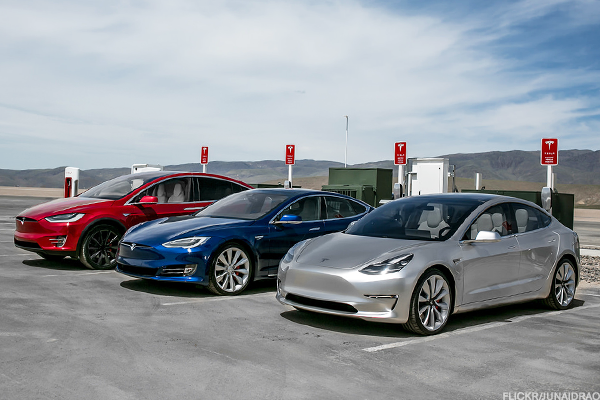
Despite Tesla’s slipping market-share crown, both the U.S. automaker and BYD retain their rating as “Leaders” in the industry, per the report. They are the only automakers in that top category.
While all but one of the Asian manufacturers saw their scores rise, several European automakers slipped in their overall EV assessment. That’s the case for BMW, Mercedes and Volkswagen VWAGY.
Stellantis STLA rose above Mercedes as it improved its overall EV score, and Ford F edged its rating slightly ahead, gaining one place in the ranking.
In the “Transitioner” grouping, the Chinese manufacturers Chongqing Changan Automobile (SH:000625), unlisted Chery and Great Wall Motor GWLLY (HK:2333) all improved their scores, putting those generally budget manufacturers firmly in the middle of the range.
Chery has reportedly submitted a listing application for an initial public offering in Hong Kong that should raise around US$1.5 billion.
The only Asian manufacturer to see its rating slip is Hyundai-Kia, which saw its score fall as well as its rating, moving down from “Transitioner” to “Laggard.” It had previously been on the cusp. I would suggest that doesn’t bode well for the future share-price movement of both Hyundai Motor HYMTF (KR:005380) and separately listed affiliate Kia KIMTF (KR:000270).
At the time of publication, McMillan was long BYDDY.