Interesting Trade Idea for BigBear.ai as Stock Plummets
The AI platform provider was slapped around for a loss on an otherwise strong day for stocks across sectors.
You've reached your free article limit
You've read 0 of 1 free Pro articles.
Back on July 24, I previewed second quarter earnings for BigBear.ai Holdings BBAI. I had mentioned early on in that piece that maybe the McLean, Virginia headquartered platform provider to those seeking artificial intelligence powered decision making solutions (especially those focused on national security) might just be a fit for those looking for an AI-type stock still trading at an affordable price. Well, BigBear is a lot more affordable on Wednesday than it was then.
In all fairness to the author of that piece (that's me), I did state in my conclusion that BigBear was not an automatic "buy" and that a double-top pattern of bearish reversal had developed. That said, at that time, I did see the stock's 21-day EMA as the likely pivot, which seemed to be true... for a little while.
Long story short, BBAI was slapped around for a loss of 15.8% on Tuesday, which was a strong day for stocks across all sectors and cap sizes. Let us explore (this piece comes to readers on Wednesday morning via subscriber request).
Earnings (or Lack Thereof)
On Monday afternoon, BigBear posted a Q2 GAAP EPS of -$0.71 on revenue of $32.5 million (-18.3%). Both of these numbers fell short of Wall Street's expectations by a wide margin. A very wide margin. Wall Street had been looking for a loss of between a nickel and a dime per share on revenues of more than $40 million. For the full year, BigBear projected total revenue of between $125 million and $140 million. Wall Street had been looking for close to $168 million. Yes, that's another sizable miss.
Operations
As revenue was contracting 18.3% to $32.472 million, the cost of those revenues dropped 15.2% to $24.359 million. This left a gross profit of $8.113 million (-26.7%) as gross margin dropped from 27.8% to 25%. As far as operating expenses are concerned, administrative expenses were down a bit, research and development costs were slightly higher, and restructuring charges were higher. The firm also took a goodwill impairment of $70.636 million.
In all fairness to BigBear, most tech firms would have reported adjusted earnings and not recorded the impairment nor the restructuring charges as ordinary operating expenses, so kudos to the management team. After all of that, the firm was left with an operating income/loss of -$90.302 million, down from -$16.67 million for the year-ago period.
After accounting for interest, other income and expenses, and taxes, GAAP net income/loss printed at -$228.619 million or -$0.71 per fully diluted share. That was down from -$14.439 million a year ago of -$0.06 per share.
The Man With a Plan?
CEO Kevin McAleenan commented in the press release:
"Our robust balance sheet allows us to make significant transformational investments to shape the future of BigBear.ai. Our capital raising activities this quarter coincide with the tremendous opportunities we see coming from the One Big Beautiful Bill, particularly in the Department of Homeland Security, and several of which are uniquely aligned to our core capabilities. This legislation will bring a generational investment and provides over $170 billion in supplemental funding to the Department of Homeland Security, and $150 billion to the Department of Defense for disruptive defense technology. This is not incremental funding for innovation — this is a transformative level of investment. As a Mission Ready AI company with a national and border security focus, it’s directly in our lane.”
Fundamentals
For the quarter reported, BigBear generated operating cash flow of -$3.868 million. Add to this capex spending of just $1.164 million and free cash flow printed at -$5.032 million, which was an improvement from -$8.769 million for the year-ago comparison.
Moving on to the balance sheet, the firm ended the period with a cash position of $390.845 million and current assets of $424.383 million. Current liabilities add up to $221.645 million, which does include a small amount of traditional short-term debt and $193.199 million in derivative liabilities. These do include notes convertible in 2026 and 2029, so those holding equity could end up facing some eventual dilution.
Total assets amount to $599.372 million, including $164.067 million in goodwill and other intangibles. While 27% of total assets being intangible might not be all that concerning for a normal firm, this is a firm "hoping" to generate $140 million in revenue for the full year and worth about $2 billion by market cap. That seems like a lot to me.
Total liabilities less equity comes to $332.822 million including another $102.683 million in long-term debt. While I do not love this balance sheet, there is enough cash on hand to take care of the firm's entire debt load as well as those derivative liabilities, so it's not awful.
Wall Street
As one might have expected, there is not a lot of coverage of this stock on Wall Street. That said, two highly rated sell-side analysts did react to this release.
- Jonathan Ruykhaver of Cantor Fitgerald, who is rated at five stars (of five) at TipRanks, reiterated his "buy" rating while increasing his target price from $5 to $6
- Mira Patchera of TR, who is rated at four stars at TipRanks, reiterated her "hold" rating while decreasing her target price from $7 to $6
The Chart
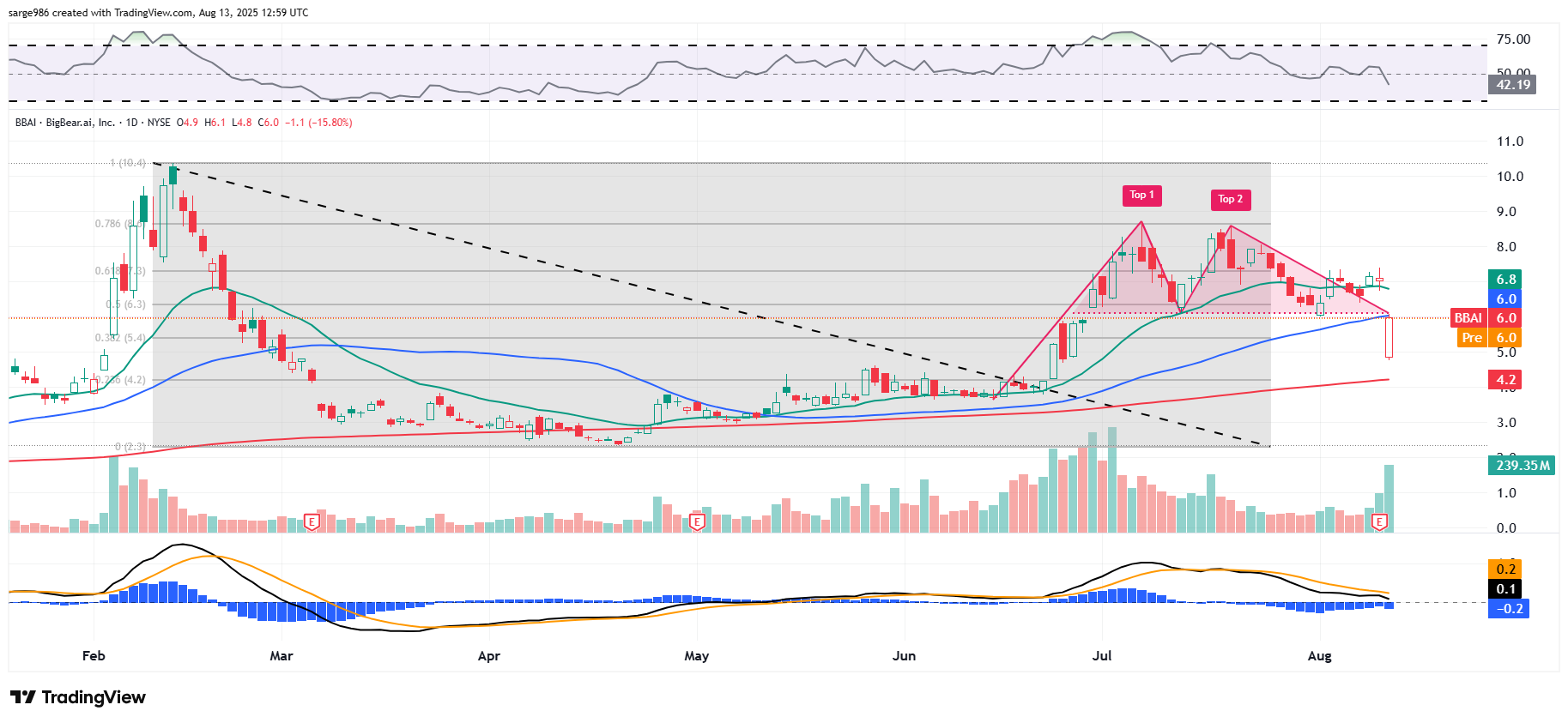
Readers will see that the downside pivot created by the double-top pattern of bearish reversal was triggered by these results. Note that the 200-day SMA at $4.20 is currently running alongside the 23.6% Fibonacci retracement level of the February through April sell off after the double top kicked in at the 78.6% level. This may very well be one of those stocks where the algorithms that control price discovery seek out Fibonacci retracement levels.
Now that the 50-day SMA and 21-day EMAs have been broken, I would be really slow about initiating this stock above the 200-day line. What I find interesting is that a trader interested in getting to wait for their price could get paid about $0.65 to write December 19 $4.50 puts on this name. If that's too risky, the $4.00 puts went out on Tuesday night paying about $0.50. That sounds fair, and if the trader does get tagged in December, the net basis would be down around $3.50.
At the time of publication, Guilfoyle had no positions in any securities mentioned.