I'm Going to Give This Cheap Stock a Workout
This old favorite of investors might just be ready to muscle up again.
You've reached your free article limit
You've read 0 of 1 free Pro articles.
I recently initiated a new long position in a "Stocks Under $10" name that certainly has its issues fundamentally. When you see it, you'll think to yourself: "Oh, yeah. I forgot about that stock. That stock is trading below $10?" That stock is Under Armour ( (UA) , (UAA) ). And, yes, the stock has been trading well under $10 for more than a year.
I view this as a trade rather than an investment at the moment, but a trade that might not come to a resolution all that quickly.
Enter Jay Sole, an analyst at UBS who's rated four-stars by TipRanks. On Friday, Sole reiterated his "Buy" rating on the stock and his $8 target price. Sole wrote that Under Armour remains one of the world's best-known and liked athletic wear brands and adds that investors are "materially" undervaluing the brand. Sole sees the stock as a potential turnaround story and sees the company possibly "achieving a five-year EPS compounded annual growth rate of 25%."
UBS had just completed its "Global Sportswear Survey" and found that Under Armour as a brand was just below companies like Nike (NKE) , Adidas (ADDYY) and Puma (PMMAF). This was a better showing, apparently, than expected.
Earnings
Not a lot of good here. Under Armour is expected to report in early February. Wall Street is looking for an adjusted loss per share of $0.02 on revenue of slightly more than $1.3 billion. That would compare poorly to the $0.08 reported for the same period one year ago while reflecting annual sales growth of -6.4%. Of the 23 sell-side analysts that cover Under Armour, 21 have revised their earnings estimates for the period lower since the start of the quarter. Two have left their numbers unrevised.
Fundamentals
Over the trailing 12 months as of the end of the September quarter, Under Armour had generated operating cash flow of $88.1 million, out of which came capital spending of $133 million. This left free cash flow of a loss of $44.9 million.
Looking over the balance sheet, at the end of September, Under Armour held a cash position of $396 million, inventories of $1.037 billion and current assets of $2.944 billion. Current liabilities ran at $1.737 billion. That's good for a current ratio of 1.69, which does pass muster. The issues are that inventory valuations for struggling retailers are always questionable and that Under Armour had $599.4 million in debt on the balance sheet due to mature within 12 months. With $396 million in cash, it will have to be creative.
Total assets amount to $4.899 billion. Intangibles to include goodwill make up little more than 105 of that, which does not bother me. Total liabilities less equity came to $3.044 billion. This includes an additional $590 million in longer-term debt. Given that this number is not awful, a refinancing that pushes out maturity is likely in order. Oh, did I mention that 35% of the entire float is held in short positions?
What's Up with the Different Listings?
I currently hold UA shares. Those are the Class C shares that have the same economic interest in the company as do the Class A shares. Those trade under the ticker UAA. The difference is that the Class A's have one share-one vote rights, while the Class C's have no voting rights. It doesn't really matter as the Class Bs are not listed and owned in totality by founder Kevin Plank. Those shares have 10 votes per share and afford Plank a rough 65% control of the company.
Why do I own the UAs? I simply made an error when entering my initial order and given that the two trend almost in parallel, I did not bother correcting my error. The UAAs are the ones that analysts are discussing when they talk about the company and typically trade at a slight premium to the UAs.
The Chart
This is close. I almost see a "descending triangle," which is a pattern of bearish continuance.
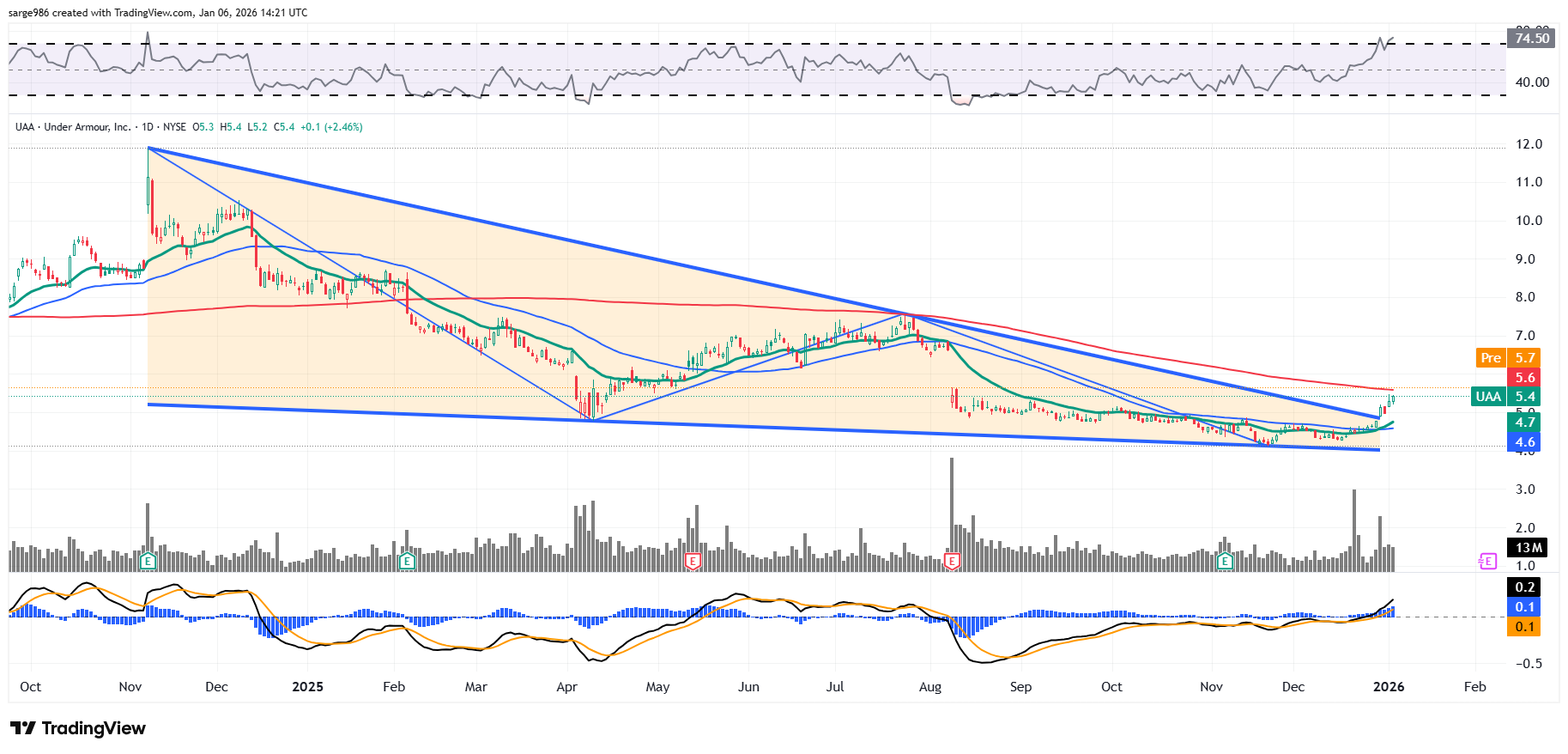
Instead, I think I see a "falling wedge" pattern of bullish reversal. The stock has just broken out from the upper trendline and is now closing in on its 200-day simple moving average. Currently at $5.60, that's our pivot as that is where professional managers who have given up on the name might invest in the shares. Some pros have a rule about not investing in stocks that trade under $5. This stock no longer has that problem, so this is really a key pivot.
Relative Strength is juiced to the point of possibly being overbought. The daily moving average convergence divergence is currently about as bullish as a daily MACD can be with all three components where they need to be to spring a rally. I am not as aggressive as our friend, Jay Sole, but I actually have skin in the game. My target for the trade is an even $7 (for the UAA, that's when I'll sell the UA. Unless I figure out a profitable ratio for a pairs trade to get me out of one and into the other).
At the time of publication, Guilfoyle was long UA equity.