How to Trade JPMorgan as Jamie Dimon Warns of 'Significant Risks'
The results are strong as the big bank kicks off earnings season, but the stock less so.
You've reached your free article limit
You've read 0 of 1 free Pro articles.
On Tuesday morning, several of the big banks kicked off the second quarter earnings season and among them was JPMorgan Chase JPM.
JPMorgan, as the firm is called on Wall Street, is broadly considered to be "best in class" in the money-center banking space and that firm was among those banks reporting on Tuesday morning. For the three-month period ended on June 30, JPMorgan posted a GAAP EPS of $5.24 on revenue of $45.68 billion.
These numbers absolutely crushed expectations that were for something closer to $4.49 on $44 billion. Crushed! That said, those looking for something negative could easily point to last year's comparisons. That $5.24 EPS was up against a tough looking $6.12 for Q2 2024, while the revenue print amounted to a year-over-year contraction of 10.4%.
Net interest income excluding markets printed down 1% at $22.8 billion. Non-interest revenue landed at $14 billion, which was down 31%. Excluding the net gain related to Visa V shares and securities losses, non-interest revenue would have been up 8%.
The provision for credit losses was $2.849 billion, down from $3.052 billion a year ago. Net charge-offs in Card Services were up $179 million to $2.4 billion. The net reserve build of $439 million was driven by the impact of net lending activity, somewhat offset by a decrease in the weight placed on adverse scenarios. The quarter did include a tax benefit of $774 million driven by the resolution of certain tax audits and the impact of tax regulations finalized in 2024.
During the quarter, the firm paid out cash dividends of $3.9 billion to shareholders, while repurchasing $7.1 billion worth of common stock. Book value per share at quarter's end was $122.51, up 10% year over year, whale tangible book value per share grew 11% to $103.40.
The CEO on Performance
CEO Jamie Dimon commented in the press release:
"Each of the lines of business performed well. In the CIB, Markets revenue rose to $8.9 billion, and we supported clients as they navigated volatile market conditions at the beginning of the quarter. Meanwhile, IB activity started slow but gained momentum as market sentiment improved, and IB fees were up 7% for the quarter. In CCB, we added approximately 500,000 net new checking accounts, which drove sequential growth in checking account balances. In Card, we launched a refreshed Sapphire Reserve along with a new Sapphire Reserve for Business, with positive early reactions and strong new card acquisitions. Finally, in AWM, asset management fees rose 10%, and we saw continued client asset net inflows of $80 billion, with client assets crossing over $6.4 trillion.”
The CEO on the Economy
Still from the press release, Jamie Dimon added, “The U.S. economy remained resilient in the quarter. The finalization of tax reform and potential deregulation are positive for the economic outlook; however, significant risks persist — including from tariffs and trade uncertainty, worsening geopolitical conditions, high fiscal deficits and elevated asset prices. As always, we hope for the best but prepare the Firm for a wide range of scenarios."
Segment Performance
- Consumer and Community Banking: generated net revenue of $18.847 billion (+6%). producing net income of $5.169 billion (+23%). Strong performance in Card Services and Auto was offset slightly by weakness in Home Lending. The provision for credit losses was $2.082 billion (-21%).
- Commercial and Investment Bank: generated net revenue of $19.535 billion (+9%). producing net income of $6.65 billion (+13%). Strong performance in Markets was dragged mildly by slower growth in banking and payments. The provision for credit losses was $696 million (+81%).
- Asset & Wealth Management: generated net revenue of $5.76 billion (+10%), producing net income of $1.473 billion (+17%). Strong performance across management fees and inflows supported increased brokerage activity. The provision for credit losses was $46 million (+130%).
- Corporate generated net revenue of just $1.538 billion (-85%). producing net income of $1.695 billion (-75%), which is not a misprint. The drop-off in performance here was driven by the impact of changes in funds transfer pricing for consumer deposits. The provision for credit losses was $25 million, up from $5 million.
Guidance and Returns to Shareholders
JPMorgan increased guidance for full year net interest income to a rough $95.5 billion, up from previously issued guidance for $94.5 billion. The firm also announced its intent to increase the quarterly dividend from $1.40 per share to $1.50. On top of that, the Board of Directors authorized a new $50 billion common share repurchase program.
The Chart
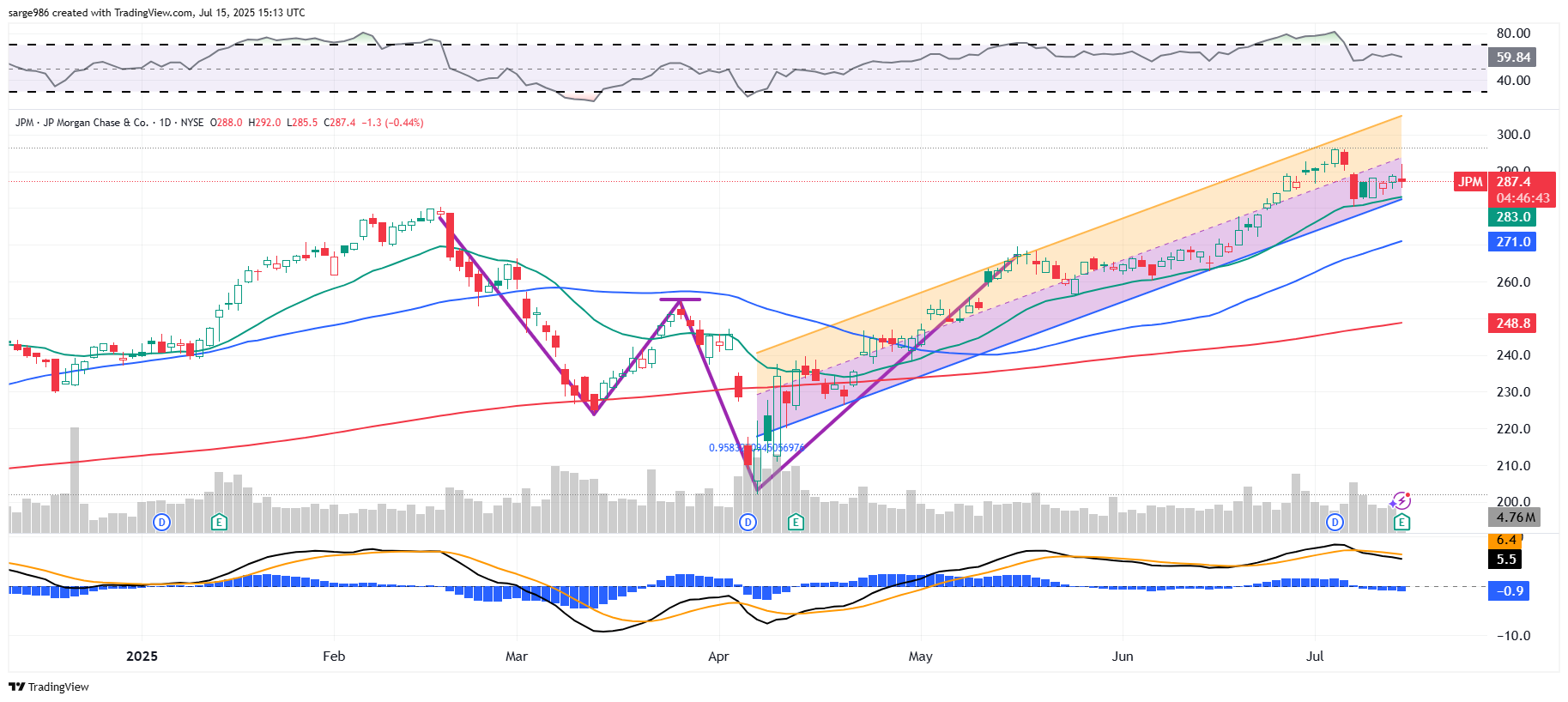
Readers will see that JPM broke out from a rather sloppy double-bottom pattern of bullish reversal this past spring with a $255 pivot. The Raff regression model illustrates the uptrend in place since that breakout. If you've been in this name with me, then it's not core to your book and you're probably only up about 21% on the trade.
I see the stock working a little too close to a couple of downside catalysts at this point. The bank is performing well. There is no argument there. That said, the stock has to find support here, above the 21-day and lower trendline of the model. Those two lines are running together. Their loss would drive swing traders out of the stock. My plan then would be to exit with them and re-enter close to the 50-day SMA which is where I would expect professional managers to defend the name.
Should swing traders defend the stock here, then I will sit tight and set my sights on the upper trendline of the model. Keep in mind that JPM's stronger than neutral reading for relative strength is at odds with a daily MACD that is looking more and more bearish of late.
At the time of publication, Guilfoyle was long JPM equity.