How to Take Advantage as Trump Administration Creates Investment Opportunities
The presidential administration is generating momentum in several sectors. Here's how to construct a portfolio accordingly.
You've reached your free article limit
You've read 0 of 1 free Pro articles.
Interest in "production for security" (or ProSec) is finally getting the traction it deserves! Not just from the government, but investors, financial institutions and corporations are starting to respond to this trend.
Benefits for Companies the Government Takes an Interest in
The government has been taking stakes in companies. Ultimately, that means, we the citizens (and taxpayers), have been taking stakes in companies. We will benefit if those holdings do well.
When the government takes a stake, it brings a few things to the table that don’t necessarily happen when a financial market participant takes a stake:
- The U.S. government is a massive consumer. Can it direct spending?
- The federal government has a lot of influence on regulations. Can it make it easier to push regulations through? Or find loopholes (like nuclear reactors on army bases)?
- Lower cost of capital. Between the investment and encouraging lending, companies in these industries could see lower costs of capital.
Ultimately, the country wins if we have a safer base of production and refining of things critical to modern day life, such as:
- Semiconductors and AI
- Pharma and biotech
- Electricity and energy of all types to produce electricity, including:
- Nuclear (my favorite area)
- Solar. I know it is hated by the administration, but I think the administration has demonstrated its willingness to pivot and I believe many people consulting with the government will hammer home the need for solar, to fill the gap between now and when nuclear options will come online.
- In between, the entire energy/electricity production sector should do well.
- Processed/refined commodities critical to any of the above (also including military equipment)
- While not a direct beneficiary, indirect beneficiaries will include large engineering firms as well as logistics/heavy equipment, etc.
There is no shortage of investment opportunities.
The Trades and Portfolio Construction Thoughts
There are multiple ways to participate at the moment.
A Portfolio of 'Lottery' Tickets
Scour the universe of stocks with smallish market caps ($10 billion and under). Look for those associated with any of the above areas. There seems to be no shortage of stocks that fit into that bucket. Maybe do some diligence on the names (weirdly, what the company is named may be a factor – we have AI looking into that), and what they own in terms of rights or IP. Who is the management? Then finally, look for price action and volume. This strategy is not my “finest moment” and any true fundamental investor will shake their heads in disgust, but that doesn’t mean we can’t create a portfolio (one that we trade, with a focus on volume) that works well.
National Champions
I would argue that the Intel (INTC) investment is more of a “national champion” type of investment than other investments that we have seen so far (which have been far smaller). While “National Champions,” as I use it, will do very well from an investment standpoint, it is quite possible for the entire sector to do well. Maybe the “National Champion” gets some of the benefits listed above, but the entire sector could do well, because the government’s actions demonstrate a commitment to the sector/industry.
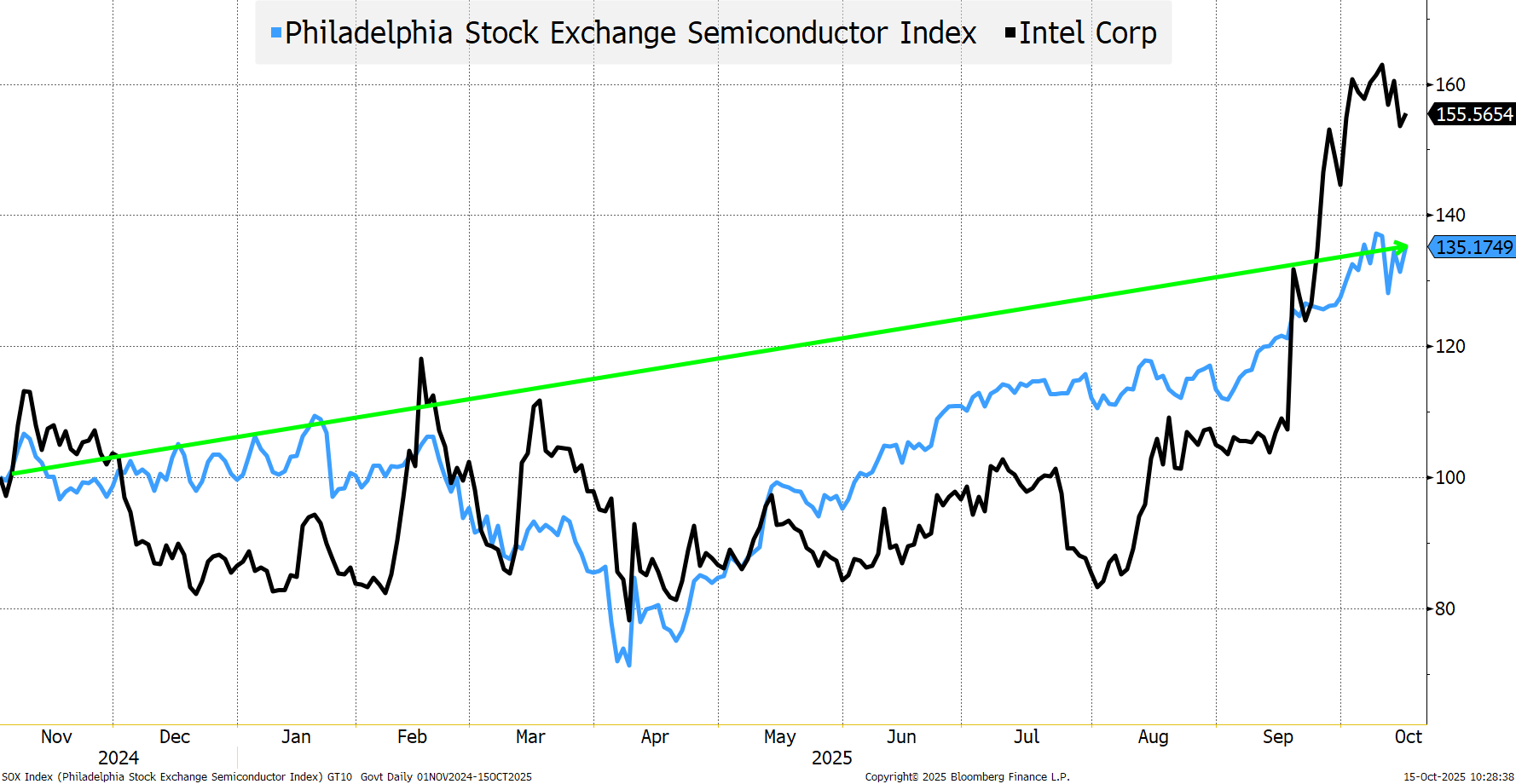
Do not doubt, for a moment, that the administration wants to win the race for AI superiority.
So, look for bigger companies, even industry leaders, in fields that we think the government will focus on. You can only do so much with small companies. What companies are there in pharma, biotech, traditional energy, commodities, etc., that might become a “national champion”? I’m not 100% sure if U.S. Steel (X) fell into this category, but maybe it did, indicating the INTC may not be a “one off” – thus validating the search for more national champions.
The opportunities range from what still hasn’t run enough, to what the administration focus on next. I would list nuclear as the former and solar as the latter.
I will even add in bitcoin miners, who have had a decent run, but not only is this administration focused on stablecoins and crypto, but many seem to be able to pivot to data center technologies.
What I’d avoid (and why I expect a launch of new ETFs trying to capture the zeitgeist):
- Foreign-owned, foreign-focused companies. The administration seems to be softening its stance in this regard, with Canada and potentially NATO. It is strengthening its resolve to push on China. That is one of the issues with some of the ETF’s I’ve looked at – too much foreign, especially China, investments.
- Too much focus on the commodities themselves. Processing and refining gets the edge. On commodities of all types, the companies pulling it out of the ground (or sea) will do well, but it is the processing and refining where China dominates. That is where I see the most upside. China does not control the rare earths and critical minerals themselves, the way they control the processed and refined versions.
These types of stocks now make up the bulk of my equity portfolio.
At the time of publication, Tchir was long INTC.