How to Play a Falling U.S. Dollar? Head to Brazil and Mexico as U.S. Freezes
Here's how to use overseas stock ETFs to blunt the impact of a weak greenback.
You've reached your free article limit
You've read 0 of 1 free Pro articles.
On Monday, I explained why the U.S. dollar is likely to continue falling. On Tuesday, as if on cue, the U.S. Dollar Index plunged to its lowest level in nearly four years.
The greenback has now lost about 3.5% over the past two weeks (arrow). That may not sound impressive, but it’s a significant move for a G-7 currency.
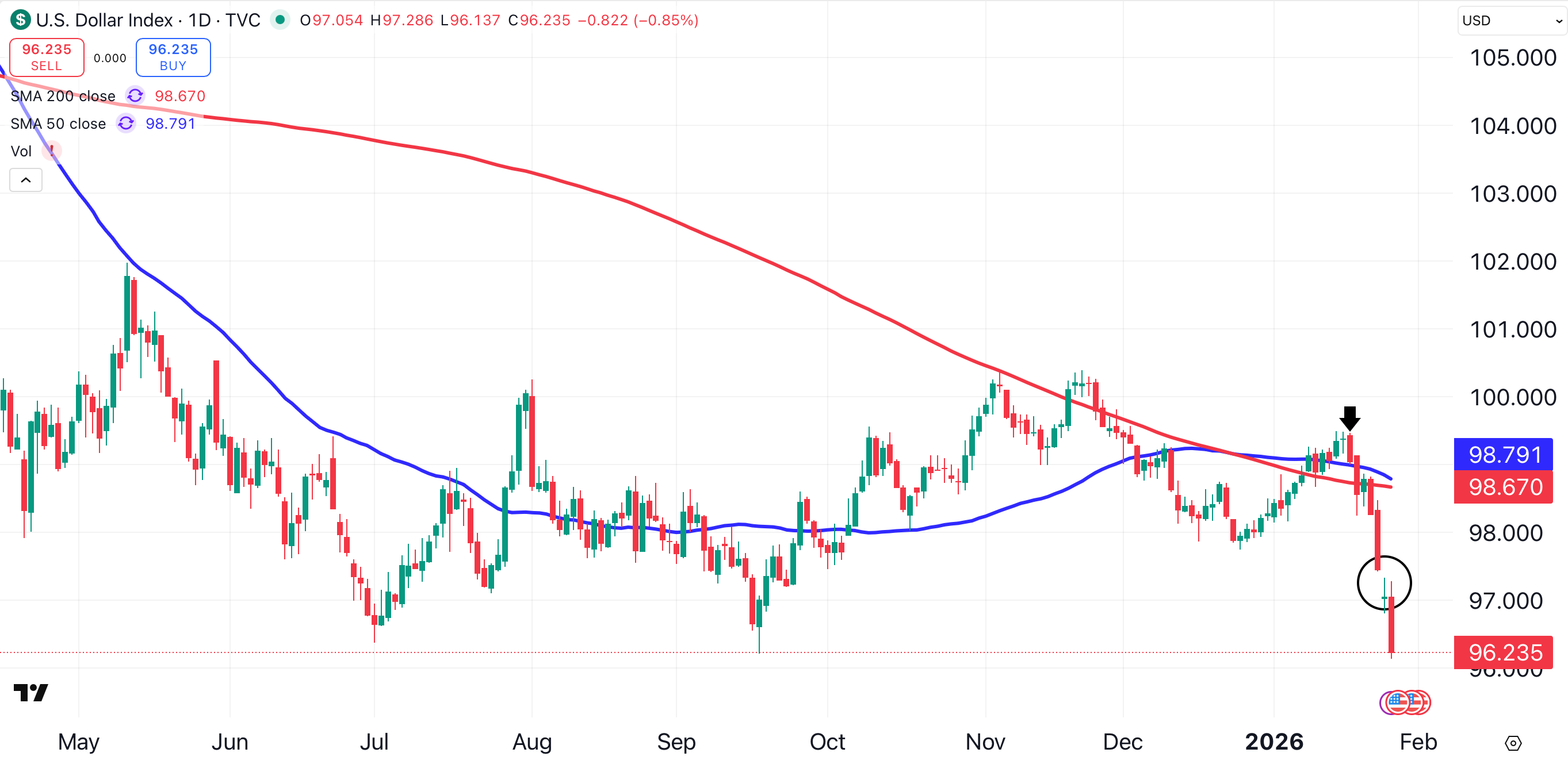
The selling in the dollar isn’t just accelerating, it’s also becoming more aggressive. The large gap that occurred after this past weekend (circled) is one indication that traders are leaning into this selloff. Gaps of this size are rare in the world of G-7 currencies.
What’s the game plan for a weak U.S. dollar? Here are two ETFs to watch.
Toes in the Sand
As I write from the frozen Northeast, after digging out from the weekend storm, I can’t help but notice that it’s 87 degrees in Acapulco. It’s 84 degrees in Rio de Janeiro, where it's currently the middle of summer.
Circumstances have conspired to keep me in the Land of Frozen Extremities, but as investors, we can still enjoy the benefits of Mexico and Brazil. Not due to their warm sandy beaches, but because these are currently two of the world’s hottest markets.
Hitching a Ride
When you invest in an overseas company, you are essentially hitching a ride on that country’s currency. If the currency is strong relative to the U.S. dollar, the gains are enhanced, because those gains will be measured in terms of U.S. dollars.
This type of price action is currently visible in Brazil and Mexico. As the dollar falls against the Mexican peso and Brazilian real, the relative strength of those currencies is reflected in their stock markets.
This strength is visible in two popular ETFs. On the left, the iShares MSCI Brazil ETF (EWZ) has already gained 17% year-to-date. The iShares MSCI Mexico ETF (EWW) , shown on the right, has gained 10% year-to-date.
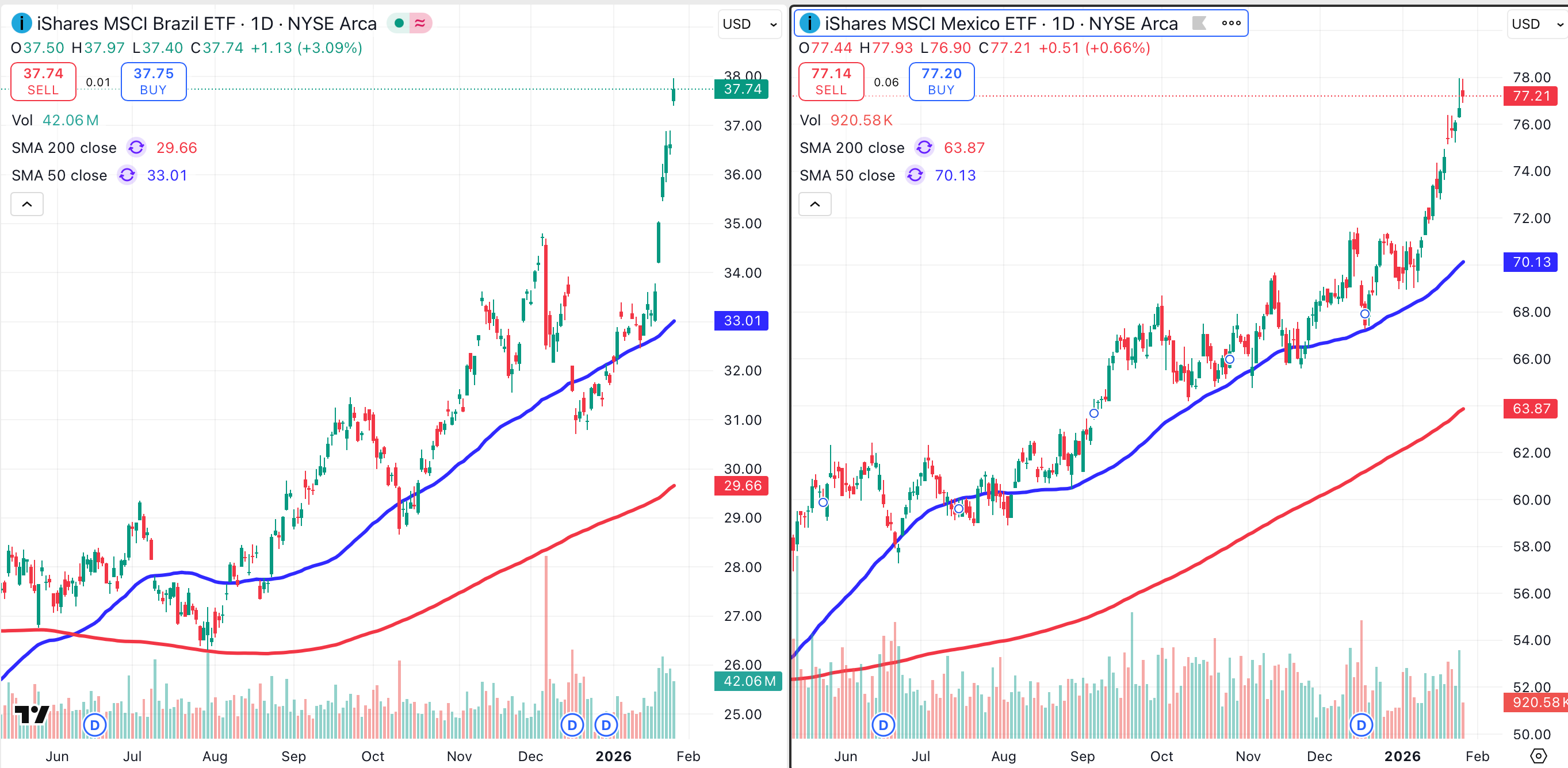
These ETFs are valued in U.S. dollars, but the companies represented within those ETFs are measuring their earnings in their home currencies.
When you gain money in a stock that is based in a foreign currency, and then translate those gains into a weaker currency like the dollar, those gains are enhanced due to a favorable exchange rate. That’s one reason why these ETFs are performing so well right now.
Bottom Line
Foreign stock ETFs like EWW and EWZ still have plenty of potential upside, as these overseas markets have underperformed U.S. stocks by a wide margin in recent years.
I’m buying both EWW and EWZ. Both ETFs are stronger than the broader markets, and the exposure to foreign currencies can be considered a hedge against dollar weakness.
At the time of publication, Ponsi was long EWW and EWZ.