How to Handle a Hot Cleveland-Cliffs After Rare Earths 'Re-Focus'
Here's why the stock is on fire Monday and where I'll really get interested.
You've reached your free article limit
You've read 0 of 1 free Pro articles.
Shares of steel producer Cleveland-Cliffs (CLF) are surging on Monday after the company reported its third-quarter financial results.
Did Cliffs finally hit one out of the park? No, not really.
For the period, the company posted an adjusted loss per share of $0.45 (GAAP loss per share: $0.51) on revenue of $4.734 billion. The rather negative-looking adjusted bottom line met expectations, but sales, though up 3.5% year over year, fell short of Wall Street consensus.
So, why did the stock run 19% ahead of the opening bell? There is more than one reason. Adjusted EBITDA landed at $127.9 million, about $15 million above expectations, while the company projected full-year capital expenditures of $525 million, down huge from a prior forecast for $600 million.
The top reason, in my opinion, of why the stock is hot Monday is this: Cliffs informed investors that it is seeking to expand its presence in the production of rare earth metals and is currently studying sites in Michigan and Minnesota that have exhibited a potential for possessing significant deposits of rare earth minerals.
On the matter, from the press release, CEO Lourenco Goncalves commented, "The renewed importance of rare earths has driven us to re-focus on this potential opportunity at our upstream mining assets. It would align Cleveland-Cliffs with the border national strategy for critical materials independence, similar to what we achieved in steel."
Rare earth/critical minerals and metals-related stocks were up as a group on Monday morning. This came after Australian Prime Minister Anthony Albanese all but offered President Trump a solution for Beijing's curbs on exports of these materials to the U.S., immediately strengthening the U.S. position and weakening China's going into the upcoming trade negotiations.
Operations
As sales increased 3.5% to $4.734 billion, total operating costs, including costs of goods, increased 2.2% to $4.938 billion. That left a GAAP operating loss of $204 million, a sharp improvement from the year-ago comp of -$1.248 billion. After accounting for interest, taxes and other income & expenses, GAAP net loss attributable to shareholders improved to $251 million from -$1.235 billion. That works out to a GAAP loss per share of $0.51, narrowing from the year-ago comp of -$2.49. Once adjusted for six different smallish items, loss per share printed at $0.45, versus -$2.06 a year ago.
Fundamentals
For the period reported, Cliffs generated operating cash flow of -$143 million. Tack on capex spending of $157 million and free cash flow printed at -$300 million, versus the year-ago comparison of -$235 million. At least the company is smart enough to neither repurchase stock nor pay shareholders a cash dividend.
Turning to the balance sheet, Cliffs ended the quarter with a cash position of just $66 million and inventories of $4.683 billion. That put current assets at $6.689 billion. Current liabilities add up to $3.28 billion, so it runs with a robust-looking current ratio of 2.04. There is no short-term debt on the books, but given the size of those inventories, the quick ratio stands at just 0.61, which is a bit scary.
Total assets amount to $20.29 billion of which less than 15% is labeled as either goodwill or other intangibles. That's positive. Total liabilities less equity comes to $14.583 billion. That's not scary.
What is scary is that Cliffs has long-term debt of $8.039 billion on the books versus that paltry cash position. This is not as weak a balance sheet as it appears, as long as those inventories are turned into cash at optimal prices and as long as the company's current accounts receivable of $1.797 billion is paid on time, meaning that its customers are in good shape in this economy.
The Chart
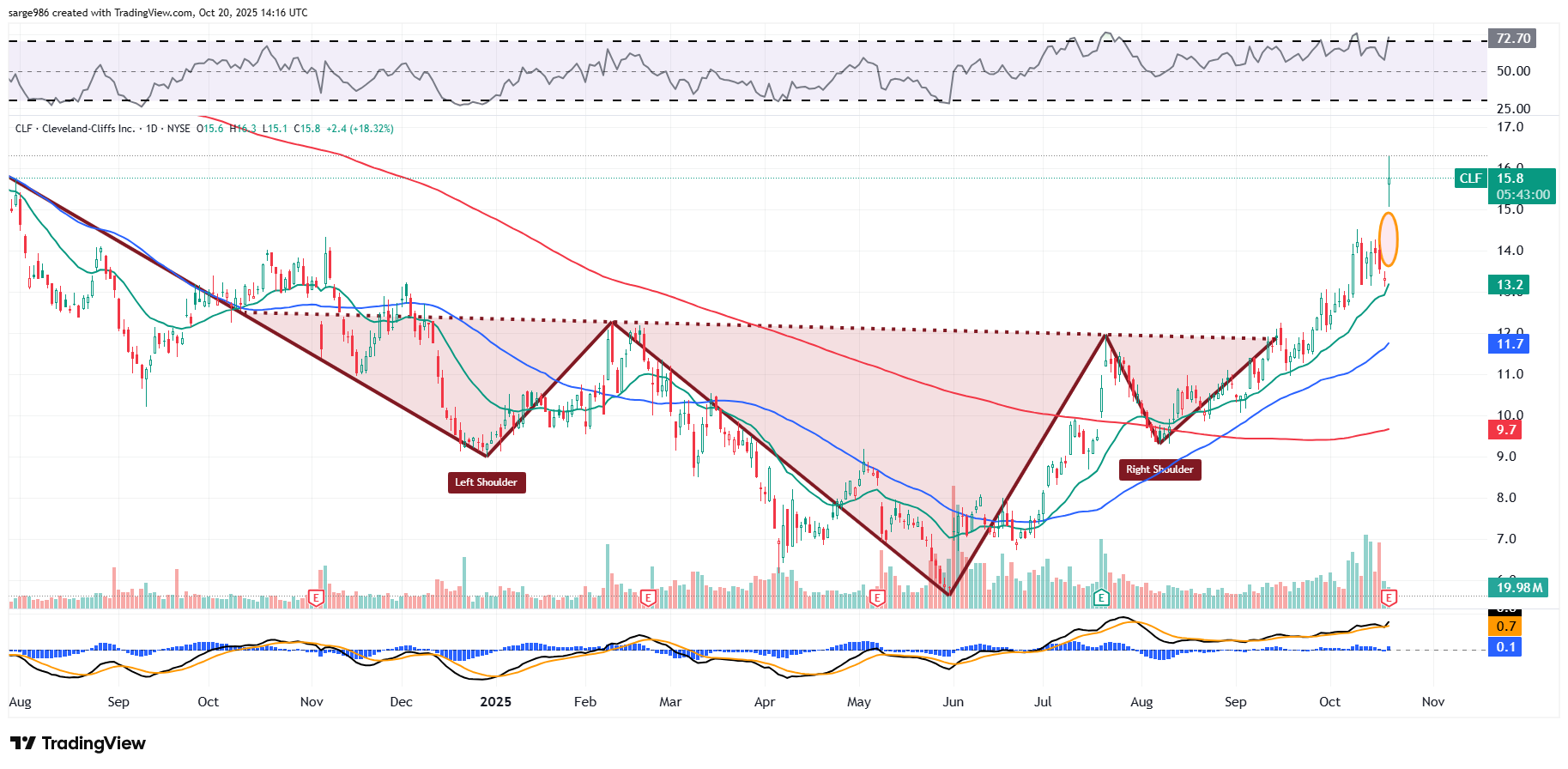
The good news for shareholders is that CLF has broken out of a giant inverted head-and-shoulders pattern of bullish reversal with a $12 pivot. The bad news is that the stock, after this Monday move, is now trading a rough 31% beyond that pivot. Does that mean it's time to sell this stock? It could.
Relative Strength is bordering on entering an overbought condition. For about a month, whenever this stock has flirted with technically overbought territory, it has given back some gains. On the bright side, CLF experienced a (not quite, but still positive) faux-golden cross back in August.
That golden cross may not have been the real thing (because the 200-day simple moving average was in decline at the time), but the stock did take off and the daily MACD's bullish posture was reinforced as a result.
Bottom line? My curiosity is piqued.
I do not think I will chase Monday's move, but I am encouraged by the company being willing to mine whatever sells in any environment. I imagine at some point, maybe not too far off, the stock will try to fill Monday morning's gap opening. If it does, it will trade as low as $13.49 when that happens. That's where my bid for a few shares will be. For now, I am not chasing a stock that consistently loses money.
At the time of publication, Guilfoyle had no positions in any securities mentioned.