How I'm Trading Regional Banks After Jamie Dimon's 'Cockroach' Message
As the sector spooks investors there are several moves I'm making and preparing for.
You've reached your free article limit
You've read 0 of 1 free Pro articles.
JP Morgan Chase Chairman and CEO Jamie Dimon let us know there would be some squalls ahead earlier in the week.
After his "best in class" large U.S. bank had suffered $170 million in losses on short-term loans made to non-financial borrowers, Dimon said, “When you see one cockroach, there are probably more. Everyone should be forewarned on this one.”
Since then, all kinds or creepies and crawlies have climbed out of the cupboards.
Anyone who has ever lived in an urban setting knows that when you see one cockroach, you don't just leave your dishes and cookware in the cupboards, you wrap them or keep them in plastic bags until you're sure that the crisis has passed. The problem is that once you know you have issues, it takes quite a while to reach a point where you're sure those issues have moved to the past tense. Then you don't trust your neighbors because you assume that they were sloppy and careless about throwing out things that roaches eat and may still be careless.
Earlier this week, we learned that Jefferies Financial (JEF) had more exposure than it would want to now bankrupt auto parts maker First Brands. On Thursday, we learned that Zions Bancorp (ZION) had disclosed a $50 million loss across two loans. That came after Western Alliance (WAL) had sued a borrower, alleging fraud.
Total losses across the group so far could reach hundreds of millions of dollars. So, as investors, do we run away from regional banks as the cockroaches multiply? Is this an opportunity to get into regional banks as this really is not all that lousy an environment for bankers... as long as economic activity remains strong and as long as inflation remains under wraps.
Near Armageddon
If you woke up on Friday at a normal time when humans arise, then you don't know. At zero dark-thirty this morning, equity index futures were trading deep in the hole. My P/L was trading deep in the hole. I told the troops to get their gear, pack for the field and get in formation in front of the barracks. I was prepared for ugly. Then, Fifth Third Bank (FITB) , which is in the middle of trying to acquire Comerica (CMA) , reported a solid third quarter.
Fifth Third, a regional banker, beat expectations for both the top and bottom lines. The bank's provision for credit losses was up from prior quarters, but by no more than one might have expected. In the press release, CEO Tim Spence wrote, "Fifth Third's financial results once again underscore our strong balance sheet, diverse revenue streams, and disciplined expense management. We've continued to expand our net interest margin, improve our pre-provision net revenue, and strengthen our efficiency ratio."
Spence went on for a while about how great his bank is doing and then added this gem:
"By focusing on high-quality deposits, diversified loan originations, recurring fee revenue and consistent improvements in operating scalability, we expect to continue to generate strong, stable through-the-cycle returns for our long-term shareholders."
No mention of trouble. The stock had been down 6% on Thursday and down big again overnight. That swung to pre-opening gain ahead of the 09:30 a.m. bells up at Times Square and down at 11 Wall Street.
The Whole Market Rallied
It wasn't just Fifth Third earnings that eased investor fears. American Express (AXP) , which has as much exposure to business and household credit as anyone, also posted a solid quarter and, on top of that, raised full year guidance for both profitability and revenue growth.
On top of solid earnings reports published by a regional bank and a national/global credit card company, President Trump said in an interview at Fox Business that the threatened high tariffs on Chinese imports were indeed "not sustainable." This made it safe for investors to look at their portfolios. If only you kids could have seen what these markets looked like overnight. Gee whiz.
Additionally, Oppenheimer analyst Chris Kotowski, who is rated at five stars by TipRanks, upgraded Jefferies from Perform (hold-equivalent) to Outperform (buy-equivalent) with an $81 target price.
Did I Act?
I hold three bank stocks. Two large banks, Wells Fargo ( (WFC) ) and JP Morgan (JPM) . One regional bank, KeyCorp (KEY) . I added to that long position while it was down. I am also watching M&T Bank (MTB), another regional, for possible entry. M&T also reported a nice quarter this week without raising any credit related concerns. Unfortunately, MTB's chart is telling me to hold off for now.
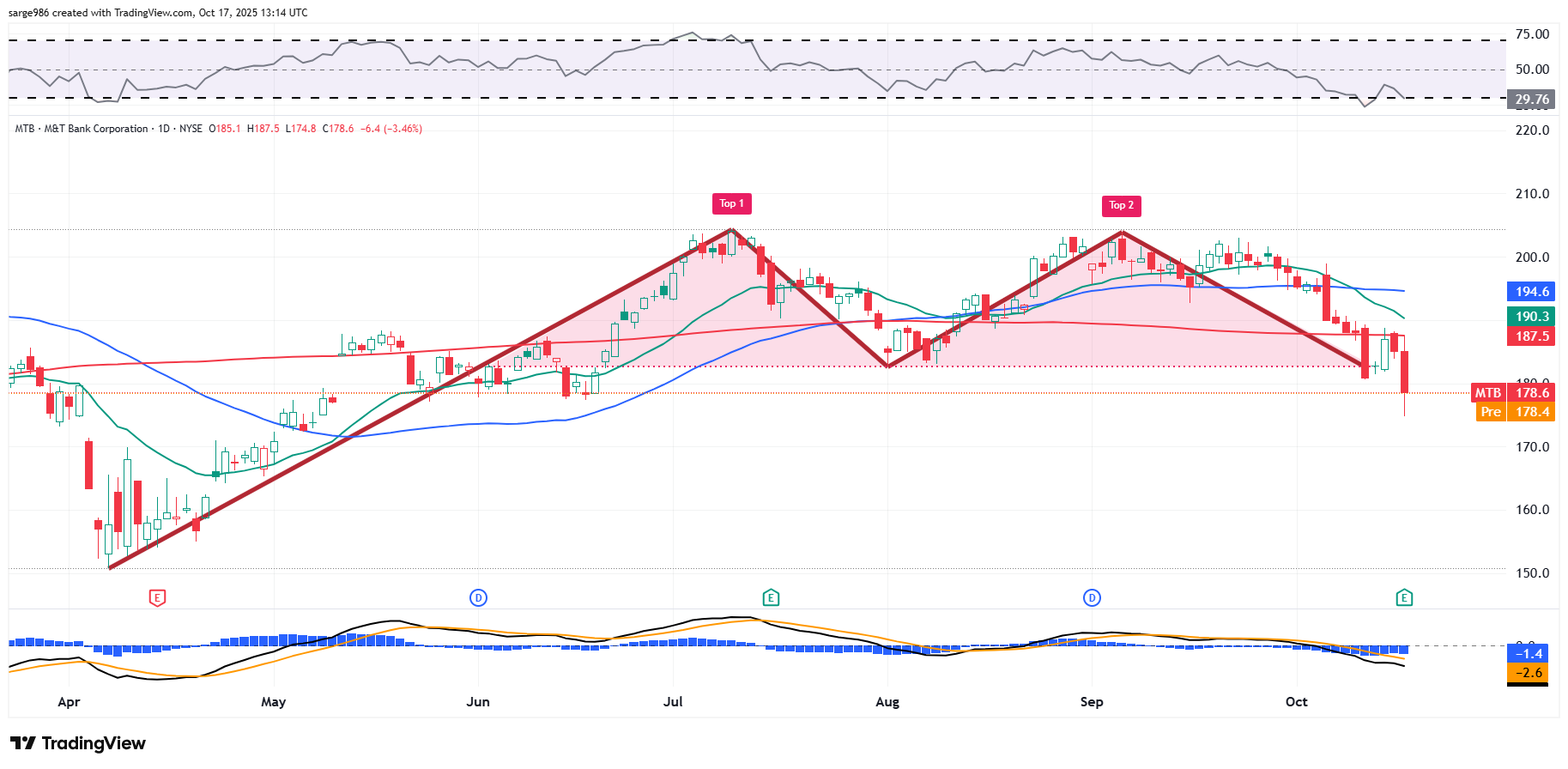
MTB has lost all three key moving averages while triggering a $183 downside pivot that had been created by a double top pattern of bearish reversal. There will be an entry point and I will be there. It's just not visible yet.
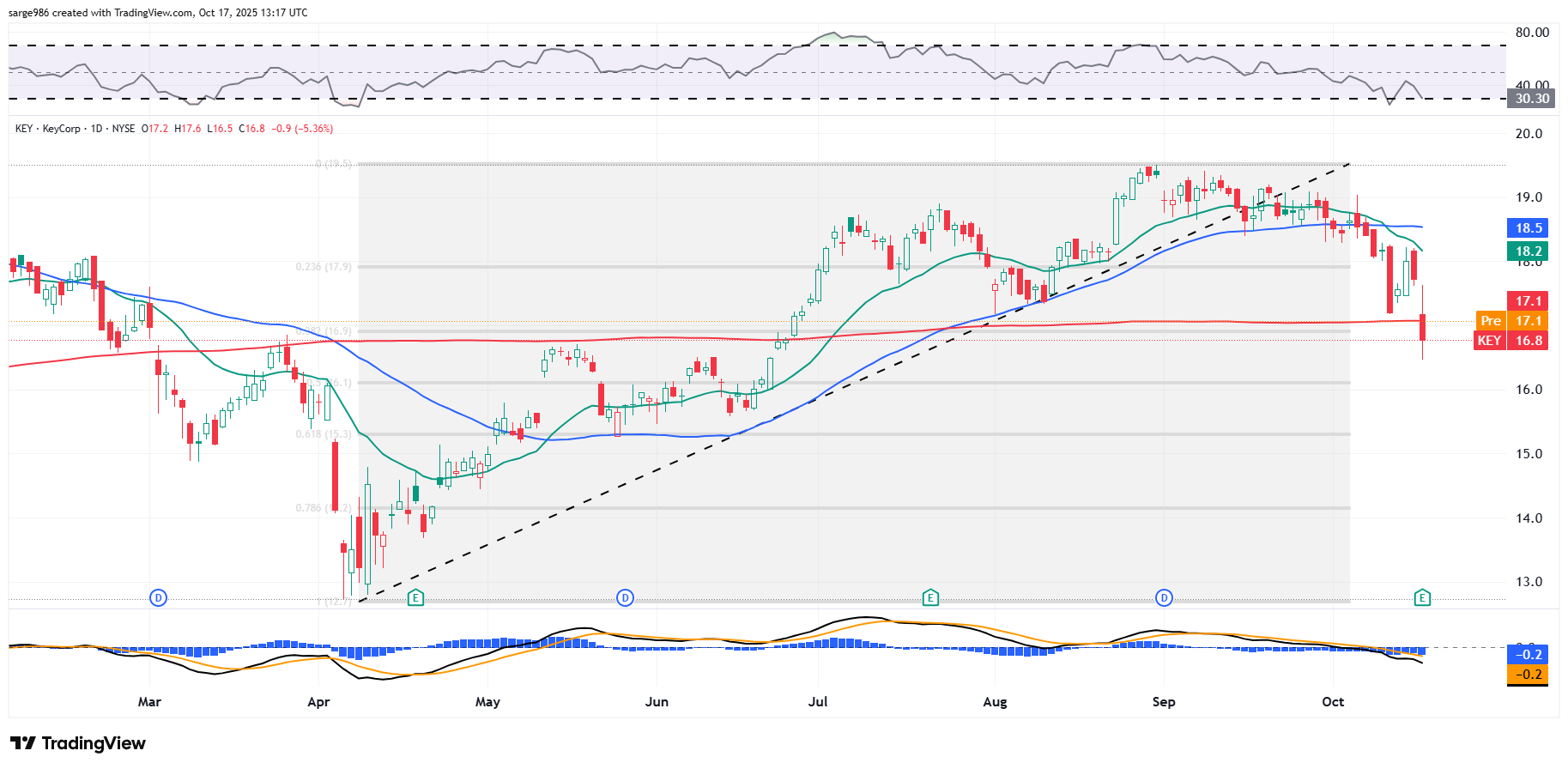
KEY is putting up a fight to both hold its 200-day SMA and hold the 38.2% Fibonacci retracement level of its early April to mid-August rally. This is either a terrific opportunity in KEY, or if it loses contact with the important red line, time to get out. The stock loses that line, I will sing a different tune really quickly. Until then, I ride with the "take 'em" kids.
At the time of publication, Guilfoyle was long WFC, JPM and KEY equity.