Here's Why CoreWeave Is Struggling in Wake of Earnings Beat
The firms top- and bottom-line numbers both beat Wall Street, but a closer look reveals why investors are concerned.
You've reached your free article limit
You've read 0 of 1 free Pro articles.
On Monday evening, CoreWeave (CRWV) posted the firm's fiscal third quarter financial results. For the period ended September 30, the firm posted a GAAP EPS of -$0.22 on revenue of $1.365 billion. Those top- and bottom-line numbers both beat Wall Street quite handily while the revenue print was good enough for year-over-year growth of 133%. Yet, the stock is down more than a bit on Tuesday morning. So, what gives?
The deal is this:
Fiscal full year revenue guidance was a little light as the firm repealed a delay at one of their third-party providers, which is pushing out at least some expected revenue from the current quarter into Q1 2026. Additionally, there's significant cash burn and, in October, the proposed deal to acquire Core Scientific was terminated. That deal should not adversely impact the firm's ability to execute its business as the firm already leases capacity from that firm. but this is not a positive either.
Operations
We know that revenue grew 133% to $1.365 billion. Out of that number, the cost of that revenue increased 158% to $368.8 million. Technology and infrastructure costs increased 162% to $747.5 million, administrative costs grew 352% to $151.9 million and marketing costs grew almost tenfold to $44.645 million. That left an operating income of $51.85 million, down from $117.116 million from the year-ago comparison.
After interest, other income and expenses and taxes, the firm's net income/loss did improve from -$359.807 million to -$110.124 million. This works out to a GAAP EPS of -$0.22, up from -$1.82. The problem here is that operating income is decreasing and that year-ago loss of -$359.807 million was largely due to a loss of $341.133 million on a fair value adjustment related to the firm's assets.
Without that adjustment, last year's same quarter net loss came to just -$18.674 million. Hence, the "better" EPS is not really better when we are only considering the business.
Fundamentals
For the period reported, CoreWeave generated operating cash flow of $1.689 billion. Out of that number came capex spending of $3.279 billion, leaving free cash flow of -$1.59 billion. That's down from -$601 million for the year-ago period. The cash burn was up almost a cool billion. Yikes. Obviously, the firm is not yet in any position to return capital to shareholders.
Moving on to the balance sheet, including restricted cash, the firm has a cash position of $2.961 billion and current assets of $4.731 billion. Current liabilities add up to $9.715 billion. This includes shorter-term debt of $3.712 billion and deferred revenue of $1.108 billion. Even adjusted for that deferred revenue, the firm's current ratio stands at 0.51. Put bluntly, that's just awful. Having more short-term debt than cash or assets that can be quickly turned into cash does not excite me either.
Total assets amount to $32.91 billion, including a negligible number for goodwill or other intangibles. It's mostly property. Total liabilities less equity comes to $29.032 billion including non-current deferred revenue of $4.228 billion, but also longer-term debt of $10.323 billion. Yes, this balance sheet has issues.
My Thoughts
There are problems here. The cash burn and the messy balance sheets are warnings. The business is growing like a weed, but so are expenses and the debt load, especially the shorter-term debt load is downright scary.
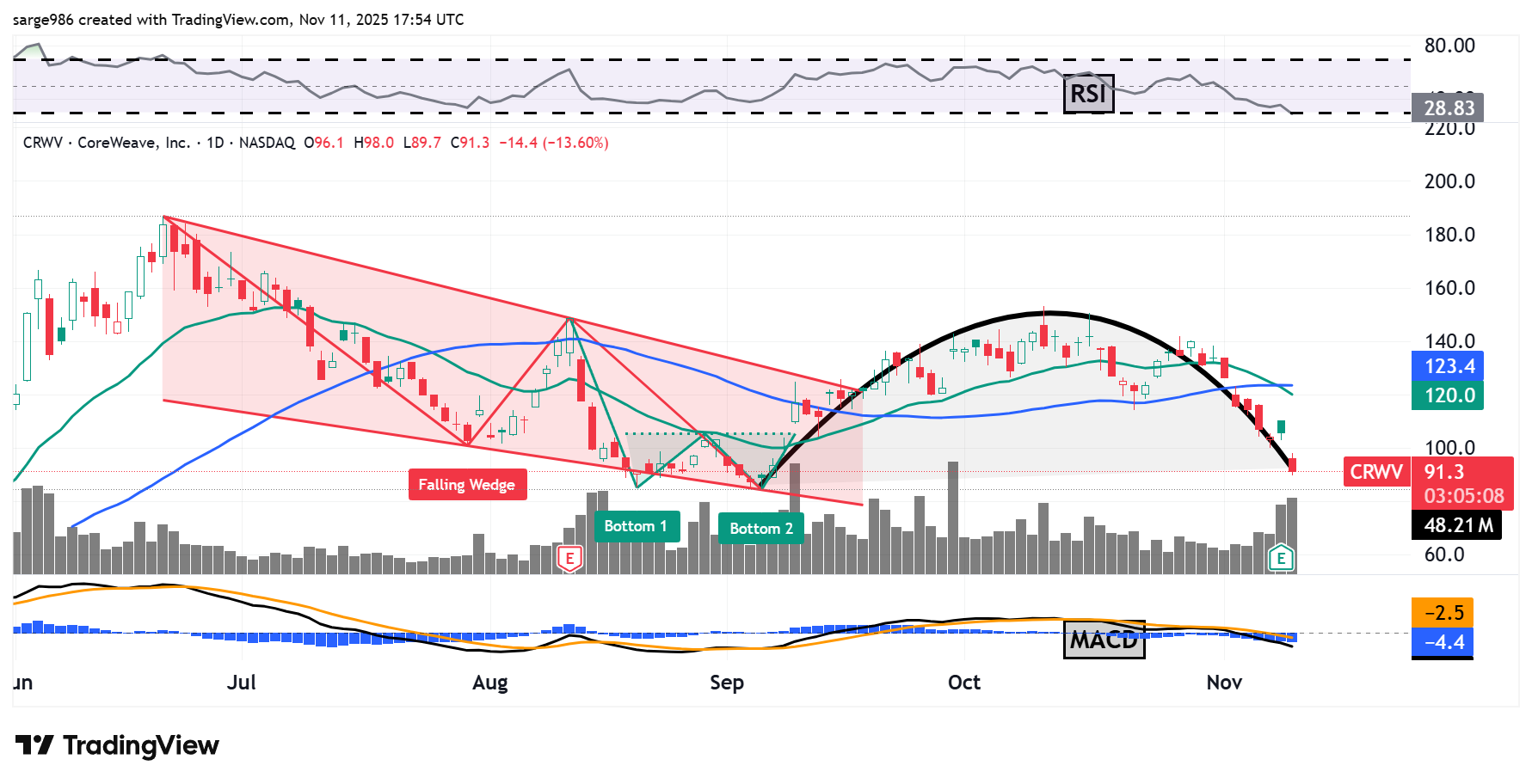
Readers will see that CRWV blasted out of a falling-wedge pattern of bullish reversal that culminated in a double-bottom pattern of bullish reversal in early September. That was like rocket fuel for the stock.
Unfortunately, now wee see an inverted cup pattern. We don't know if the pattern will pass a handle, but this is bearish. The stock has surrendered its 21-day EMA and 50-day SMA in short order, sacrificing the support of both swing traders and portfolio managers in the process. Both the RSI and daily MACD tell an unfortunate tale.
This stock has given up 40% of its value in less than four weeks. I may have been brave enough to enlist at 17. I am not brave enough to try to catch this falling knife until I see a reason. I don't see a reason.
At the time of publication, Guilfoyle had no positions in any securities mentioned.