Here's What the China Ban Means for Nvidia Investors: Is it Time to Buy?
After a harsh update in the U.S.-China trade war, investors want to know if it's time to buy the chip maker dip.
You've reached your free article limit
You've read 0 of 1 free Pro articles.
Readers more than likely well know the Nvidia NVDA news by now.
After the closing bell on Tuesday afternoon, it was revealed that the firm had filed a Form 8-K to inform investors and the U.S. Securities and Exchange Commission of an occurrence that would significantly impact the firm's financials. For the sake of those readers who do not frequent my early morning "Market Recon" column, I'll repost the quotes that I lifted from the filing:
"On April 9, 2025, the U.S. government, or USG, informed NVIDIA Corporation, or the Company, that the USG requires a license for export to China (including Hong Kong and Macau) and D:5 countries, or to companies headquartered or with an ultimate parent therein, of the Company’s H20 integrated circuits and any other circuits achieving the H20’s memory bandwidth, interconnect bandwidth, or combination thereof. The USG indicated that the license requirement addresses the risk that the covered products may be used in, or diverted to, a supercomputer in China. On April 14, 2025, the USG informed the Company that the license requirement will be in effect for the indefinite future."
Nvidia is informing all interested parties that its H20 GPUs are no longer available for sale to Chinese customers or to customers elsewhere with Chinese parent companies without obtaining an export license that would not likely be very easy to acquire. Nvidia's H20 chip is considered somewhat comparable to the H100, and H200 AI chips sold in the U.S. and to customers in U.S.-allied nations. The H20 had been considered China-complaint by the Joe Biden administration as it runs with slower interconnection speed and bandwidth than does the H100 and H200. The H20 is designed off of Nvidia's Hopper architecture, which was introduced in 2022 and is one generation behind the firm's current top of the line Blackwell architecture.
The financial impact came in the next sentence:
"The Company’s first quarter of fiscal year 2026 ends on April 27, 2025. First quarter results are expected to include up to approximately $5.5 billion of charges associated with H20 products for inventory, purchase commitments, and related reserves."
I appeared on television on Wednesday morning in China and in English speaking Asia-Pacific nations. I was asked if this was a buying opportunity for those interested in being long Nvidia. The question is not one that is easily answered.
Should this ban stay in place, then Nvidia is a more difficult firm to invest in. If this is simply (nothing simple about it) another negotiatory tactic by the U.S. president in trying to gain an edge in the ongoing "trade war" with China, then perhaps the ban is temporary. I don't know.
What Does Nvidia China Ban Mean for Investors?
There is no doubt that this unfortunate (for Nvidia) development puts the firm's future in a tough spot. Nvidia's design team has been at the forefront of the boom in all things generative AI-related since that boom started. Morgan Stanley issued a note to clients on Wednesday morning explaining that the $5.5 billion in charges related to inventories, and purchase commitments, likely amounts to a reduction of $12 billion in annual revenue generation based on gross margin assumptions of roughly 60%.
That would take the consensus view for fiscal full-year sales down to an approximate $191 billion from something closer to $203 billion. That takes expected sales growth from more then 55% for the full year down to something more like 46%. Not bad at all for almost any firm, even "growthy" type firms not named Nvidia. For the first quarter, Nvidia is expected to have put together sales growth of more than 65%, so this is some significant slowdown over the last nine months of the fiscal year.
Interestingly...
This comes shortly after President Trump, at least temporarily, exempted high-tech and consumer electronic devices from the reciprocal portion of his tariffs, even when trading with Chinese customers. Not just that, but this also comes after Nvidia announced plans to produce up to $500 billion worth of AI infrastructure in the U.S. over the next four years.
That commitment would include the building of a plant capable of manufacturing supercomputers in Texas and an agreement to produce its higher-end AI-capable chips in Arizona in conjunction with foundry services provider Taiwan Semiconductor TSM and Amkor Technologies AMKR.
Why Would Nvidia Do That?
The ban on the H20's certainly will slow sales growth and put a crimp in margins. There will likely be an effort at some point, unless the ban is lifted, to liquidate inventories of H20 GPUs at greatly discounted prices targeting lower-end or smaller businesses that might benefit from the use of this kind of slower, but still AI-capable chip. The commitment to U.S. investment will also pressure margin while taking on payroll that it might not have otherwise had to do.
Perhaps this move was something of a trade, to get in the president's good graces or rather out of the line of fire going forward from here, to get help in killing or weakening the AI Diffusion Rule. This rule was designed to effectively limit the spread of artificially intelligent technology beyond U.S. borders as a protectionist means toward maintaining U.S. dominance in AI development. Perhaps such an investment was more or less a downpayment on the preservation of the firm's position atop the AI food chain.
Nvidia Stock Chart
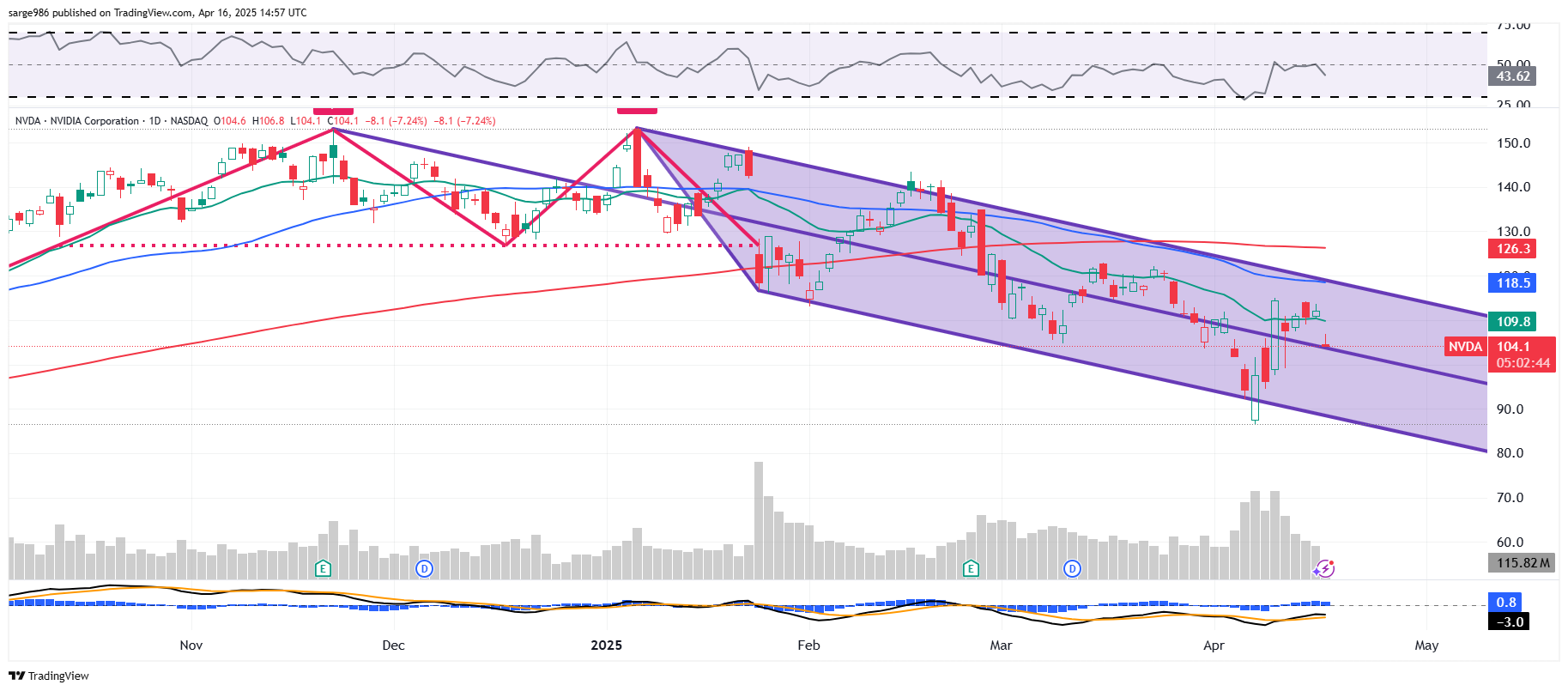
Readers will see that the stock came out of a double-top pattern of bearish reversal that spanned from last October into early January and then trended lower from that point on. That downtrend is illustrated here within the confines of an Andrews' Pitchfork model. The last sale, at times, has pierced both the lower trendline and upper trendline of the model, but there has clearly been no breakout. Even after the rally of April 9, the stock struggled to hold its 21-day EMA for a week, finally losing that battle on Wednesday morning.
The stock continues to trade well below both its 50-day SMA and 200-day SMA, which keeps portfolio managers at reduced levels of long-side exposure. Losing the 21-day EMA has now turned the swing crowd against the stock. There is a chance that NVDA hangs on to the central trendline of the pitchfork as it tried to do in late March.
Relative strength has peaked at "neutral" for two months and remains unimpressive. The daily MACD is not quite as bearishly postured as one might expect. Don't get me wrong. The MACD is not bullish, but the histogram of the nine-day EMA is above zero and the 12-day EMA is above the 26-day EMA. That said, the 12- and 26-day lines still reside below the zero bound.
My Thoughts on Buying Nvidia Now
I am not especially motivated to initiate NVDA at this time. A small entry could be made at that central trendline ($103-ish), but if that line is lost, respect the 8% rule, because this stock could go to $90 if there is no sharp improvement made in trade relations between the U.S. and China.
If one is long the stock, the upside pivot, which is the 50-day SMA, is almost 15% in its own right, never mind that above that resides the 200-day SMA. This is not a good chart, and investing in NVDA today would be more like gambling than it would be calculated. Of course, this story is subject to the whims of presidents Trump and Xi.
PS...
Nvidia competitor Advanced Micro Devices AMD expects the new licensing developments to cause that firm to take an up to $800 million charge in connection to its MI308 GPUs. I have a small log position in this stock and am very likely to liquidate that position after this article hits publication in compliance with my 8% rule. Unless, of course, AMD rallies ahead of said publication.
At the time of publication, Guilfoyle was long AMD equity.