Here's the Smartest Backdoor Play Into OpenAI Before the IPO
This stock offers a way for investors to access an early stake in OpenAI and go 'all in' on Artificial Super Intelligence.
You've reached your free article limit
You've read 0 of 1 free Pro articles.
I’ve argued before that SoftBank Group (SFTBY) (T:9984) is both the most dynamic company in Japan and one of the most influential venture-capital investors into the tech sector.
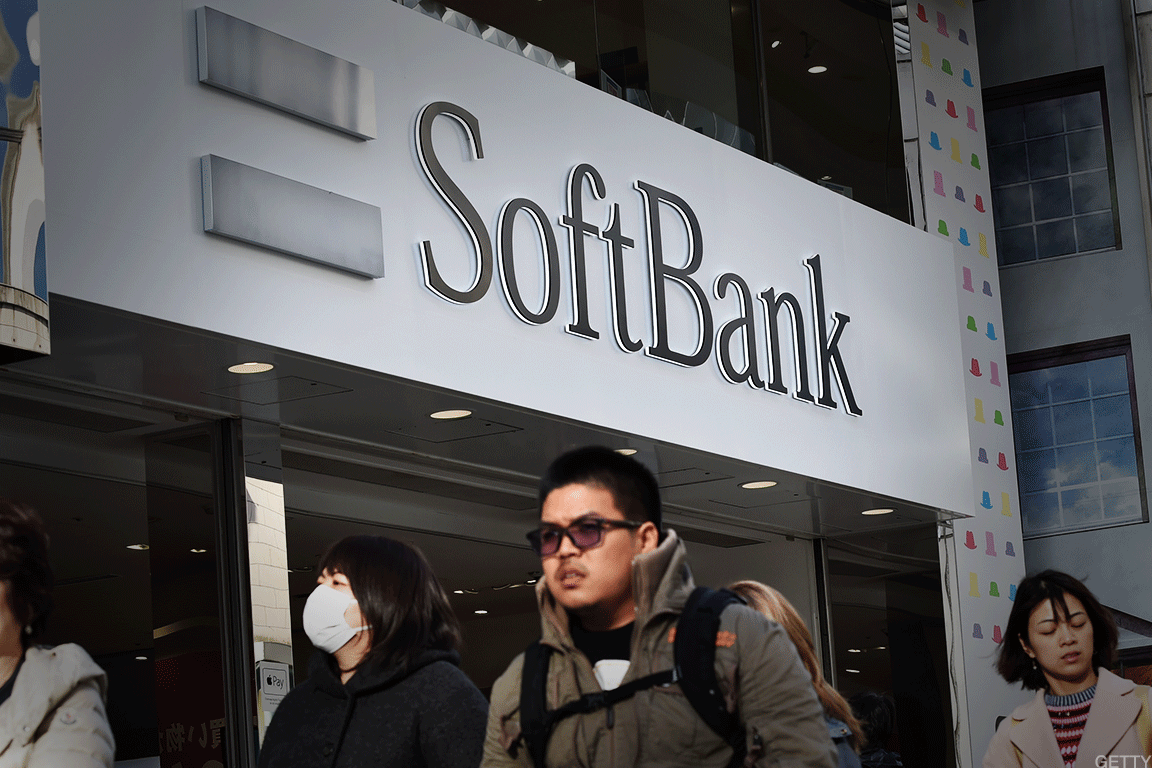
As I’ll explain, SoftBank also now offers equity investors a way to access unlisted OpenAI before any market debut.
SoftBank rides high when tech does well, suffers if there’s a tech shakeout, and completely missed the mark with bets on the likes of WeWork.
Well, tech is riding high, and so are SoftBank’s shares and earnings. Coupled with the afterglow of Prime Minister Sanae Takaichi’s record victory at Sunday’s elections, a stock-market positive as I discussed in my last column, and we are seeing an exceptional showing for the stock.
SoftBank shares are up 20.8% this week alone, having almost doubled with a 90.6% gain in 2025. They are well off the record highs set last October, down 30.4% from the ¥6,924 price they touched around the time Takaichi was confirmed on October 21 as Japan’s first female leader. But they appear to have a firm footing to move higher once again from here.
An 11% Stake in OpenAI
The company has reported a US$1.6 billion profit for Q3 that represents the fourth straight quarter of gains. It also turns around what was a loss of US$2.4 billion for the same quarter the year before, giving it a US$20.8 billion profit for the first nine months of the fiscal year that runs through March.
A large part of that gain stems from an increase in the valuation of its investment into OpenAI. It has built a stake of around 11%, having invested a cumulative US$34.6 billion that it marked to market at U$54.4 billion in its earnings, netting a paper profit of US$19.8 billion.
SoftBank is, in effect, a proxy stock for investors to take a position on OpenAI before its market debut. SoftBank cites the OpenAI stake up front in its earnings presentation, alongside its other Q3 tech investments, which I’ll outline below.
Microsoft (MSFT) holds the largest stake in OpenAI, at 27%, but is of course a far larger company and a less-direct play on OpenAI.
While the OpenAI stake is currently standing it in good stead, the increase in SoftBank leverage could cause problems should AI valuations take a hit. Its Q3 loan-to-value ratio has risen from 16.5% at the end of Q2 to 20.6% as of the end of Q3 on December 31. That’s the highest ratio since Q3 2021. The company says it intends to keep LTV below 25% in “normal times,” but could test 35% “during emergencies.”
Besides the direct investment into OpenAI, SoftBank is also a partner with the company on the Stargate initiative, a partnership that also includes Oracle (ORCL) . OpenAI and SoftBank are each investing US$500 million into SoftBank subsidiary SB Energy, which is building a data center in Texas that’s one of five AI sites that Stargate intends to operate. OpenAI has a 15-year lease on the Texas data center, although it’s not an exclusive deal.
'All in' on AI
Korean-Japanese founder Masayoshi Son has declared he is “all in” on investment into what he calls Artificial Super Intelligence. He argues that form of AI will be 10,000 times more intelligent than the human brain, and believes it should emerge over the next 10 years to improve on Artificial General Intelligence, which can achieve levels similar to “human genius,” or 10 times smarter than the average person.
ASI would be the product of AGI models “stimulating each other to rapidly accelerate their evolution,” Son argues in a message to investors, stating he is “more energized than ever” by this opportunity to encourage the “evolution of humanity.”
SoftBank started life as a prosaic software-sales company. The first hit it big with an early investment into Alibaba Group Holding (BABA) (HK:9988). Subsequent missteps saw Son question whether he’d lost his investment touch. He tearfully recalls that he thought he was done.
But Son’s decision to refocus on investment into Artificial Intelligence is proving a savvy move. In the last three months of 2025, it also bought chip designer Ampere Computing for US$6.5 billion, spent US$5.4 billion on the robotics business of automation specialist ABB ABBNY, and bought the data-center operator DigitalBridge Group (DBRG) for US$3.1 billion.
Increase in Leverage a Concern
That’s not to say it’s all smooth sailing. SoftBank had to liquidate its US$5.8 billion holding in Nvidia (NVDA) to fund its AI investments. It also sold US$12.7 billion in shares of the mobile-phone provider T-Mobile (TMUS) and has leveraged its 90% ownership of British chip developer Arm Holdings (ARM) to the tune of US$20 billion.
Its main way of exiting its venture-capital positions is through public listings or buyouts.
Also, its Japanese payments service PayPay filed with the SEC for an initial public offering on Wall Street. The Venmo-like app operator has 72 million registered users in Japan and says it accounts for one in five cashless payments in the country. The details aren’t yet set for the IPO date, price and size, but it intends to list under the ticker PAYP.
In Q3, there were market debuts in India for eyewear maker Lenskart Solutions (NSE:LENSKART) and e-commerce platform Meesho (NSE:MEESHO). Lenskart gave SoftBank’s Vision Fund 2 a gross profit of US$918 million, while Meesho generated US$510 million in gross profit.
Those figures almost seem quaint, however, compared with the US$81.2 billion in investment profits that “SVF2” is sitting on. SoftBank stock offers a way to tap that position before any OpenAI listing.
At the time of publication, McMillan was long MSFT and NVDA.