Has This Troubled Small-Cap Finally Bottomed... Or Is It Going to Zero?
Let's examine the charts and fundamentals and come up with a plan.
You've reached your free article limit
You've read 0 of 1 free Pro articles.
Earlier this week, Hain Celestial HAIN released its fiscal second-quarter financial results. Another space stock? Not exactly. This is a health and wellness company. They sell snack foods perceived as a healthier alternative to the usual and herbal teas.
The results? They were awful. Oh, and the company cut its fiscal 2025 (June) guidance. The shares then sold off, extending a now more than three-year downtrend. Our look at this stock today comes via a request made by one of our subscribers.
For the period ended December 31, Hain Celestial posted adjusted EPS of $0.08 (GAAP EPS: -$1.15) on revenue of $411.49 million. These top and adjusted bottom-line results both fell short of what Wall Street had been looking for, while sales contracted 9.4% from the year-earlier comparison.
Organic sales (not of organic foods) were down 7%. The GAAP print shocked the street as Hain took a $91.267 million goodwill impairment, a $17.986 million impairment against intangibles and long-lived asset valuations, and several productivity-related, and litigation costs.
Of course, there is a huge difference between the company's statement of income and the adjusted numbers for operating expenses, so I don't know if going through its operations line by line, like we often do, would be helpful. I will say this, as sales dropped 9.4%, the cost of those sales dropped 9.6%, as GAAP gross profit slid 8.6%. This was on a gross margin that actually increased from 22.5% to 22.7%.
So, while the business is not flourishing, there is a business that could survive if they can clean up their act.
The CEO
President and CEO Wendy Davidson commented in the press release:
“Despite challenges in the quarter, we generated strong operating cash flow and further reduced debt. We drove sequential improvement in baby & kids and in our largest category, meal prep. However, sales growth in the quarter was hindered by poor in-store performance in snacks, driven by marketing and promotion effectiveness, and supply chain challenges, both of which we have already taken steps to address. We are confident that the actions taken, combined with promotional timing shifts, confirmed distribution gains, and full infant formula supply, will drive organic net sales growth in the second half of the year."
Fundamentals
For the quarter, Hain generated operating cash flow of $30.9 million. Out of that number came capex spending of $6.4 million, leaving free cash flow of $24.5 million. The company obviously did not return any capital to shareholders. That said, Hain did pay down $61.9 million in debt, while only issuing $50 million in new debt, so some of this cash flow was put to good use.
Looking at the balance sheet, the company has a cash position of $60.5 million, inventories of $260.5 million and current assets of $548.5 million. Current liabilities add up to $289.3 million and that includes just $7.5 million in short-term debt. This leaves the company with current and quick ratios of 1.9 and 0.99, respectively. These ratios both pass muster. The company can meet its short-to medium-term obligations without concern.
Total assets amount to $1.961 billion. Goodwill and other intangibles account for $1.049 billion of this. At 53.4% of total assets, this does concern me.
Total liabilities less equity comes to $1.156 billion. This includes long-term debt of $720.9 million in long-term debt. Yes, this concerns me as well.
At least it does seem like Davidson understands the gravity of correcting for the business and getting the size of the debt load relative to free cash flow and cash on the books under control.
Wall Street
David Palmer of Evercore ISI and John Baumgartner of Mizuho Securities are probably the top-ranked analysts that follow this stock. Both reiterated "hold" ratings on the stock, as Palmer took his price target down to $6 from $9 and Baumgartner took his target down to $4.50 from $7. Even Alexia Burland Howard at Bernstein, who is the only "buy" I can find and is rated at just two stars by TipRanks, cut her price target to $8 from $12.
My Thoughts
The business is in decline. The CEO thinks she can turn that around, but this will be a case of "show me."
The debt load is daunting but at least will not significantly hamper the business for at least another year. The balance sheet could be better managed, but at least cash flows are positive. You really can't fix anything without that.
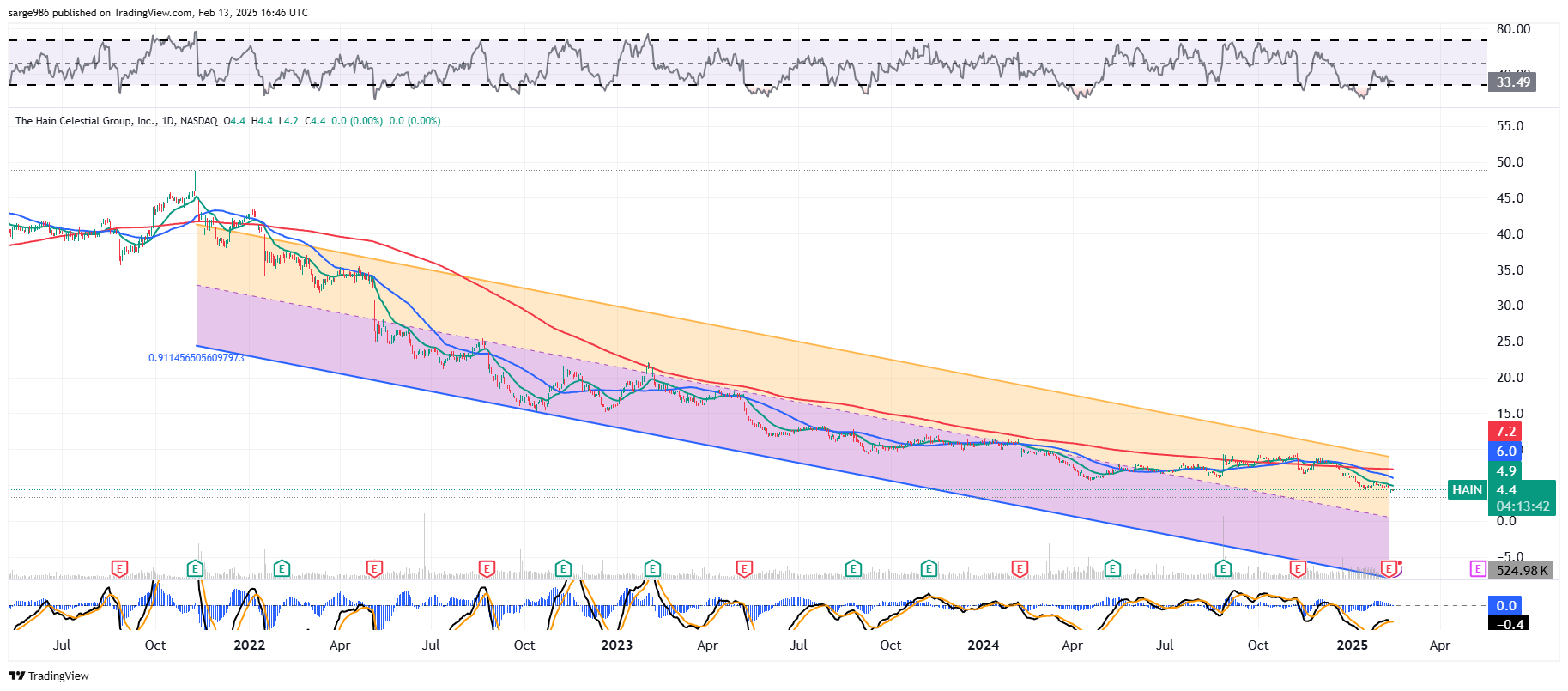
Pretty tough three and almost a half years. Let's zoom in:
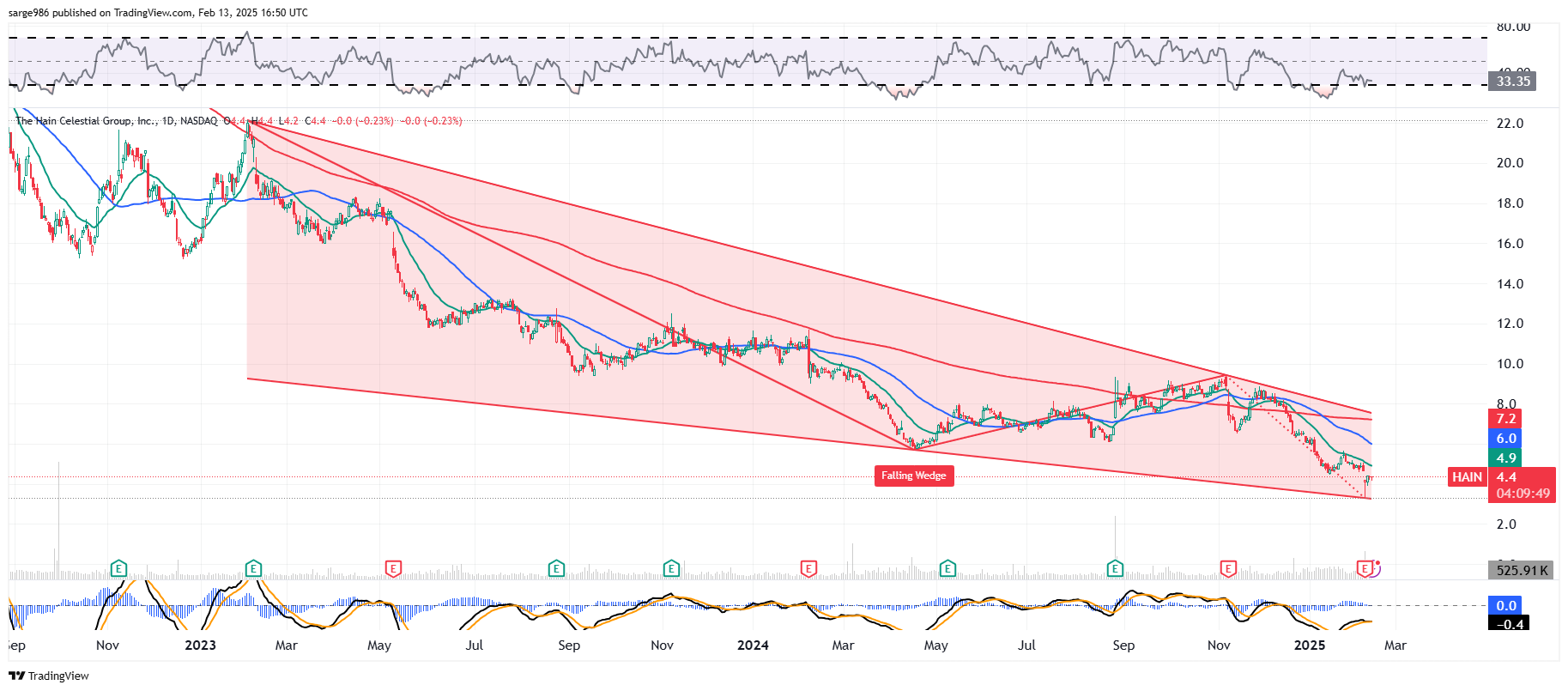
The stock is currently mired in a falling wedge pattern since the start of 2023. As we know, falling wedges are considered patterns of bullish reversal. So, has HAIN finally bottomed, or is it anchors aweigh for this crew? I am not sure that I would initiate here until I see something more than a "more than year-long," potentially bullish pattern.
That said, if I were already long this name and it was against me, I probably would not sell my shares down here. I probably would consider adding close to the bottom trendline of the wedge, which may be unrealistic as that would be close to $3.30.
Instead, I might write May 16 $4 puts for about $0.30 in order to shave a little something off of net basis and then write a like number of May 16 $5 calls for another $0.25.
That should bring in some cash while waiting to see if Davidson's plan has any teeth to it. Of course, to do this, the investor has to be prepared to add at $4 by May and sell at $5 by May. Hopefully, this idea buys some time.
At the time of publication, Guilfoyle had no positions in any securities mentioned.