Harsh Reality for Netflix Stock After $11 Billion Report
Is the streaming giant in a good position for investment after a strong quarter?
You've reached your free article limit
You've read 0 of 1 free Pro articles.
From my vantage point, the Netflix NFLX quarter looked good, and the guidance was robust. Still, markets sold the shares off overnight. it could be profit taking as the shares ran much higher from early April into the end of June. That said, the shares have sold off since that late June high. So, what gives? Let's talk about what's going on with Netflix.
Netflix, the streaming entertainment industry leader, reported the firm's second quarter financial results on Thursday afternoon. For the three-month period ended June 30, Netflix posted a GAAP EPS of $7.19 on revenue of $11.079 billion. The EPS print beat Wall Street by about 12 cents and compares very well to the year-ago comp of $4.88. The revenue print was good enough for year-over-year growth of 15.9%.
The firm continues to build out its ads business and expects to roughly double ads-driven revenue in 2025. The firm is now focusing on enhancing capabilities for advertisers. The Netflix Ads Suits rollout has now been completed, and the firm believes that its ad tech platform is now "foundational" to its long-term ads strategy. Will the ads business become a higher priority than the pure subscriptions business? Just as an observation, that is something that not just Netflix, but the entire streaming entertainment industry does seem to be moving toward.
Of course, the second quarter's better than anticipated execution was driven not just by increased ad revenue, but also by increased subscriptions and higher prices for the firm's services. Let's explore.
Operations
While revenue generation ramped 15.9% to $11.079 billion, the cost of those revenues was up 2.9% to $5.325 billion. After accounting for operating expenses such as marketing costs, technology development and administrative costs, operating income printed at $3.775 billion, which was up 45% from the year-ago period. Operating margin absolutely soared from 27.2% in Q2 2024 to 34.1% for the quarter reported.
After factoring for interest, other income and expenses and taxes, net income landed at $3.125 billion (+45.6%). This works out to an EPS of $7.19 per fully diluted share, up from $4.88 a year back. This was also up sequentially from $6.61 for Q1 2025.
Geographic Performance
- U.S. and Canada generated revenue of $4.929 billion (+15%). Adjusting for constant currency and currency hedging gains and losses, growth remained 15%.
- Europe, Middle East, Africa generated revenue of $3.538 billion (+18%). Adjusting for constant currency and currency hedging gains and losses, growth becomes 16%.
- Latin America generated revenue of $1.307 billion (+9%). Adjusting for constant currency and currency hedging gains and losses, growth becomes 23%.
- Asia/Pacific generated revenue of $1.052 billion (+24%). Adjusting for constant currency and currency hedging gains and losses, growth becomes 23%.
Guidance
For the current quarter, Netflix is projecting revenue of $11.526 billion, which would be good for year-over-year growth of 17.3%. Operating income is seen at $3.525 billion (+24.6%) as operating margin expands from 29.6% to 31.5%. Net income is projected at $2.979 billion, which would be good for a fully diluted EPS of $6.87. That would be up from the Q3 2024 comps of $2.364 billion and $5.40. Wall Street had been looking for something like $6.63 on $11.26 billion. In short, the Q3 2025 guidance is strong. The firm also lifted full-year revenue guidance from $43.5 billion to $44.5 billion to $44.8 billion to $45.2 billion.
Fundamentals
For the quarter reported, Netflix generated operating cash flow of $2.423 billion. Out of that number came capex spending of $155.9 million. This left free cash flow of $2.267 billion, which was up a stunning 86.9% from the year-ago comparison. Out of that free cash, the firm repurchased $1.654 billion worth of common stock. Netflix does not pay shareholders a cash dividend, but it probably should be considered as the firm is buying back stock aggressively.
Looking at the balance sheet, Netflix ended the quarter with a cash position of $8.391 billion and current assets of $11.993 billion. Current liabilities add up to $8.942 billion. That does not include any short-term debt, but it does include $1.728 billion in deferred revenue, which is not a true financial obligation. This leaves the firm's current ratio at a healthy enough 1.34. adjusted for those deferred revenues, this ratio rises to a better looking 1.66.
Total assets amount to $53.099 billion (nothing intangible), while total liabilities less equity comes to $28.147 billion. That number does include long-term debt of $14.453 billion. That's a bit much for me, but not a deal-breaker. The firm can handle the debt-load and did pay off $1.033 billion in debt during the quarter reported.
My Thoughts
It is apparent that the markets are not impressed in these Netflix earnings nor in the guidance. The opening bell rang half an hour ago and I saw the stock is now down 5.6%. Cash flows are strong. Revenue growth is strong. Margin is strong. The ad business is growing. The guidance is strong. I think I would want to take advantage of this weakness, if the stock were not still trading at 50-times forward looking earnings. Let's take a look at the chart.
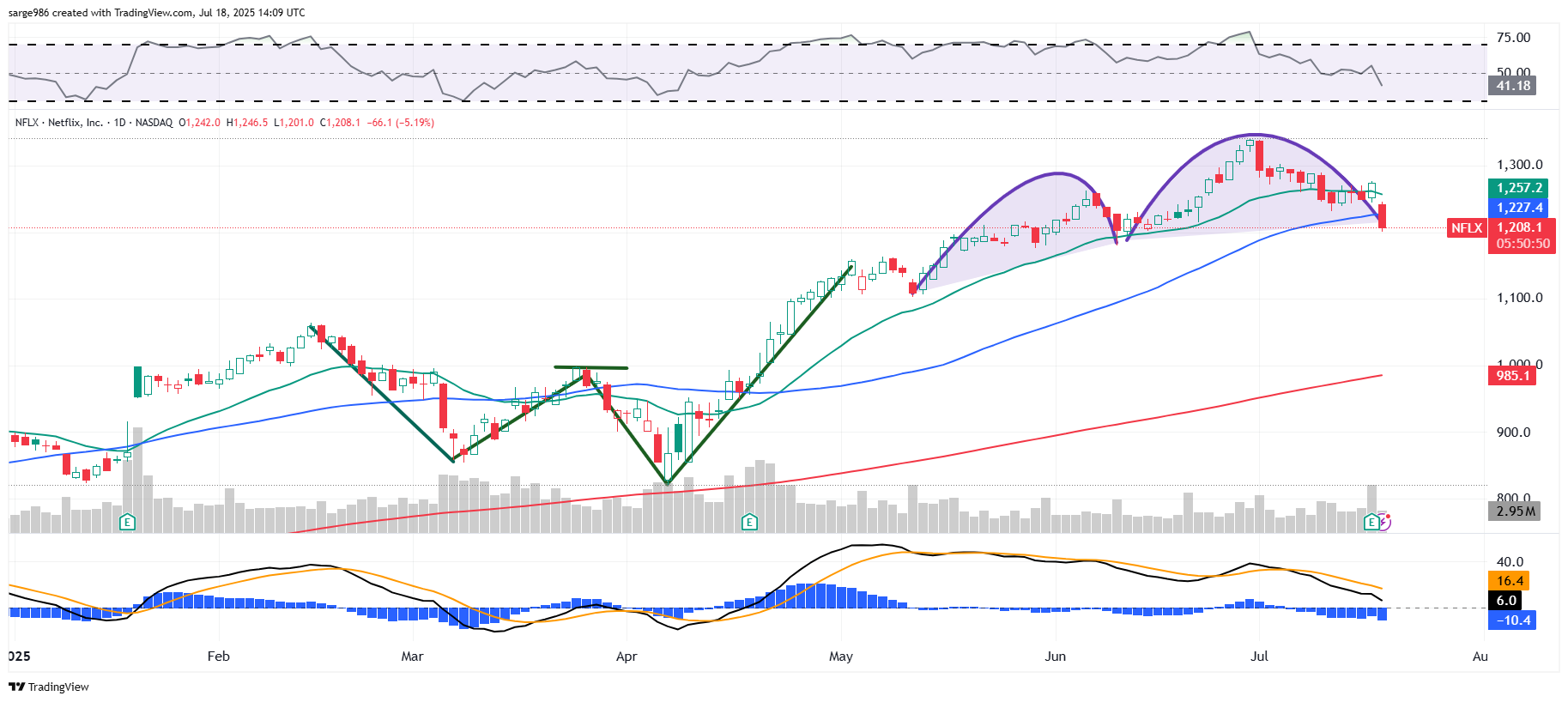
Readers will see that NFLX shares broke out from a double-bottom reversal this past spring and into the June 30 high. I think investors should be on the alert at this point, even if the stock rallied from here, that the shares have already created two thirds of a head-and-shoulders pattern of bearish reversal. This is not a healthy-looking chart.
Relative strength is now sub-neutral. The daily MACD is now pretty bearish looking as well. The histogram of the nine-day EMA has been below zero since very early July. In addition to that, though both lines are still above zero, the 12-day EMA is now below the 26-day EMSA and the spread between the two is expanding. There is no way to see something positive in that.
Lastly, the stock is now trading below its 50-day SMA. There is a very good chance that if it does not look like the shares can retake that line before going into the weekend on Friday night that portfolio managers will be forced to reduce long side exposure by their respective risk managers. This, in my opinion, is not a dip to be bought, unless that line is retaken and held.
At the time of publication, Guilfoyle had no positions in any securities mentioned.