Goldman Sachs Poised for Rally After 'Crushed' Earnings
The big bank faces a bullish pennant as earnings came in.
You've reached your free article limit
You've read 0 of 1 free Pro articles.
On Wall Street, some used to call them "The Empire" and really, after Solomon Brothers was acquired and First Boston's star faded after the dot-com bubble burst, they stood alone as the elite investment bank on Wall Street.
Others used to say that if you needed 1,000 hammers today, Goldman Sachs GS bought the hardware store yesterday, if you needed 1,000 birthday cakes today, Goldman bought the bakery yesterday.
I've had some (quiet) bad blood with Goldman Sachs over the years. The fact is that I am sure no one still working there knows who I am. I could be biased as I go through my analysis of the firm's second quarter earnings, but I have never been a fan, I have traded the stock, but never invested in the name, despite its success.
The year was 1987, pre-crash. I was working for the Pershing division of Donaldson, Lufkin & Jenrette. I had the Marine Corps on my resume, and I was going to night school, but I didn't know much about the business yet. I had sent out resumes to literally every firm I had heard of. I got a nibble at Goldman. They called me in for an interview.
I had no idea just how elite they thought they were. The interviewer made a donkey's tail out of me, asked me questions I couldn't possibly answer, which may have been a test in hindsight. Finally, she asked me, "What in the world makes you think you are worthy of working for Goldman Sachs?"
Time passed. By 1998, I had become one of the more well thought of floor traders at First Boston during the dot-com bubble. I ran a section of the floor. I had been added to the execution side of the investment banking team. I was no longer a "know nothing" looking for a job. I was being well compensated.
It was about 11 years later. Along comes Goldman Sachs making an effort to recruit me away from First Boston. I laughed and laughed. I then told the recruiter that I would rather be out of work than work for Goldman Sachs. I never forgot how I was treated in their offices when I was really just a buck sergeant looking for a job.
I would, many years later, find myself out of work. That was a blessing. I started my own business and have been working for myself for more than nine years now. Looking back, I can't believe that I ever allowed myself to work for someone else for so long. Had things not worked out the way they did, I never would have realized my potential. Still, don't like the way that Goldman recruiter treated me on that day in 1987.
Goldman Reports!
On Wednesday morning, on the second day of big bank earnings releases, Goldman Sachs posted the firm's second quarter financial results. For the three-month period ended June 30, Goldman posted a GAAP EPS of $10.91 on revenue of $14.583 billion. These numbers not only crushed expectations but also compare very well to the year-ago EPS of $8.62, while reflecting year-over-year revenue growth of 14.5%.
Net interest income of $3.1 billion easily exceeded expectations for something closer to $2.8 billion. Provision for credit losses came to $384 million, well below expectations for something up around $408 million, though that is up sharply from $282 million for the year-ago comp. Annualized return on average common shareholder equity printed at 12.8%, up from 10.9% a year ago.
Segment Sales Performance
- Global Banking and Markets: generated revenue of $10.12 billion (+24%). Investment Banking fees were up 26%. Fixed Income, Currency and Commodities revenues were up 9% and Equities-driven revenue was up 36%.
- Asset and Wealth Management: generated revenue of $3.78 billion (-3%). Both equity (-$1 million) and debt investments (-72%) produced significantly lower net revenues that were partially offset by increased management fees (+122%).
- Platform Solutions: generated revenue of $685 million (+2%). Consumer platform revenues increased slightly (+4%), as transaction banking revenues decreased (-11%).
Returns to Shareholders
Earlier this week, the Board of Directors increased the firm's quarterly dividend to $4.00 per common share from $3.00 to be paid to shareholders of record on August 29 on September 29. The 33% increase brings the firm's forward-looking dividend yield up to 2.28%.
During the quarter reported, Goldman returned $3.96 billion in capital to shareholders, of which an even $3 billion came in the firm of common share repurchases. The firm repurchased $5.3 million shares at an average price of $564.57.
The Chart
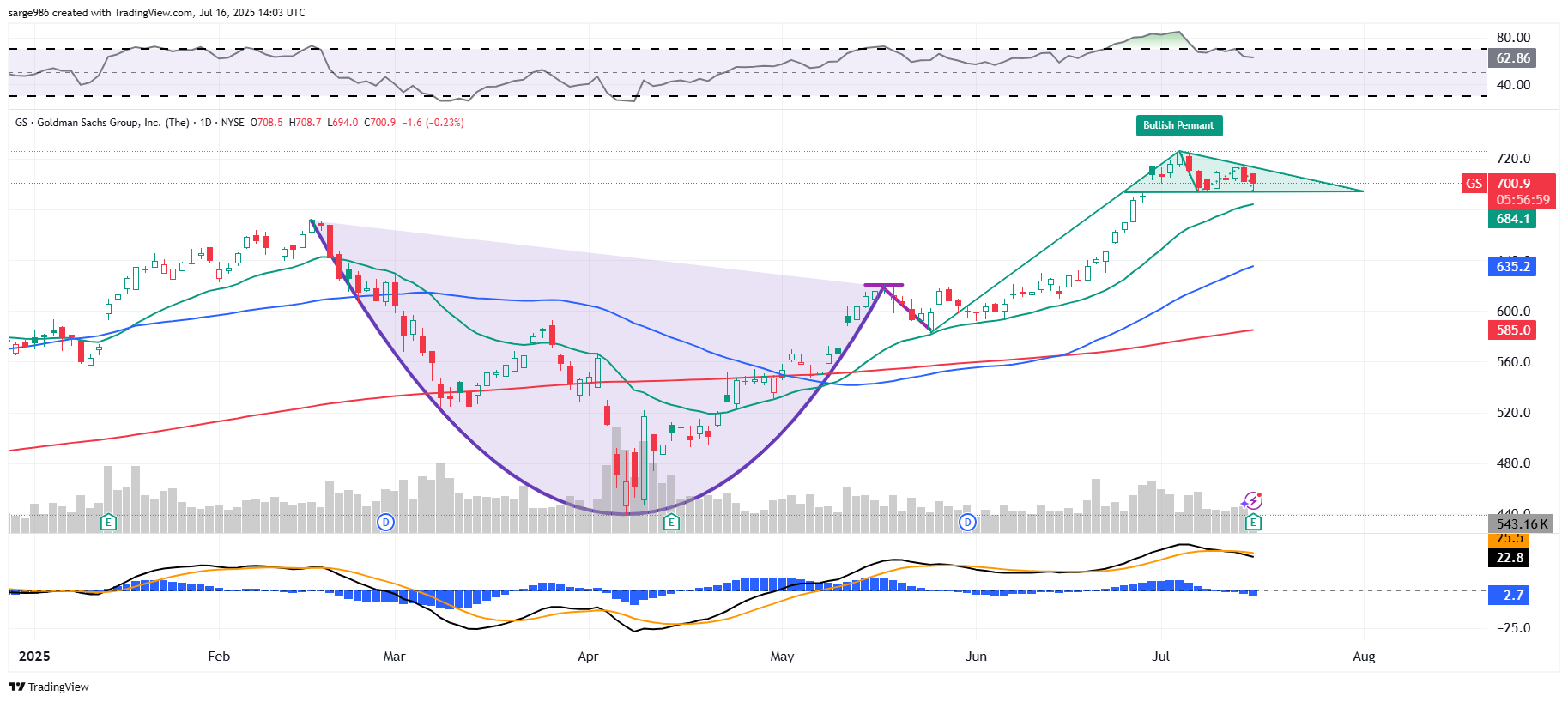
It appears that the shares of Goldman may be setting up for another leg of the stock's recent rally. I show readers here a cup-with-handle pattern with a $620 pivot that stretched from mid-February into late May. This produced a breakout that took the shares all the way up to $726 before they paused.
However, this period of consolidation that really is only about two weeks old, is starting to look like a bullish pennant formation. This is a pattern of continuation, which would mean that the uptrend is still in place, and this is but a pause that refreshes.
Relative strength is quite robust without being technically overbought. The daily MACD has become a little wonky. The histogram of the nine-day EMA has gone negative due to this period of consolidation, while the 12-day EMA has crossed below the 26-day EMA. That said, both of those lines are still in positive territory.
What to watch for? The upside pivot for a further breakout is that $726 high. The downside pivot would be the 21-day EMA. Losing that line would force the swing crowd out of the stock and put the professionals in the position of defending the stock at the 50-day SMA. Though I think the upside option is more likely for traders, that second option is probably what investors looking to add should hope for.
At the time of publication, Guilfoyle had no positions in any securities mentioned.