GE Vernova Powers Up, AI Charges Ahead, World As You Knew It Spins Away
I'm eyeing a new price for GEV, gathering intel on AI, and figuring how to hedge against one's own demise in the labor force.
You've reached your free article limit
You've read 0 of 1 free Pro articles.
It made sense that Nvidia NVDA CEO Jensen Huang, CEO Lisa Su of Advanced Micro Devices AMD and CTO Shyam Sanker of Palantir Technologies PLTR were front and center. After all, the event had been labeled the "AI Summit." The White House had released a 26-page document that would serve as a framework for more than 90 federal policy plans expected to unfold over the next few months or so.
The first paragraph of the introduction to that document is clear: "Whoever has the largest AI ecosystem will set global AI standards and reap broad economic and military benefits." The second paragraph adds: "Winning the AI race will usher in a new golden age of human flourishing, economic competitiveness, and national security for the American people."
Pres. Trump would sign three executive orders before leaving the event where he detailed his administration's plan going forward.
The administration appears to be backing away from the regulation side of AI in order to create a fertile environment for the president's three pillars that will serve as the outline for the nation's AI plan of action. The three pillars are as follows:
Pillar One: Accelerate AI Innovation. This pillar involves the removal of red tape and "onerous" regulation and attempts to ensure that AI protects free speech while combating synthetic media in the legal system. This pillar encourages open-source and open-weight AI, invests in the science behind AI, empowers labor and tries to build out an AI evaluations ecosystem.
Pillar Two: Build American AI Infrastructure. This pillar will streamline permitting for the building of data centers, semiconductor fab facilities and energy production infrastructure. The idea is to rapidly develop a grid that can match the needs of the innovative side of AI while training a capable workforce. Cybersecurity will be enhanced and prioritized.
Pillar Three: Lead in International AI Diplomacy and Security. This pillar will outline how to export American AI to allies and partners and how to counter Chinese influence. The plan will be to align global protection measures while strengthening export control enforcement and ensuring that the U.S. government is at the forefront of evaluating national security risks that arise in the development of frontier modeling.
My Thoughts on the Future
There is no doubt that there is no going backwards. There will be serious, ongoing, sustained tailwinds behind those businesses that can provide platforms for the commercial and military use of generative artificial intelligence. Investing in cloud-based, AI-focused software providers, AI infrastructure / hardware providers and those that can produce the increased energy required will be how to hedge. How to Hedge?
By that I mean, how today's laborers across any number of occupations can hedge against the almost certain and monumental gains in efficiency and production to come over the medium-term future. That increased production will lead to a decreased demand for both white-collar and blue-collar labor. The value placed on middle managers will from here carry forth a downward trajectory as small unit leadership is replaced by speed and data-backed decision making.
I don't write this to scare anyone. Just understand that life is now going to be defined as how well one can adapt to existing in a constant state of transition. Lifelong civilians may struggle with this. No one is going to work at the same job or for the same employer for decades over a career anymore. There will be no pension. That ship has sailed. You only have yourself to rely on now. Wall Street probably experienced this well before Main Street, so I know what I speak of. Human traders started being replaced by algorithms in the early 2000s. By late 2006, algorithms were already handling the vast majority of real-time decision makers. We had to adapt. We had to recreate ourselves.
I was always the "math kid." I could not beat the algorithms on speed, but for a long while, I was still more accurate, and I could often reverse engineer what I was seeing on the tape to figure out the intentions of my competitors. Traders who could not do those things in their heads were gone by 2012. They had become "blacksmiths." In time, even I could not beat the algos on accuracy. I had to create new methods in order to survive. You have all read my rules. They have kept me relevant. I almost did not survive on the street. Honestly, my low was pretty low.
That technological progress that knocked off Wall Street more than a decade ago will now come for Main Street. I have no ideas how to adapt for the masses serving in sectors of the economy that I have never worked in. I do, however, know that to hedge against a reduced potential for a sustained higher level of compensation as a product of one's labor, one must swallow their pride, put aside their ego and invest in what they likely see as the very threat to that current existence.
By The Way...
The European Union and the U.S. appear to be progressing toward a large trade deal that would likely set a 15% tariff on most imports to the U.S. Both sides have obviously accelerated negotiations over recent days in order to get ahead of the president's August 1st deadline and avoid what could be a "full-blown" trade war.
A majority of E.U. member states are said to be likely to accept that idea and have that rate cover automobiles. The president has threatened the E.U. with 30% tariffs, while the E.U. has threatened to respond in kind with increased tariffs on more than $100 billion worth of American exports to the block.
Marketplace
The environment for equities was very strong on Wednesday as news of a trade deal with Japan, the Philippines and a revised deal with Indonesia made the rounds. The upside momentum accelerated in the afternoon as traders and investors heard rumors of progress in the U.S. / E.U. talks mentioned above. Markets also responded well to the Trump administration's "AI Summit."
The S&P 500 gained 0.78% on the day as the Nasdaq Composite gained 0.61%. The Dow Industrials tacked on 1.14% and closed just shy of an all-time record. While the S&P 500 and Nasdaq Composite have been setting new records on a near-daily basis of late, the "Dow" has not set a new all-time high since December of last year. There was no rotation, just capital inflows, as small to mid-cap stocks remained hot, too.
Ten of the 11 S&P SPDR ETFs closed out the Wednesday session in the green, led by Health Care XLV, and followed by the Industrials XLI and Energy XLE. Away from Health Care, defensive sectors placed in the bottom three rungs on the daily performance tables. That can probably be taken as a vote for increased economic growth going forward in response to the gains made in efficiency and production that were spoken about at the AI Summit.
Breadth
Winners beat losers by more than 2 to 1 at the NYSE and by a rough 9 to 4 at the Nasdaq. Advancing volume took a commanding 74.6% share of composite NYSE-listed trade and a 65.2% share of composite Nasdaq-listed activity. Aggregate trade was slightly higher across Nasdaq-listings on a day over day basis. We were that close to labeling Wednesday a new bullish "Day One" but alas, it was not to be. We'll take it. It does illustrate strength in the marketplace, but the fact is that aggregate trade was slightly lower on Wednesday from Tuesday across NYSE-listings and across the membership of the S&P 500 as well.
Semis Down? Not So Fast...
On Wednesday, the Philadelphia Semiconductor Index closed essentially flat (-0.02%) on the day, which might make sense as Texas Instruments TXN was slapped around for a loss of 13.3% and ON Semiconductor ON gave up 4.6%. I thought it odd that despite all of the optimism around the semis that came out of the AI Summit on Wednesday, that the semis would be down on the whole.
It turns out that the semis were not down or even flat on the whole. The poor performance of the Philly Semiconductor Index was simply a matter of weighting. The Dow Jones U.S. Semiconductor Index, which basically measures the performance of the same stocks, was up 1.28% on the day despite those losses in TXN. The gains that were made by AMD (+2.54%), Nvidia (+2.44%) and Taiwan Semiconductor TSM, which was up 2.25%. were indeed enough to carry that index. Always dig deeper when something does not look right.
Holy GE Vernova, Batman!
On Wednesday, GE Vernova GEV was up a stunning 14.6% or about $80 for the session. I came in long the stock, but clearly not enough. I had considered doubling my long position ahead of the earnings release. I had a feeling and didn't go for it. Thankfully, the Colonel, who can beat me (by like a point) on a raw IQ test, was on the ball, so we did participate to a greater degree than we would have if I were the only one running the show. Three cheers for the Colonel. Huzzah!
GE Vernova blew away estimates for adjusted earnings per share revenue generation, order backlog, and adjusted earnings before interest, taxes, depreciation, and amortization. Power, wind and electrification all beat their individual segment expectations. The company also increased its outlook for the year for revenue generated, EBITDA margin and free cash flow. So, what now?
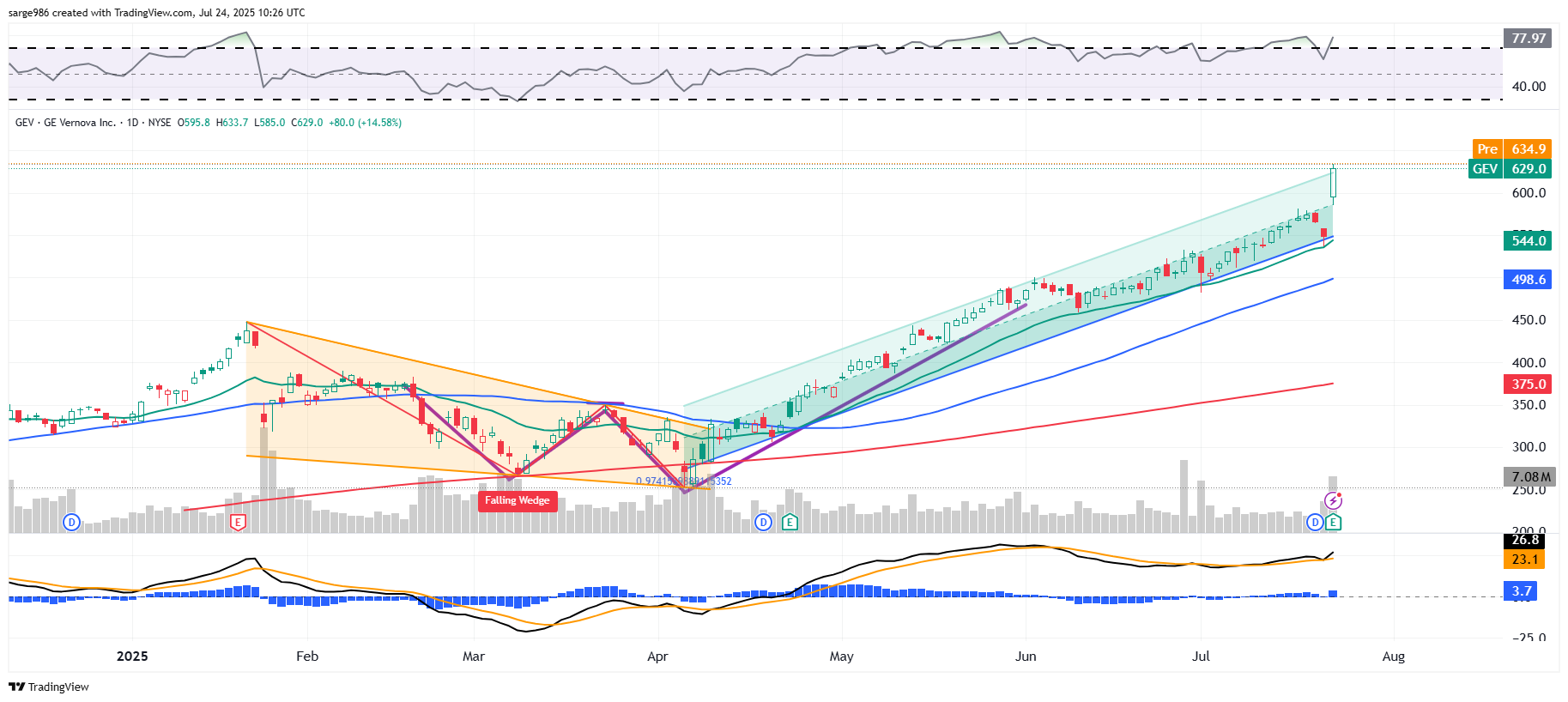
Will there be some profit taking? That certainly would not surprise me. Readers will see that back in early April, the stock broke out of the double whammy of a Falling Wedge and a Double Bottom, both patterns of bullish reversal. The uptrend is illustrated here using a Raff Regression model, out of which the shares spend Wednesday trying to break out past the upper trendline. That's a moving pivot that currently stands at a rough $623.
A full 100% Fibonacci extension (beyond the late January through early April selloff) would put the shares at a rough $645. That could be where some traders who are up huge might want to think about taking off a few shares. I, going off of pivot, and then allowing for that potential profit talking, am thinking that the stock could hit $715. With all of my key indicators still flashing bullish signals, that is my target price.
Economics
(All Times Eastern)
08:30 - Initial Jobless Claims (Weekly): Expecting 228K, Last 221K.
08:30 - Continuing Claims (Weekly): Last 1.956M.
09:45 - S&P Global Manufacturing PMI (Jul-Flash): Expecting 52.6, Last 52.9.
09:45 - S&P Global Services PMI (July-Flash): Expecting 52.9, Last 52.9.
10:00 - New Home Sales (Jun): Expecting 651K, Last 623K SAAR.
10:30 - Natural Gas Inventories (Weekly): Last +46B cf.
11:00 - Kansas City Fed Manufacturing Index (Jul): Expecting 6, Last 5.
The Fed
(All Times Eastern)
Fed Blackout Period.
Today's Earnings Highlights
(Consensus EPS Expectations)
Before the Open: BX (1.09), CMCSA (1.18), HON (2.66), LHX (2.49), TXT (1.45), UNP (2.90), VLO (1.77)
After the Close: INTC (.01), VRSN (2.20)
At the time of publication, Guilfoyle was long LHX, NVDA, AMD, PLTR, GEV equity.