Firefly Aerospace: Catch or Release the Rocket Lab Competitor?
Here's where I get interested in the space and defense technology company after first results since going public disappoint.
You've reached your free article limit
You've read 0 of 1 free Pro articles.
On Monday evening, Firefly Aerospace FLY posted its first quarterly earnings since becoming a publicly traded company. The numbers were disappointing.
For the three-month period ended June 30, Firefly posted a GAAP loss per share of $5.78 on revenue of just $15.549 million. These top-line and bottom-line numbers both fell short of Wall Street's expectations, while the tiny revenue print reflected a year-over-year contraction of 26%.
On the bright side, Firefly's gross profit improved to $3.995 million from $2.951 million a year ago, as gross margin widened to 25.7% from 14%. Unfortunately, R&D-related expenses increased 15.8% to $45.774 million, dropping the GAAP operating loss to $54.35 million from $48.9 million. That took the company's GAAP loss per share down to $5.78, fully diluted, from the year-ago comparison of -$4.60.
Firefly did issue full-year revenue guidance of between $133 million to $145 million, which more or less straddled the $139 million or so that Wall Street was looking for.
Just Who Are These Guys?
Firefly is a Cedar Park, Texas-headquartered space and defense technology company. The company has designed, developed and deployed vehicles and "spacecraft solutions" to support critical missions across the space domain. Its clientele come from both the private and public sectors.
The company operates through two business segments, the aforementioned Spacecraft Solutions business that includes the Blue Ghost lander and Elytra, which is a line of Low Earth Orbit, Medium Earth Orbit and Geostationary equatorial orbit satellites.
The Launch segment itself offers services through two rock types. One, Alpha, is a U.S.based orbital rocket in the 1K Kg class that now has four successful launches under its belt. The second, Eclipse, is a reusable and scaled up version of Alpha.
Is This an Opportunity?
FLY is trading around 11% lower in early trading Tuesday in response to these earnings. That said, the stock was up 9.6% on Monday going into the event, so it is really back where it was late last week.
I will say this. It is difficult to value a company that is losing a chunk of dough on very little revenue at more than $7 billion.
The balance sheet is in good shape, for now, so that's not an issue. Firefly has more than $205 million in unrestricted cash on hand and just $6.5 million in short-term debt as well as $123.5 million in longer-term debt. I see $82.7 million in "current" deferred revenue as well as another $75.8 million in deferred revenue not labeled as "current," so there are orders.
Firefly claims an order backlog of roughly $1.3 billion, which includes the recent NASA contract award worth $176.7 million for Blue Ghost (Mission 4) lunar payload delivery. The company also landed a $10 million contract addendum on Monday for the acquisition of additional lunar data beyond the requirements for Blue Ghost Mission 1.
My instinct is to wait on this one. This is not a stock trading under $10 as competitor Rocket Lab RKLB was when we jumped on that one. That was not such a risky investment upon initiation. This carries considerably more risk, in my opinion. Is that my book talking? Maybe. It is difficult to recognize one's own bias.
That Said...
Three five-star rated (by TipRanks) sell-side analysts opined on FLY Tuesdau morning. Sujeeva De Silva of Roth MKM reiterates a buy rating and $60 price target (the stock closed on Monday at $49.52). Seth Seifman of JP Morgan reiterated his "overweight" (buy-equivalent) rating and $55 price target, and Kristine Liwag of Morgan Stanley reiterated her "equal-weight" (hold-equivalent) rating and $52 target.
Investors should be cognizant that JP Morgan was one of the lead bookrunning managers for the Firefly Aerospace IPO and Morgan Stanley was a joint bookrunner. Roth Capital was also a co-manager. So, Firefly is an investment banking client of the firms that have had their analysts opine on the stock this morning.
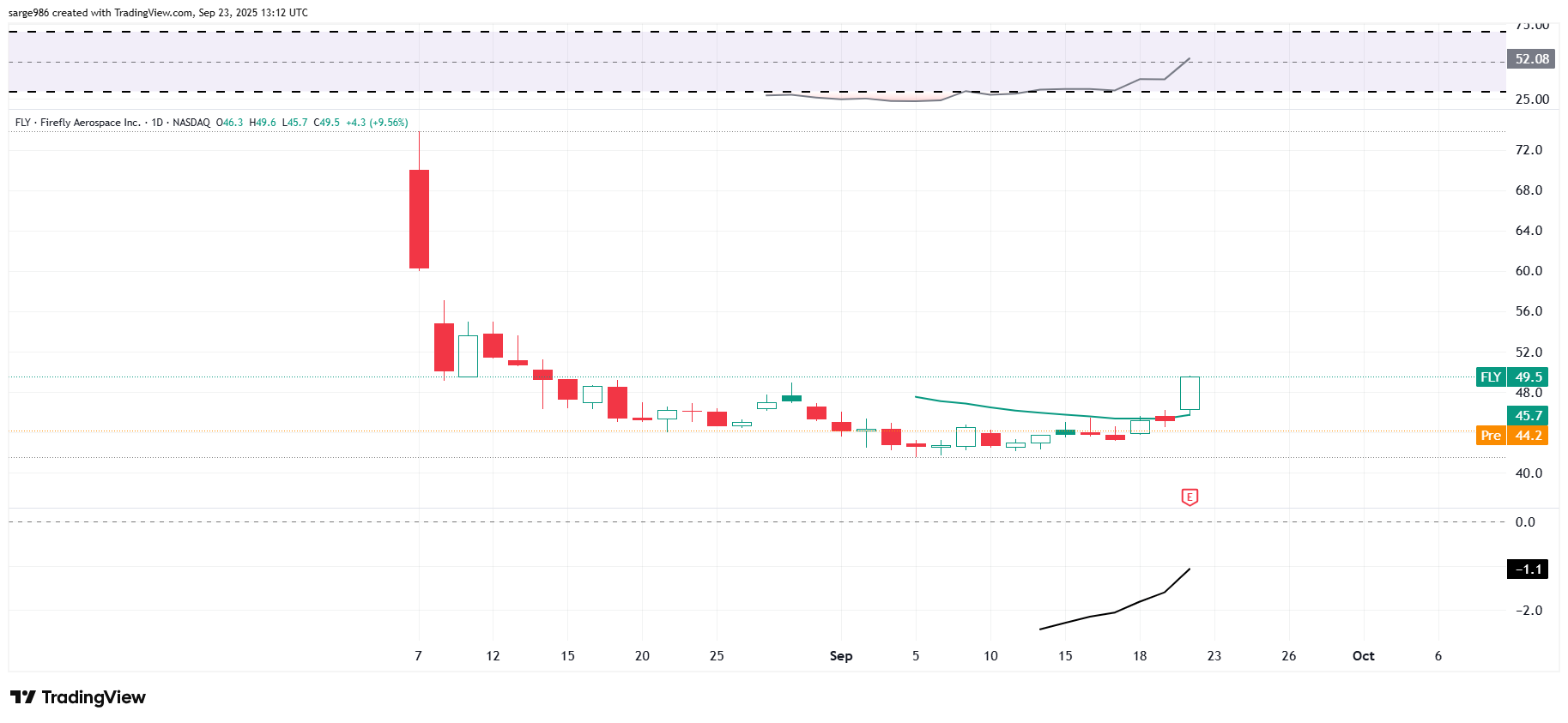
Readers will see that the stock debuted on August 7. The shares were priced at $45 and traded as high as $73.80 that day. Since then, the stock has traded as low as $41.57 on September 5). Tuesday morning, I see the shares trading with around a $44 handle.
It is imperative for the stock to defend that September 5 low. Failure to hold that level could lead to much lower prices. The stock is not likely to go to zero, as Northrop Grumman NOC is an investor. That said, the above-mentioned investment bankers had initially valued the shares in a range spanning between $35 and $39 going into the IPO process. I get interested in that price range.
At the time of publication, Guilfoyle was long RKLB and NOC equity.