Every Manager Is Watching This Alphabet Line After CEO Spooks Wall Street
I want to get back into the Big Tech giant after earnings, but I won't make a move until I know what happens next.
You've reached your free article limit
You've read 0 of 1 free Pro articles.
On Wednesday evening, Alphabet (GOOGL) released the firm's fourth quarter financial results. They were good. They were very good. Still, the stock sold off with tech in general. This is that story.
For the period ended December 31, 2025, Alphabet posted a GAAP EPS of $2.82 on revenue of $113.828 billion. While that bottom-line print beat Wall Street by about 18 cents per share, the sales print exceeded consensus by almost $2.4 billion. That's incredible.
The CEO
Sundar Pichai, who is CEO of both Alphabet and the Google subsidiary, commented in the press release:
“It was a tremendous quarter for Alphabet and annual revenues exceeded $400 billion for the first time. The launch of Gemini 3 was a major milestone and we have great momentum. Our first-party models, like Gemini, now process over 10 billion tokens per minute via direct API use by our customers, and the Gemini App has grown to over 750 million monthly active users. Search saw more usage than ever before."
Pichai added:
"YouTube’s annual revenues surpassed $60 billion across ads and subscriptions; we now have over 325 million paid subscriptions across consumer services, led by strong adoption for Google One and YouTube Premium. And Google Cloud ended 2025 at an annual run rate of over $70 billion."
Then, probably not intentionally, he scared Wall Street:
"To meet customer demand and capitalize on the growing opportunities we have ahead of us, our 2026 CapEx investments are anticipated to be in the range of $175 to $185 billion.”
Wall Street did not like those projected capex numbers. Not one bit.
Operations
While revenue was growing 18% to $113.828 billion, total costs and expenses increased by 18.9% to $77.894 billion. This left operating income of $35.934 billion (+16%) as operating margin dropped from 32.1% to 31.6%.
After accounting for interest, other income and expenses and taxes, net income printed at $34.455 billion (+29.8%). That works out to $2.82 per fully diluted share, up from $2.15 for the year-ago comparison.
Segment Performance
- Google Services generated revenue of $95.862 billion (+14%), producing operating income of $40.132 billion (+22.2%). This includes subscriptions, platforms and devices. This also includes advertising on Google Search, YouTube and Google networks. Advertising generated $82.284 billion of segment revenue all by itself.
- Google Cloud generated revenue of $17.664 billion (+47.8%), producing operating income of $5.313 billion (+153.9%). Though still in third place, this offering appears to be gaining share on both Amazon's AMZN AWS and Microsoft's MSFT Azure AI-focused cloud computing platforms.
- Other Bets generated revenue of $370 million (-7.5%), producing operating income/loss of -$5.894 billion (down from -$2.783 billion). This is where you find businesses that are either experimental or do not fit neatly with Alphabet's core businesses. For example, Waymo, GFiber, Calico and CapitalG among others are located in this segment, which is why it is not profitable.
Fundamentals
For the period reported, Alphabet generated operating income of $54.402 billion. Out of that came capex spending of $27.851 billion. This left free cash flow of $24.551 billion (+29.5%). For reference, for the full year, Alphabet laid out $91.447 billion on capital expenditures. Hence, the reason why the projection for $175 billion to $185 billion for the year just started happened to knock Wall Street on its ear. Out of that free cash, Alphabet repurchased $5.499 billion worth of common stock and paid out cash dividends of $2.536 billion.
Moving on to the balance sheet, Alphabet ended the period with a cash position of $126.843 billion and current assets of $206.038 billion. Current liabilities add up to $102.745 billion including $6.578 billion in deferred revenue, but no short-term debt. That put the firm's current ratio at an even 2.00 and its adjusted current ratio at 2.14. Outstanding.
Total assets come to $450.256 billion, of which only 7% is labeled as anything resembling an intangible. Total liabilities less equity comes to just $125.172 billion. Long-term debt makes up just $10.883 billion of that. This balance sheet is fortress like. There are few better.
Opinion
Strong quarter. Very strong. Strong cash flows. Strong balance sheet. Growing businesses. Even search appears to be holding up when one might have thought search to be an early victim of AI.
Does the capex up-spend bother me? The firm has a cash position of more than $126 billion. The firm produced free cash flow of more than $73 billion last year. So, no... not really. Free cash flow will suffer because capex spending will cut deeper into operating cash flow. I can live with that. I recently sold my Alphabet. OK, I get to extract some capital. I want to get back in.
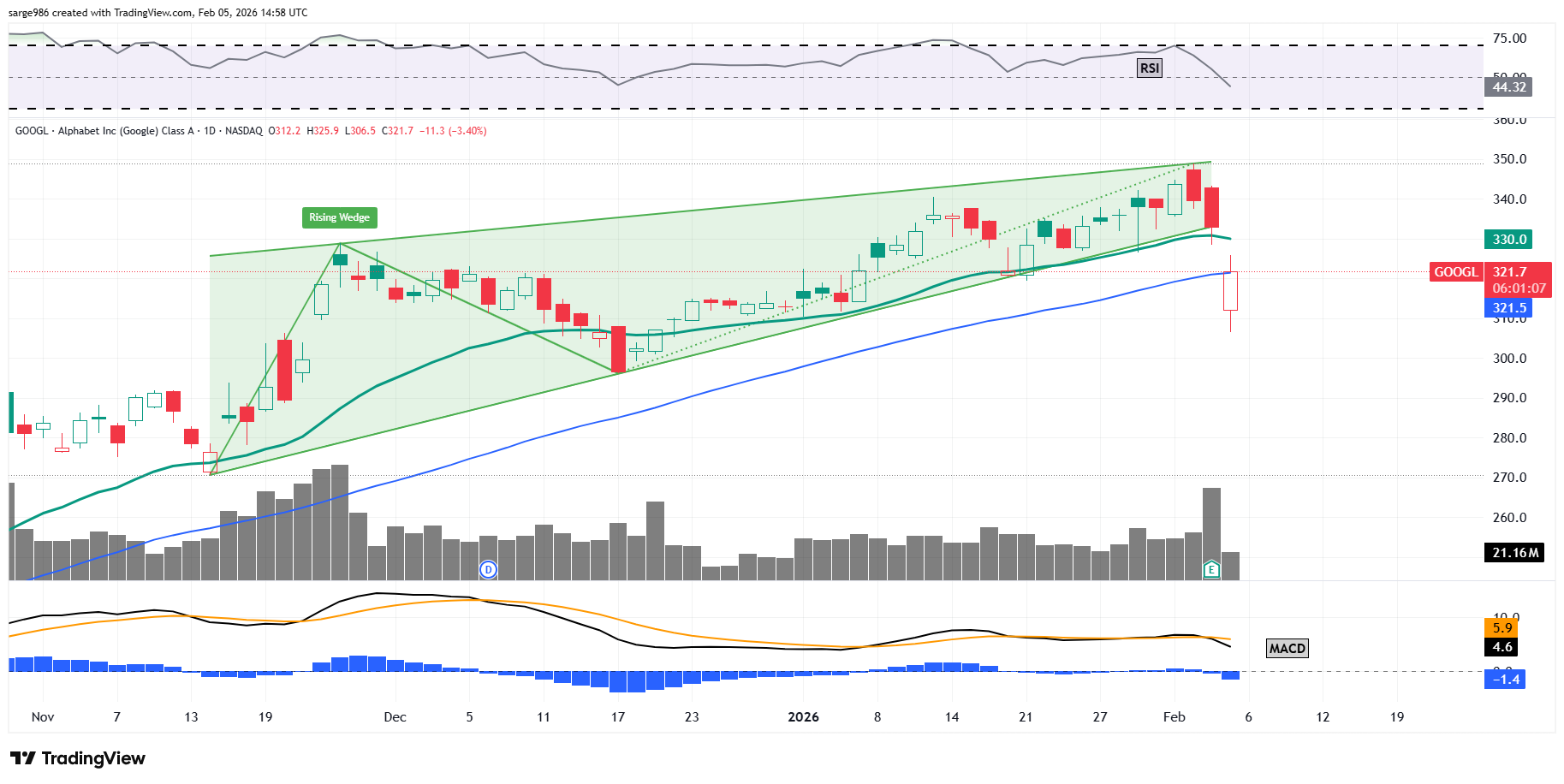
Readers will see that GOOGL has already experienced a sell-off coming out of the above rising wedge pattern of bearish reversal. The stock is trying already, after a 12% haircut from top to bottom, to retake its 50-day SMA. The indicators are not favorable at this time, but not truly awful.
If GOOGL can hang onto that thin blue line, I am back in this name by Thursday's end. If not, I give it another day or so. I do not act until I know whether or not that line will hold. Why? Because every portfolio manager on Wall Street is watching that line and I have no yearning to wind up on the wrong side of those capital flows.
At the time of publication, Guilfoyle had no positions in any securities mentioned.