EU Deal Benefits This 'Best in Class' Energy Name: Here's How to Play It
This news may very well change the stock's short-to medium-term future.
You've reached your free article limit
You've read 0 of 1 free Pro articles.
We had thought that, for the Trump administration, reaching a trade deal with the European Union would be this week's work, as if this week won't be busy enough. I mean all there is for the week ahead are negotiations with China, an FOMC policy meeting, and July Jobs Day on Friday. That doesn't even count the plethora of high-end corporate earnings releases, potential month-end mark-ups /re-weightings and the Major League Baseball trade deadline.
Are we ever thrilled that President Donald Trump and European Commission President Ursula von der Leyen sat side by side on Sunday afternoon and announced that the U.S. and EU had reached an agreement on trade palatable to both sides, thus avoiding what could have been a nasty environment between the two. The EU just happens to be, in aggregate, the largest trading partner the U.S. has.
What we learned was that the U.S. would set a baseline tariff of 15% on imports from the EU. There will also be a 15% tariff on U.S. exports to the EU. This will include automobiles, and this tariff will not stack upon, but replace other tariffs already in place. Certain categories of products will be exempt from any tariff at all moving in both directions such as aircraft, aircraft parts, semiconductor equipment, chemicals, pharmaceuticals and agricultural goods.
The Best Part
There was more good news for U.S. companies. A major part of this deal, in an effort to level the playing field as there have been other non-tariff trade barriers in the past, is the EU has agreed to purchase $750 billion worth of U.S. energy goods such as crude oil and natural gas, as well as an additional $600 billion worth of investment into the U.S. above current levels.
The energy purchases are seen as something of a shot against Russia, as crude oil and natural gas are to a great degree, where Russia's GDP comes from. This also frees much of Europe from relying upon an unfriendly neighbor for their winter heating needs. A significant portion of the $600 billion will be spent on defense.
On Defense
Defense and Aerospace names, after initially popping on the news, have been hit since the opening bell with some actual profit-taking. Interested parties who have been waiting to get into these names may want to look for an opening to get into names that have run and may have gotten away from them.
When I think what our European allies will be spending some dough on, I think of drones, or unmanned military aircraft. That means Kratos Defense & Security Solutions KTOS, which I am already long, AeroVironment AVAV and Red Cat Holdings RCAT.
Of course, there will be purchases of fighter aircraft and tanks. That's Lockheed Martin LMT, Boeing BA and General Dynamics GD, but more important will be purchases of missiles and missile defense capabilities. The undisputed leader there, outside of hypersonics, in my opinion, is still RTX RTX.
More Opportunity?
As many aerospace and defense stocks are at places on their charts where profit-taking makes some sense, many of the energy names that will now benefit from this deal, do not have impressive charts like that. Many of these names are better set up for a rally and unlike many of the above-mentioned defense stocks, are trading higher.
I'm thinking of liquefied natural gas stocks such as Cheniere Energy LNG, Venture Global (VG), NextDecade NEXT and New Fortress Energy NFE. These names, so far, are up more than mere producers of natural gas such as Range Resources RRC or Coterra Energy CTRA or big integrated oil and gas names such as Chevron CVX and Exxon Mobil XOM.
Let's return to those liquefied natural gas names. NEXT and NFE are probably more suited to my 'Stocks Under $10' column. That leaves LNG and VG and of those two, I don't think there is much argument that LNG, or Cheniere, is best in class.
Cheniere Energy
Cheniere is a Houston, Texas-based operation whose business is the production and export of liquefied natural gas. It operates two liquefaction and export facilities, one at Sabine Pass, Louisiana and the other near Corpus Christi, Texas. The company also owns and operates a 94-mile pipeline that interconnects the facility at Sabine Pass to a number of other larger interstate and intrastate pipelines.
Cheniere is expected to report its second-quarter earnings on Thursday, August 7, ahead of the opening bell. Wall Street is looking for adjusted EPS of $2.42 on revenue of about $4.3 billion. This would compare well to $1.60 for the year-ago period on top-line growth of more than 32%.
For the trailing 12 months, as of the March quarter, Cheniere had generated operating cash flow of $5.376 billion and free cash flow of $3.165 billion. As for the balance sheet, the current situation is fine. Both the current and quick ratios are healthy. That said, like many energy firms, the company has a tough-looking long-term debt-to-cash ratio.
The shares trade at "just" 20 times forward-looking earnings, which is inexpensive relative to the S&P 500. Cheniere also pays shareholders $2 a year per share, which works out to a yield of just 0.9%.
The Chart
Cheniere has been trading in a defined range. Check this out:
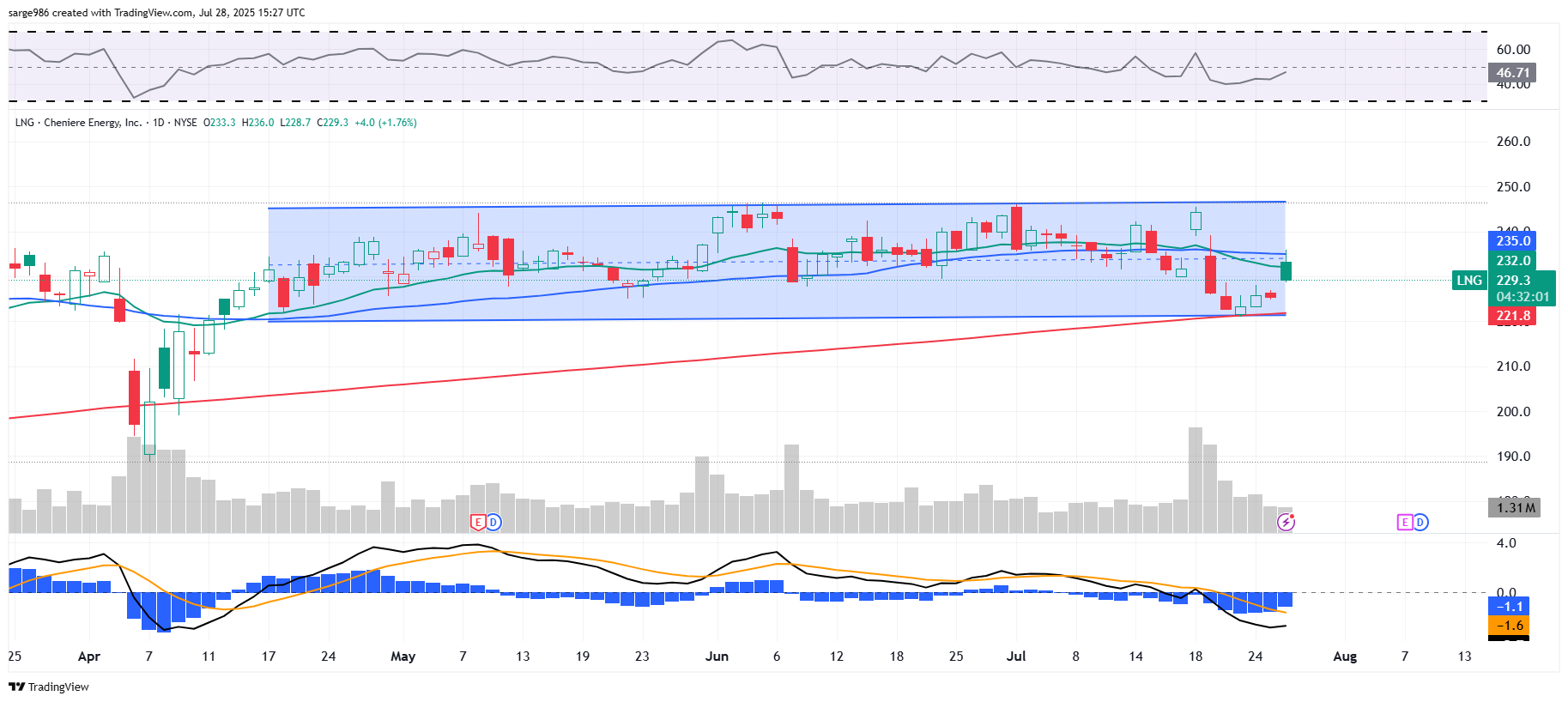
We don't see as many of these as we used to. This is called either a "flat base" or a "period of consolidation." Others might just say the stock is range-bound.
Readers will see that Relative Strength is sub-par. Readers might also see that the daily MACD (moving average convergence/divergence) is in awful shape. The histogram of the 9-day exponential moving average (EMA) is well below zero. The 12-day and 26-day EMAs are both well into negative territory with the 26-day EMA on top. That's a really bearish setup.
Then again, this news may very well change the stock's short-to medium-term future. There are other interesting developments. Support has been met at the 200-day simple moving average (SMA), meaning that institutional managers defended the stock at the level they had to. This line also coincides with the lower support line for the flat base.
The stock has also hit resistance at the 50-day SMA this morning. That means that the same professional managers that bought the stock at the red line, sold it at the blue line. Easy peasy. That makes it easier for me too.
When do I buy the stock? On a break above the 50-day SMA, which is now $235.
Where do I get short? On a break below the 200-day SMA, which is currently $222.
The plan? Day trade in between the levels. Bet bigger on a break of either level. Buy low, sell high? In 2025, it's often a safer play to bet on algorithmic overshoot once a technical level cracks.
At the time of publication, Guilfoyle was long KTOS, RTX equity.