Eli Lilly Stock Makes Surprise Move After Posting 'Video Game' Numbers
Investors are selling off the pharma giant after a promising weight loss drug underwhelms in initial results.
You've reached your free article limit
You've read 0 of 1 free Pro articles.
Readers will recall Eli Lilly LLY well.
The stock had been one of the Sarge-folio's hottest names throughout the years 2023 and 2024. We missed the very top, exiting with an average in the mid $770s, if I recall correctly without going through my records. Three-figure percentage returns are never anything to sneeze at, even if one could have done considerably better.
That said, the stock has been trading lower for about 12 months now, gave up 2.56% on Wednesday ahead of earnings, and is all over the place on Thursday morning. I last saw LLY down a rough 6.7% in pre-opening trade, as I write this piece, but that last sale has been both much higher and much lower. Our question now is: Do we get back in at these levels?
Eli Lilly released the firm's second quarter financial results on Thursday morning. For the three-month period ended June 30, Lilly posted an adjusted EPS of $6.31 (GAAP EPS: $6.29) on revenue of $15.56 billion. These top- and bottom-line numbers both crushed Wall Street's expectations, while the revenue print was good enough for year-over-year growth of 37.7%. Really an outstanding quarter.
CEO David A. Ricks commented in the press release: "Lilly delivered another quarter of strong performance, achieving 38% year-over-year revenue growth driven by robust sales of Zepbound and Mounjaro and sustained momentum across our key medicines. Our pipeline continued to advance, highlighted by positive study results in oncology and cardiometabolic health — including Mounjaro's demonstrated cardio-protective effects in patients with type 2 diabetes and heart disease and strong data for our oral incretin, orforglipron, in obesity. We also expanded manufacturing capacity to meet increasing demand and invested in key R&D initiatives to support our long-term growth."
The Quarter
As revenue grew 37.7% year over year, net income grew 91%, and adjusted net income grew 60%. Mounjaro sales were up 68% from the year-ago period and are up 85% year to date. Sales of Zepbound were up 172% from the year-ago period while a year-to-date comparison is not relevant. These are video-game type numbers.
Guidance
For the full year, Lilly increased its projection for revenue generation to $60 billion to $62 billion from previously-issued guidance of $58 billion to $61 billion. This nearly takes the low end of the range up to the Wall Street consensus view for $60.1 billion. Performance margin is seen at 42% to 43.5% as reported or an adjusted 43% to 44.5%.
That too is an upward revision of prior guidance. GAAP EPS is now seen at $20.85 to $22.10, up from $20.17 to $21.67. Adjusted EPS is now seen at $21.75 to $23.00, up from $20.78 to $22.28. This also tales the midpoint of the range well above the $21.98 or so that Wall Street had in mind.
So, What Gives?
With a quarter and updated guidance like that, why are investors selling shares heavily of late and especially on Thursday morning?
For one, President Trump is pressuring the industry on what he sees as unfair drug prices. American patients pay much more for drugs sold at the retail level than do patients in other developed nations. The president is also threatening tariffs of 150% to 250% on the entirety of American "Big Pharma" for manufacturing their products elsewhere and then importing them into the U.S. Lilly does manufacture its therapeutics in the U.S., but also in China, Germany and Ireland.
Lastly, we have the story of Lilly's oral weight loss candidate "Orforglipron" which is something the marketplace had high hopes for. Current "wonder" drugs that combat both obesity and diabetes are not oral in nature, which would be highly convenient. Those drugs are administered with a needle to the belly. A simple pill for weight loss would be a hot item. Ahead of these earnings, Phase 3 trials for this new candidate indicated that it caused weight loss of up to 11% over 70 weeks. That was seen as underwhelming by investors.
The Chart
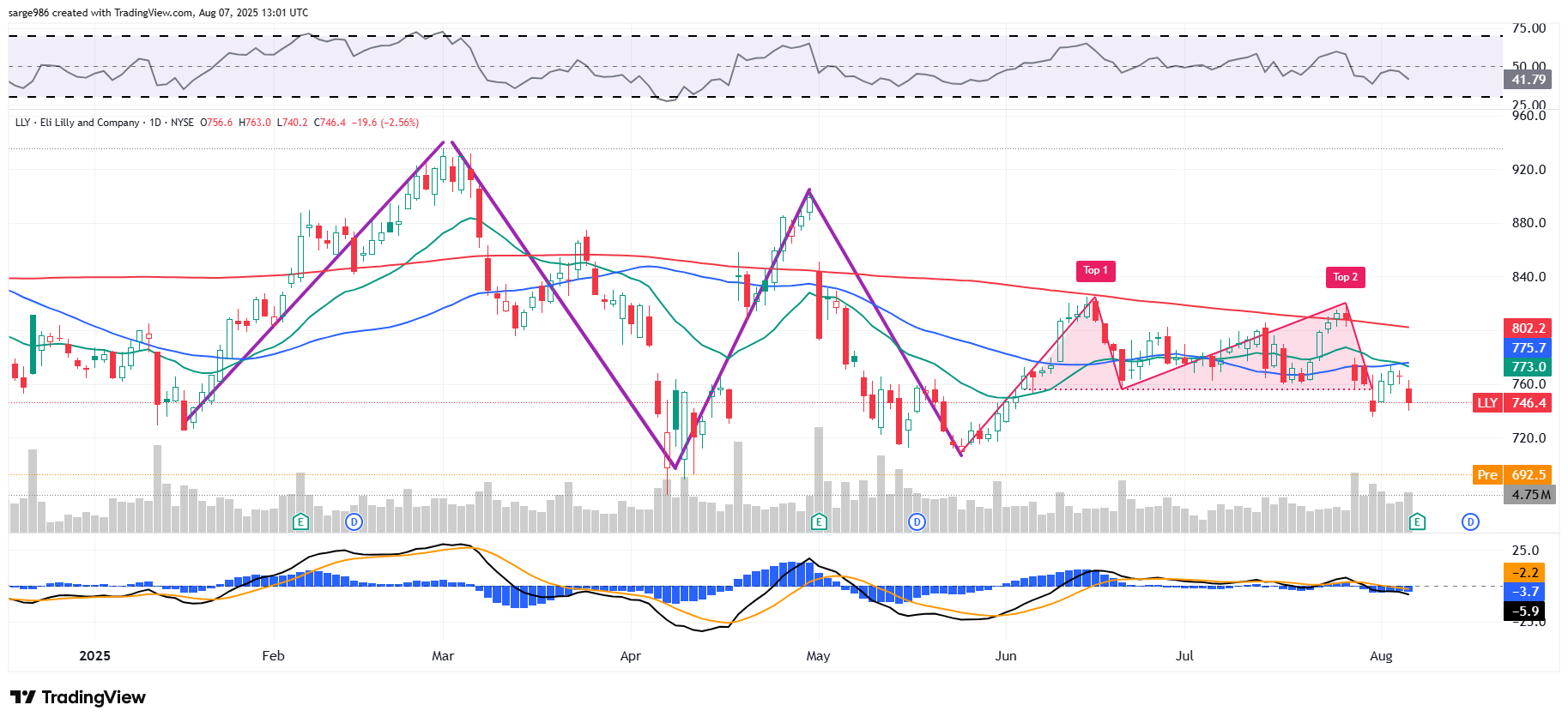
Readers will see that LLY appeared to be developing a large pennant formation earlier this year. That is lower highs coupled with higher lows that culminate in difficult to predict explosive move as the pattern closes. Something changed, starting with early June. The stock then developed a double top pattern of bearish reversal. That pattern is easier to predict, and this one had a $755 downside pivot that has obviously been triggered.
Had I recognized this pattern ahead of time, which I did not, I would have likely had a downside target of something close to $679 based on how my models work. I see the shares trading in the $690s now but have traded as low as $637 all ahead of the opening bell. Not only has the trigger been pulled, but my hypothetical target has also already been satisfied. The stock lost its 50-day and 200-day SMAs in mid-July, so much of the professional money that was going to get out, has gotten out.
Short answer? LLY will be a great trading vehicle today and probably for the short-term. So, buy the dip? If the intraday indicators say so, then sure. Mind your risk profile. Heed the 8% rule. You know the drill. See what my young pal Dougie Kass has been doing over at his Diary on Thursday morning. He is great at this sort of trading.
As far as buying the dip as an investment is concerned? You did read the "What Gives" section, right?
At the time of publication, Guilfoyle had no positions in any securities mentioned.