Does Oracle's $50 Billion Raise Announcement Change Things?
I'm closer to initiating a position on the Oracle bandwagon after a strong move.
You've reached your free article limit
You've read 0 of 1 free Pro articles.
Do Band-Aids help?
Then again, that's some Band-Aid.
On Sunday, Oracle (ORCL) announced plans to raise $45 billion to $50 billion during this calendar year to build out and develop additional capacity for the firm's AI-focused cloud infrastructure business. Oracle, chaired by Trump ally and founder, Larry Ellison, who at 81 years of age is still the company's chief technology officer, will meet these funding needs through offerings of common stock, offerings of a blend of equity-linked derivatives and adding more debt.
Regular readers know how I feel about Oracle's balance sheet. For those, who don't, I will get into that.
Why would Oracle further extend its already weak fiscal situation? Simple. The firm's largest and best-paying customers such as Advanced Micro Devices (AMD) , Meta Platforms (META) , Nvidia (NVDA) , OpenAI and Elon Musk's xAI have contracts with the firm and the firm has to meet this huge demand. A good problem to have. A difficult problem to solve. The stock is popping on the news.
In Addition...
Analyst Derrick Wood of TD Cowan, who is rated at four stars (out of five) at TipRanks, predicted that Oracle will soon consider layoffs in order to reduce pressure on operating and free cash flows.
Wood has been something of a perma-bull when it comes to ORCL. He has a "Buy" rating on the shares with a $350 target price and has had a buy on the whole way down from it's $345.72 apex in mid-September. On Friday, ORCL closed down 52.4% over that time frame.
Looking Back at the Fundamentals
For the most recent (November) quarter that we have the numbers for, Oracle generated operating cash flow of $2.066 billion. "Out of that number" came capex spending of $12.033 billion, leaving free cash flow of -$9.967 billion. Despite a remarkably negative print for free cash flow, Oracle still paid out $1.435 billion in cash dividends to shareholders.
Looking at that November balance sheet, Oracle ended the period with a cash position of $19.766 billion and current assets of $34.366 billion. Current liabilities added up to $37.795 billion including shorter-term debt of $8.091 billion but also deferred revenue of $9.94 billion (which is not a true financial obligation). That put the firm's headline current ratio (at that time) at a sub-par 0.91. Once adjusted for those deferred revenues, this ratio rises to an acceptable 1.16.
Total assets amounted to $204.984 billion including $65.967 billion in goodwill and other intangibles. At almost 32.2% of total revenue that's a little bit on the high end of my comfort zone, but not awful. Total liabilities less equity came to $174.527 billion. That included a jaw dropping $99.984 billion in long-term debt and no non-current deferred revenues. While those numbers dwarf the firm's cash position, they also raise doubts over the legitimacy of the legitimacy of the $523 billion in remaining performance obligation that the firm has been boasting about.
The Chart
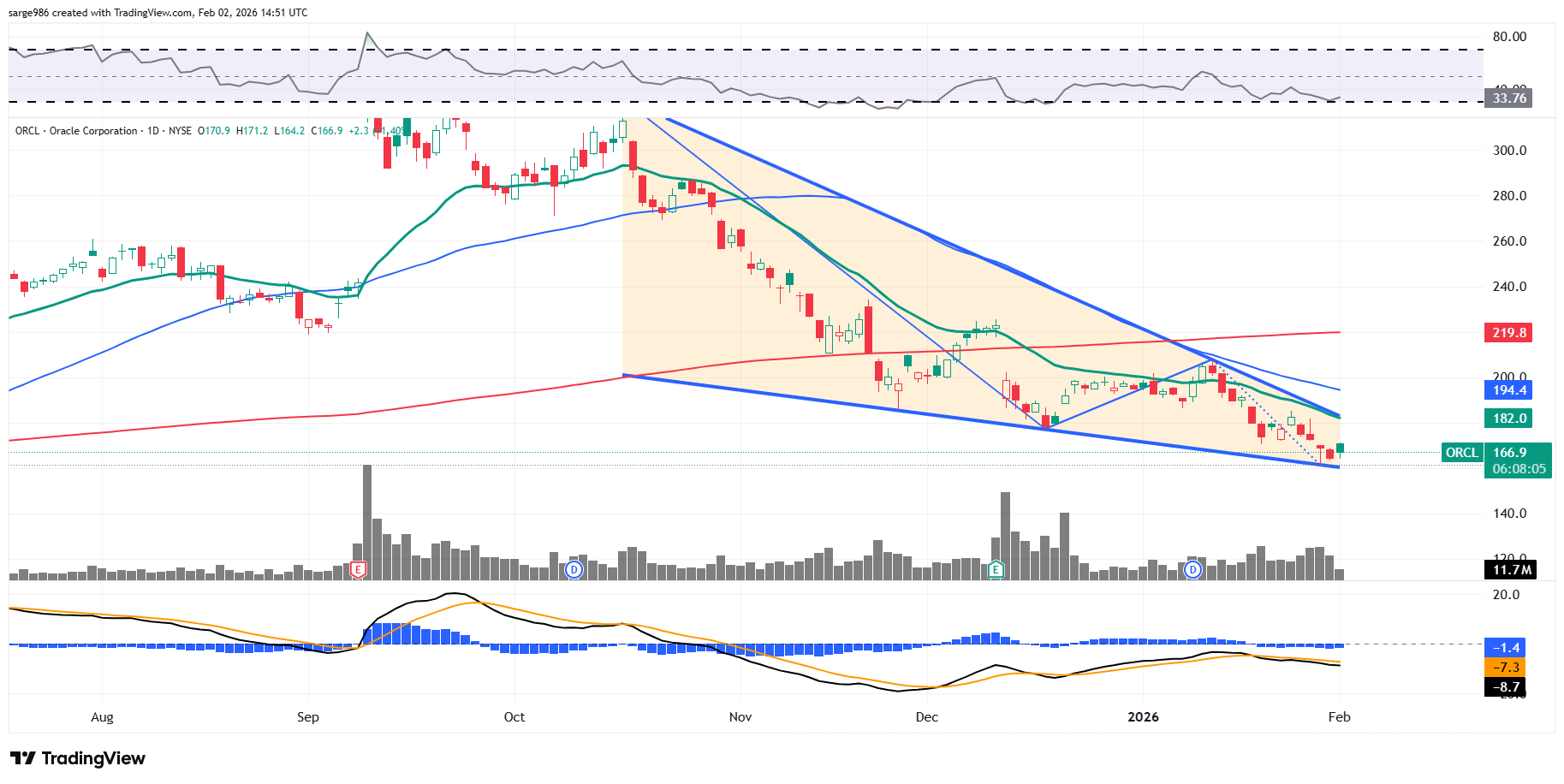
Is it time to finally jump on the ORCL bandwagon that I have been warned against initiating for months? We may be getting close. Readers will see the falling-wedge pattern of bullish reversal. I don't know if Monday morning's rally is the same thing, but we may be getting close. That wedge is closing. See that upper trendline of the wedge and the 21-day EMA running concurrently with each other. That's the pivot for now. That's where the swing crowd will engage.
The pros, however, are likely to sit on their hands until they think there will be at least a run at the 50-day SMA. Relative strength remains weak. The daily MACD remains bearish in posture. No, I do not think that it is time to get long ORCL for an investment. With fundamentals like that, this name is a long way from being suitable for careful investors. That said, for traders, while not yet time to own the shares, it is time to put ORCL back on our watchlists.
At the time of publication, Guilfoyle was long AMD.