CVS Health Appears to Reach Consolidation After Earnings
Is there a compelling trade idea for the healthcare retailer?
You've reached your free article limit
You've read 0 of 1 free Pro articles.
On Tuesday morning, CVS Health (CVS) released the firm's fourth quarter financial results. For the period ended December 31, 2025, CVS posted an adjusted EPS of $1.09 (GAAP EPS: $2.30) on revenue of $105.693 billion. These top- and bottom-line numbers all beat expectations quite handily, as that revenue print was good enough for year-over-year growth of 8.2%.
On the quarter, CEO David Joyner commented in the press release:
"Our fourth quarter and full-year results demonstrate the progress we are making in transforming the health care experience with our unique collection of businesses. From lowering drug prices, to improving navigation of health care, to being the front door of care across our country, we are well positioned to achieve our ambition to be the most trusted health care company in America."
Operations
We already know that revenues ramped 8.2% to $105.693 billion. Breaking sales down, product-driven sales grew 8.3% to $67.042 billion, premiums grew 10% to $34.017 billion, services-driven sales printed at $4.04 billion (-2.2%) and net investment income contracted slightly to $594 million. GAAP costs and operating expenses expanded by 8.6% to $103.581 billion, leaving a GAAP operating income of $2.112 billion (-10.8%).
After accounting for interest, other income and expenses and taxes, GAAP net income attributable to CVS shareholders printed at $2.943 billion (+79). That works out to $2.30 per fully diluted share, up from $1.30 for the year-ago comp. After adjusting primarily for a $1.928 billion tax benefit that alone amounted to $1.51 per share as well as for the amortization of some intangibles, net income landed at $1.387 billion (-7.9%) or $1.09 per share versus the year ago comparison of $1.19.
Segment Performance
- Health Care Benefits Segment generated revenue of $36.293 billion (+10.1%), producing an adjusted operating income/loss of -$676 million (down from -$439 million) as the medical benefit ratio held firm at 94.8%.
- Health Services Segment generated revenue of $51.244 billion (+9%), producing an adjusted operating income of $1.923 billion (+9.2%) as pharmacy claims processed dropped by 1.5%
- Pharmacy & Consumer Wellness Segment generated revenue of $37.66 billion (+12.4%), producing an adjusted operating income of $1.911 billion (+8.7%) as the number of prescriptions filled grew 6.3%.
Fundamentals
For the full year completed, CVS generated operating cash flow of $10.639 billion. Out of that came apex spending of $2.832 billion. This left free cash flow of $7.807 billion. Out of that number, the firm paid out cash dividends of $3.397 billion to shareholders.
Turning to the balance sheet, CVS ended the period with a cash position of $10.598 billion and inventories of $19.246 billion. That put current assets at $74.714 billion. Current liabilities amount to $88.692 billion including $4.068 billion in shorter-term debt. This is not as awful as it looks.
The firm has $32.669 billion in "long-term" investments that could be considered part of the cash position. Including those investments, the firm's current and quick ratios would stand at 1.21 and 0.99. Those ratios then actually do pass muster.
Total assets amount to $253.538 billion, which includes $110.986 billion in assets labeled as either goodwill or other intangibles. At almost 44% of total assets, I do not love this. Total liabilities less equity comes to $178.156 billion including $60.502 billion in long-term debt. That's a lot, but with a cash position that could be $43.267 billion, it's not quite as awful as it looks. Don't get me wrong. This is not a strong balance sheet, but it's not a PepsiCo (PEP) level train wreck either.
Opinion
These results are not bad. The balance sheet is "meh." Cash flows are solid. Profitability is solid, but in decline without the assistance of some tax benefits. Fundamentally, there is nothing to love or hate here.
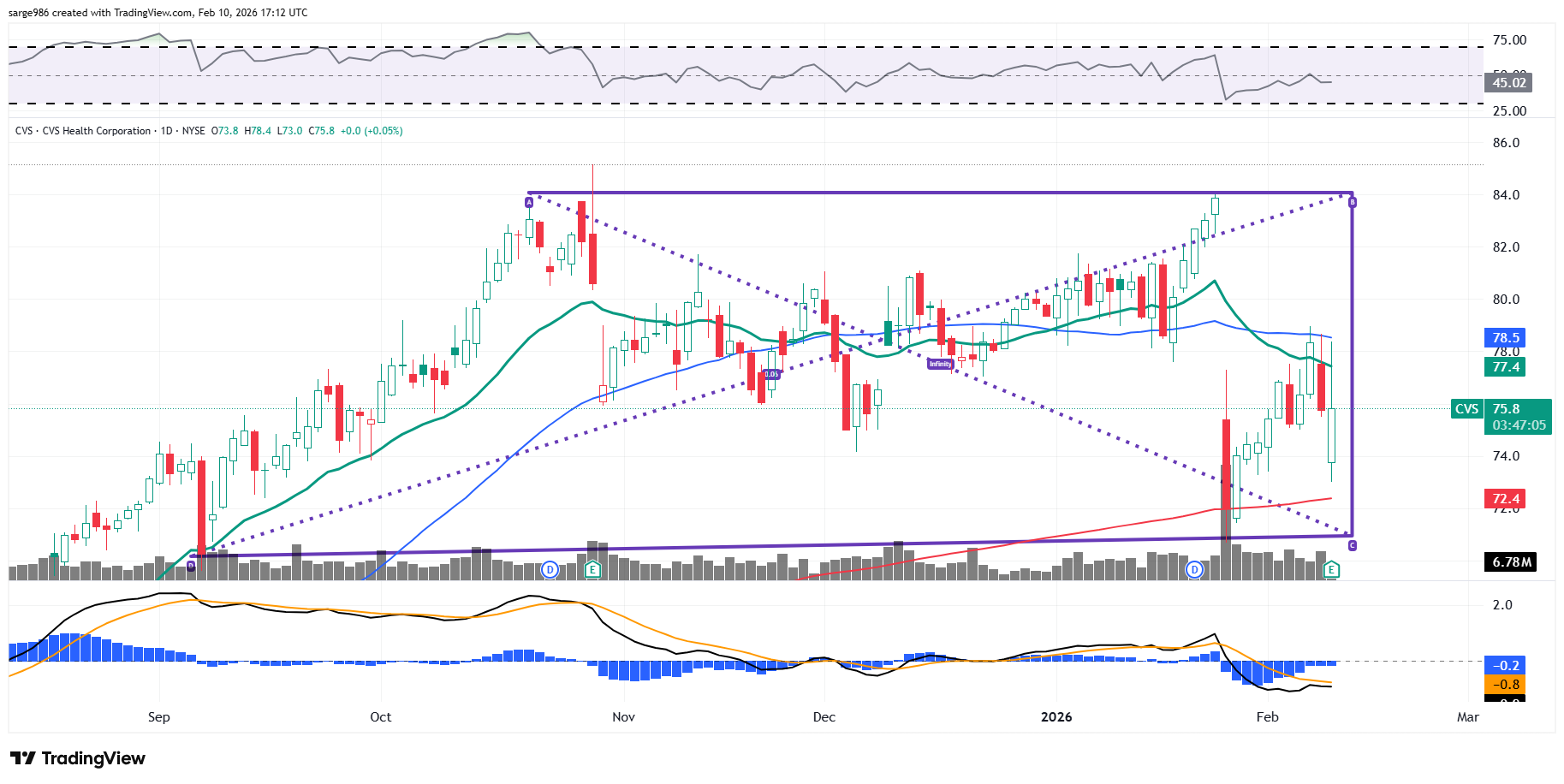
I think we see a basing period of consolidation here. The stock has found support rapidly both times that the 200-day SMA had been pierced to the downside. That means that we likely know where the institutional buyers are. The daily MACD is postured bearishly, but relative strength is close to neutral territory.
I don't want to buy this stock here. I would be more tempted to either initiate the stock close to that 200-day line (about $72.40) or go out a month and sell March 20 $72.50 puts for about $1.40 than I would be to buy the equity close to the current last sale.
At the time of publication, Guilfoyle had no positions in any securities mentioned.