CoreWeave Turns in Disgusting Report But Nvidia Can Keep it Afloat
I wouldn't buy this stock with your money.
You've reached your free article limit
You've read 0 of 1 free Pro articles.
On Thursday evening, cloud computing and large-sale AI infrastructure provider CoreWeave (CRWV) released the firm's fiscal fourth quarter financial results.
The firm, which is backed by Nvidia (NVDA) , is a primary partner of OpenAI and counts Microsoft (MSFT) , Meta Platforms (META) and IBM (IBM) among its key customers, more or less, fell flat on its face.
For the period ended December 31, 2025, CoreWeave posted a GAAP EPS of -$0.89 on revenue of $1.572 billion. While that revenue print was good enough for explosive year-over-year growth of 110%, it barely met expectations. Additionally, that bottom-line number fell a country mile (maybe more) short of what Wall Street had in mind. Clearly, demand is strong, but the cost of doing business is a concern for investors.
Chairman and CEO Michael Intrator commented:
“2025 was a defining year for CoreWeave as we became the fastest cloud in history to reach $5 billion in annual revenue. Demand continues to intensify as a broader set of customers adopt CoreWeave Cloud to run a diverse and growing set of workloads. The opportunity ahead is significant, and we are ready to capture it.”
Operations
As revenue generation popped for growth of 110.2% to $1.572 billion, operating expenses increased a incredible 162% to $1.661 billion. That left the firm with a GAAP operating income/loss of -$89 million, down from the year-ago comparison of $113 million. That took the firm's GAAP operating margin from 1% a year ago down to -6% for this period. Even after adjustments (mostly for stock-based compensation), operating margin dropped from 16% to 6%. Once interest, other income and expenses and taxes are accounted for, GAAP net income/loss printed at -$452 million, down from -$51 million. This worked out to -$0.89 per fully diluted share, versus the year ago-comp of -$0.34.
Guidance
For the full year just started, CoreWeave sees revenue of $12 billion to $13 billion, but for capex spending of $30 billion to $35 billion. You read that right.
The company is, however, projecting an annualized run rate of $17 billion to $19 billion in revenue by year's end and over $30 billion by 2027.
Fundamentals
Over the three-month period, CoreWeave did generate operating cash flow of $1.559B billion. Out of that number came capex spending of $4.06 billion. This left free cash flow of -$2.501 billion. Yikes. Obviously, the firm is in no position to return capital to shareholders.
Turning to the balance sheet, CoreWeave ended the quarter with a cash position of $3.98 billion and current assets of $7.488 billion. Current liabilities add up to $16.44 billion (not kidding). Of that, shorter-term debt makes up $6.708 billion. Deferred revenue, which is not a true financial obligation, makes up $1.709 billion. That puts the firm's adjusted current ratio at an absolutely awful 0.51. On top of that, the firm will be forced to refinance an incredible amount of debt this year unless helped out by one of their benefactors.
Total assets amount to $49.302 billion, of which intangibles are not material. Total liabilities less equity comes to $45.967 billion. This includes longer-term deferred revenue of $6.476 billion, but also longer-term debt of $14.665B billion. In all honesty, this is one of the poorest looking balance sheets I have ever had the misfortune of looking at. This pitiful excuse for a balance sheet is just disgusting.
Opinion
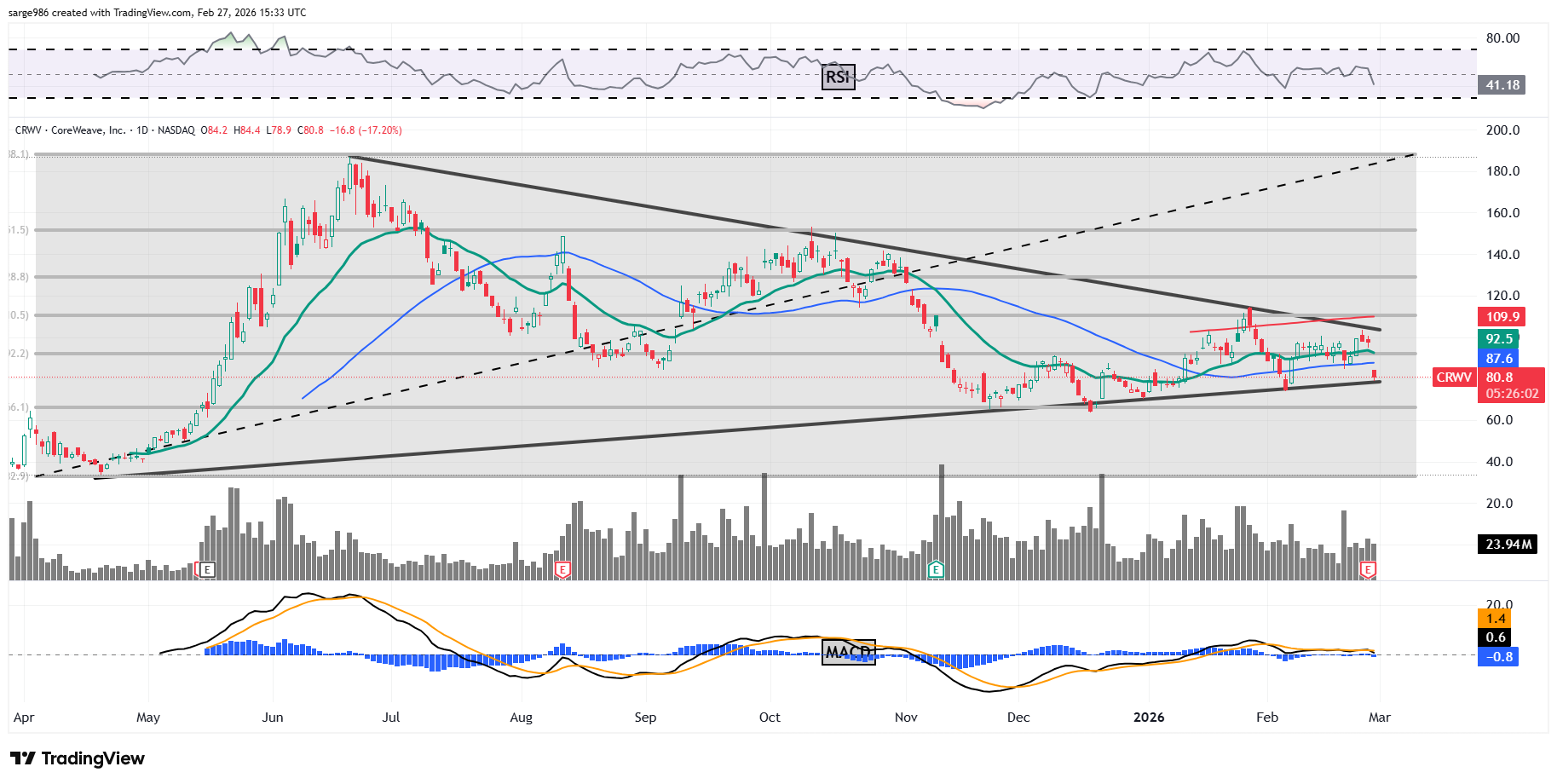
Readers will note a 10-month long closing triangle that implies a volatile move ahead. Friday's move did not break the triangle, so my guess is that this is just the start of a period of significantly increased mayhem for this name. A Fibonacci model going back over that time frame shows that the 78.6% retracement level of the April 2025 into June 2025 rally is where likely support actually is. That level is way down around $67 on this chart.
Listen, things could change. Right now, this is a train wreck, but if Jensen Huang wants these guys around, they're going to be around. That said, I have absolutely no interest in buying the dip in a stock whose statements of cash flow and balance sheet causes me pain to read. I wouldn't buy this stock with your money, even if you beat me up in high school (I probably beat you up in high school, but you know what I mean).
At the time of publication, Guilfoyle was long NVDA equity.