Cisco's Run Looks to Be Finished After Earnings Report
My two cents on the firm's stock chart after its second quarter financial results.
You've reached your free article limit
You've read 0 of 1 free Pro articles.
On Wednesday evening, Cisco Systems (CSCO) released the firm's fiscal second quarter results.
For the three-month period ended January 24, Cisco posted an adjusted EPS of $1.04 (GAAP EPS: $0.80) on revenue of $15.349 billion. These top- and bottom-line numbers all beat expectations, while that sales print was good enough for year-over-year growth of 9.7%. Earnings grew faster than expected and much faster than projected.
So, why is the stock trading 7% lower overnight? According to the media, adjusted gross margin fell short of what had been priced in. Is that a good reason for this kind of sell off? Let's figure that out, shall we?
Operations
We already know that sales increased 9.7% to $15.349 billion. Within that number, product-driven sales grew 13.8% to $11.642 billion, while services-driven sales contracted 1.3% to $3.707 billion. The cost of those sales came in a little high, at $5.377 billion, leaving gross profit of $9.972 billion, good for a gross margin of 65%. After adjustments, the cost of sales drops to a still above expectations $4.992 billion, leaving a non-GAAP gross margin of 67.48%, about 65 basis points below what Wall Street was looking for.
GAAP operating expenses crossed the tape at $6.191 billion, leaving a GAAP operating income of $3.781 billion. This was good for an operating margin of 24.6%. After adjustments, operating income printed at $5.311 billion, good for an operating margin of 34.6%, far better than the 34.3% that Wall Street had supposedly priced in.
After accounting for interest, other income and expenses and for taxes, GAAP net income landed at $3.175 billion (+30.8%). This works out to $0.80 per fully diluted share compared to $0.61 for the year-ago comp. Adjusted net income printed at $4.1 billion (+7.9%) or $1.04 per fully diluted share. That was up from the year-ago comp of $0.94.
For those about to ask, the largest adjustments were made for share-based compensation and the amortization of acquisition-related assets. I've said it before and I'll say it again: If you are a mature company and share-based compensation is something you adjust for every quarter, grow up. Just stop. Cisco went public in 1990. That's 36 years. This is an ordinary operating expense by now. Enough pretending.
Geographical Performance
- Americas generated revenue of $8.845 billion (+8%), producing a gross margin of 65.8%
- EMEA (Europe, Middle East, Africa) generated revenue of $4.425 billion (+15%), producing a gross margin of 71.7%
- APJC (Asia Pacific, Japan, China) generated revenue of $2.08 billion (+8%), producing a gross margin of 65.8%
Sales Performance
- Networking generated revenue of $8.8294 billion (+21%)
- Security generated revenue of $2.018 billion (-4%)
- Collaboration generated revenue of $1.054 billion (+6%)
- Observability generated revenue of $277 million (flat)
- Services generated revenue of $3.707 billion (-1%)
Guidance
For the current quarter, Cisco is projecting revenue of $15.4 billion to $15.6 billion, bringing the low end of the range above the $15.2 billion that had been expected. GAAP EPS is seen at $0.73 to $0.77, while adjusted EPS is seen at $1.02 to $1.03, which is in line with the $1.03 that Wall Street had in mind.
For the full fiscal year, the firm is projecting revenue of $61.2B to $61.7B, again bringing the low end of the range above consensus, which has been for $60.8B. GAAP EPS is projected at $3.00 to $3.08, while adjusted EPS is seen at $4.13 to $4.17. That took the mid-point of the range above the $4.13 that had been expected.
Fundamentals
For the period reported, Cisco generated operating cash flow of $1.822, which was well below estimates. Capex spending printed at $283 million, leaving free cash flow of $1.539 billion. While that is nothing to sneeze at, this number was down 24% year over year and fell more than $1 billion short of expectations. This is why the shares are really trading lower.
Out of that number, the firm repurchased $1.363 billion in common stock for the corporate treasury and another $784 million in common stock for tax withholding related to the vesting of restricted stock units. The firm also paid out to shareholders, cash dividends of $1.617 billion. Yes, there is clearly a cash flow management problem at Cisco.
Turning to the balance sheet, Cisco ended the quarter with a cash position of $15.777 billion and inventories of $3.92 billion. That brought current assets to $35.131 billion. Current liabilities add up to $36.786 billion. That includes short-term debt of $8.719B billion and deferred revenues of $16.199 billion. Those, by the way, are not true financial obligations.
At the headline, the firm's current and quick ratios workout to 0.96 and 0.85, respectively. While those numbers look a little wonky, once we adjust for those deferred revenues, these ratios improve to 1.71 and 1.52, in that order. These ratios pass muster.
Total assets amount to $123.371 billion, of which a stunning $67.541 billion is labeled as either goodwill or other liabilities. At 55% of total assets, I find that bordering on ridiculous. Total liabilities less equity comes to $75.648 billion, which includes long-term debt of $21.367 billion. This is not the strongest balance sheet in the world, but it certainly is functional and Cisco can certainly meet the firm's financial obligations.
My Two Cents...
I don't love the fundamentals. Cash flows are strong enough. The execs have to stop rewarding themselves to the degree that they are. My thinking is that the upside money has already been made in this stock.
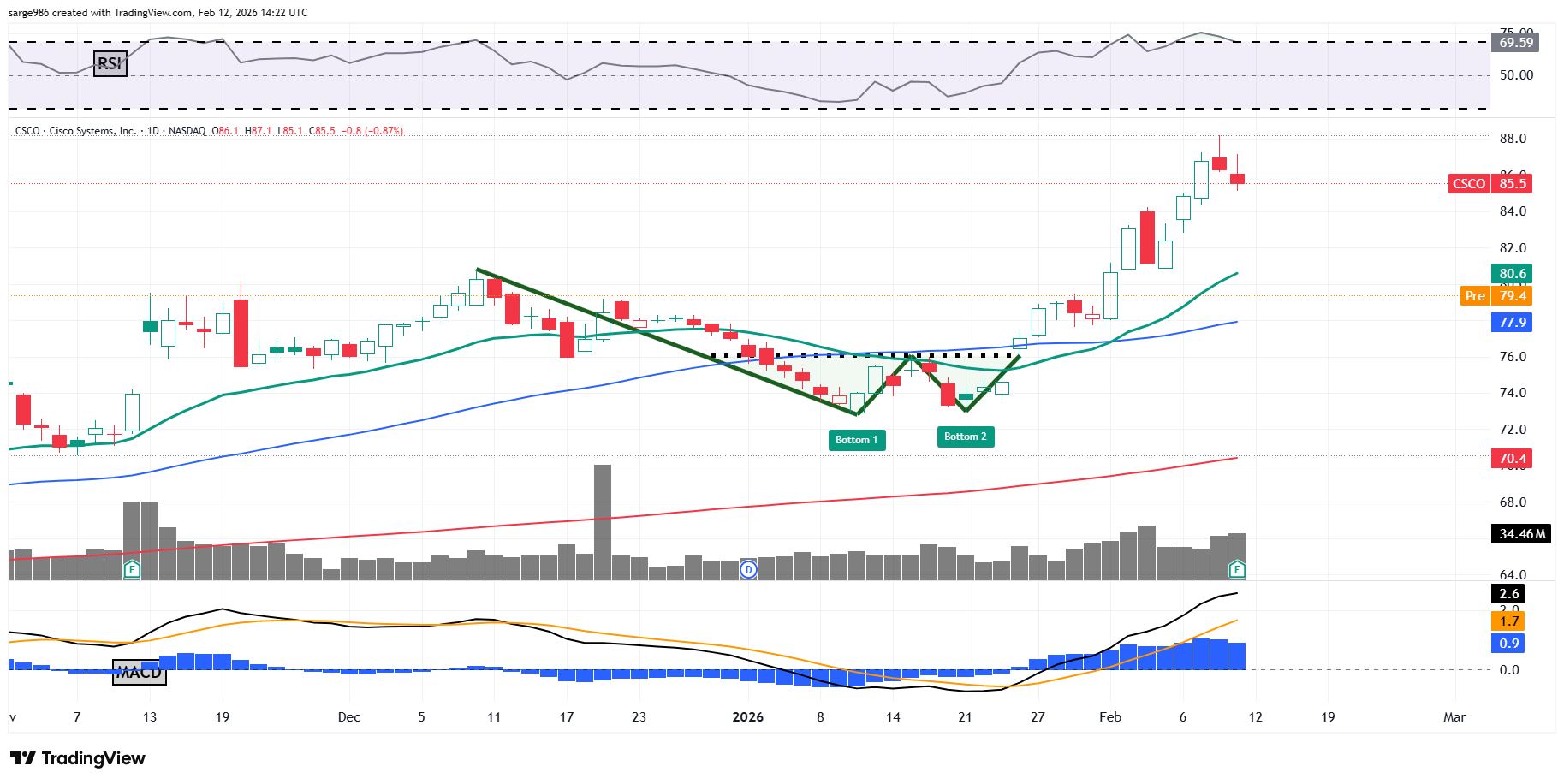
Readers will see that CSCO rocketed out of a double-bottom pattern of bullish reversal in early 2026, but that run looks to be finished. There will be a gap lower on the open, which could result in a test of the stock's 50-day SMA at $78. I believe that CSCO is probably a buy in between that 50-day SMA and the 200-day SMA at $70.
That is the range where I become an interested investor. Both relative strength and the daily MACD came into earnings too hot. I think we need to see these indicators soften up significantly before even considering entry.
At the time of publication, Guilfoyle had no positions in any securities mentioned.