CAVA Trade Idea After Stock Speed Bump Leaves Just One Positive Behind
The restaurant company fell short of expectations, but that might have opened up a lucrative trading strategy.
You've reached your free article limit
You've read 0 of 1 free Pro articles.
On Tuesday evening, CAVA Group CAVA released the firm's second quarter financial results. For the three-month period ended July 13, CAVA posted a GAAP EPS of $0.16 on revenue of $280.615 million. While the bottom-line print did beat Wall Street by about three cents per share, that top-line print fell short of expectations despite still being good enough for year-over-year growth of 20.2%.
The firm opened 16 new restaurants during the quarter, bringing the total of stores in operation to 398. Same restaurant sales grew 2.1%. Average unit volume for the period came to $2.9 million, up from $2.7 million for the year-ago comparison.
For readers who may have never heard of CAVA, the firm is a Mediterranean themed fast-casual restaurant chain, founded in Rockville, Maryland in 2006 and headquartered in Washington, DC. The firm acquired Zoe's Kitchen in 2018 and by May 2023 had closed all remaining locations of that restaurant chain, rebranding many of them as CAVA eateries.
Operations
As revenue for the quarter grew 20.2% to $280.615 million, total restaurant operating expenses increased 20.3% to $205.934 million. Total operating expenses altogether grew 20.1% to $260.97 million. That left operating income of $19.645 million (+21.7%) on an operating margin of 7%, up from 6.9%. After accounting for interest, other income and expenses and taxes, GAAP net income printed at $18.368 million (-7%). This works out to a GAAP EPS of $0.16, down from the year-ago comp of $0.17.
Guidance
For the full year, the firm now expects to open 68 to 70 new restaurants, up from prior guidance of 64 to 68. Same restaurant sales growth, was, however, taken down a notch from 6% to 8% to 4% to 6%. This is definitely impacting the stock negatively on Wednesday morning. Profit margin is expected to hold steady at 24.8% to 25.2%. The firm expects pre-opening costs to end up larger than expected, but did reaffirm guidance on adjusted EBITDA of $152 million to $159 million.
Fundamentals
For the first half of the fiscal year, CAVA has generated operating cash flow of $98.895 million. Out of that came capex spending of $76.994 million. This left free cash flow of $21.901 million (-20.1%). The firm does not return capital to shareholders.
Turning to the balance sheet, CAVA ended the period with a cash position of $385.783 million inclusive of current investments. Inventories came to $7.994 million, current assets at $418.537 million. Current liabilities add up to $153.707 million, which includes no short-term debt. That puts the firm's current ratio at a very healthy 2.72.
Total assets amount to $1.292 billion. This does include a very small level of intangible assets hardly worth mentioning. Total liabilities less equity comes to $540.925 million, which is mostly lease liabilities. There is no long or short-term debt on these books. This is a spectacularly well managed balance sheet.
My Thoughts
The firm has obviously hit a bump. Still, cash flows are positive, margins are holding up. Same store sales are pressured. That said, the balance sheet is a work of art. In theory, I find this company investable as long as a decent entry point can be found. Now, with the stock down more than 15%, let's take a look at the chart:
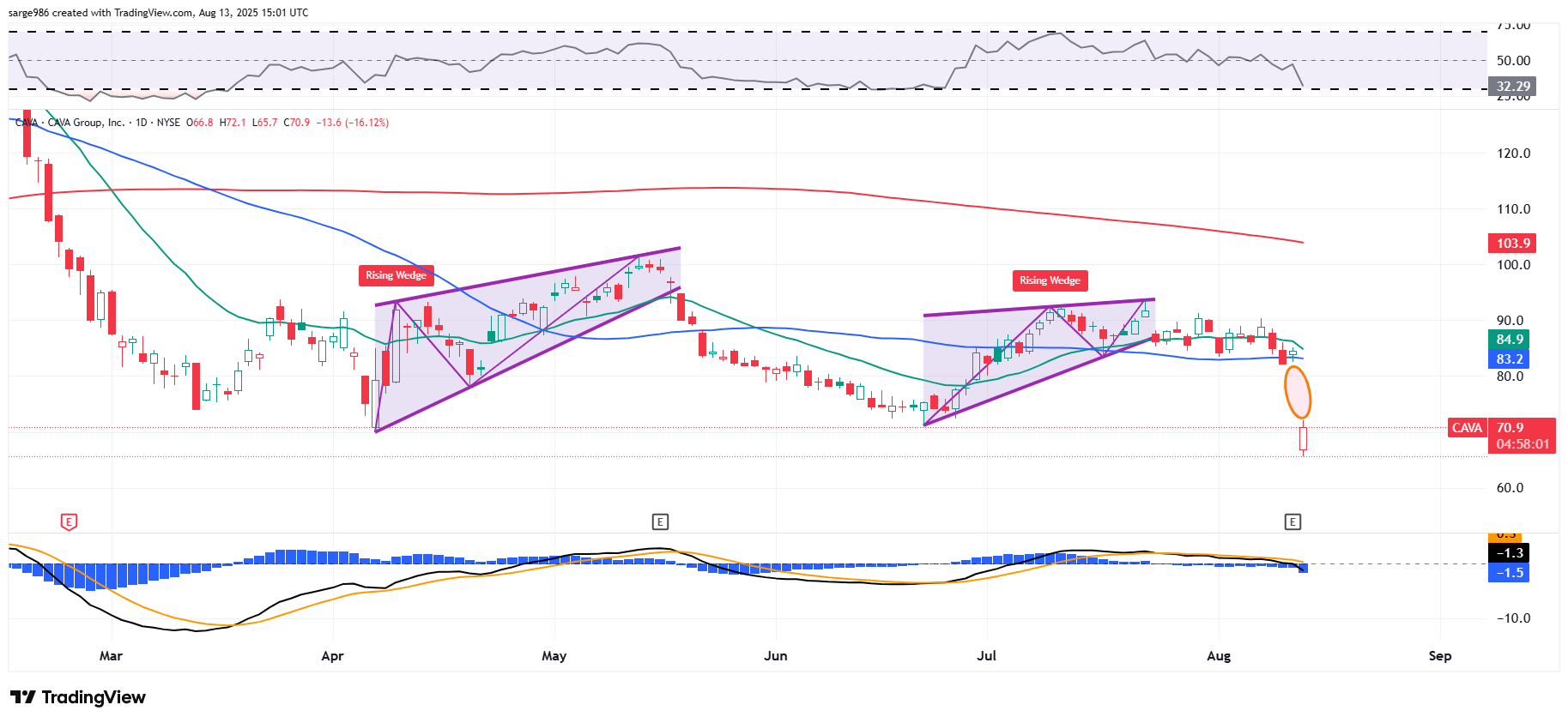
Readers will see that CAVA had developed back to back rising wedges of bearish reversal and that they both worked to precision for technical traders. Now, this breakdown is a bit more serious. The stock has now lost its 50-day SMA after losing its 21-day EMA. This will force portfolio managers to either exit the stock or reduce exposure as the 200-day SMA is nothing but a distant memory.
Both the stock's relative strength and daily MACD are weak and looking rather bearish. The one positive left behind is Wednesday morning's gap. We all know that unfilled gaps don't have to fill, but they usually do. It just can take a while. I would not buy the shares here. The shares still look expensive even at this discount.
One idea in my opinion would be to write November 21 (after Q3 earnings) $60 puts for about $3.25 and purchase November 21 $50 puts for about $1.10. This would pay the trader a net $2.15 if those strike prices are never reached. If they are reached, the trader may end up long the shares at a net basis of $57.85, but will have an escape valve should the shares fall below the $50 level by then.
At the time of publication, Guilfoyle had no positions in any securities mentioned.