Buying This AI Infrastructure Name After Reverse Merger
Nomad’s transportable battery systems could help data centers bridge the gap between power demand and grid infrastructure.
You've reached your free article limit
You've read 0 of 1 free Pro articles.

I expect Bitcoin and Ethereum to give us plenty to work with over the next several months. As I wrote on Monday, I am turning more bullish on crypto. On Wednesday, though, I am stepping away from crypto and returning to the stock market to talk about a small-cap company trying to bridge the gap between AI’s power needs and the grid’s ability to deliver.
AI doesn’t run on intelligence. It runs on electricity.
A $40,000 GPU with no power is a very expensive doorstop. A $1 billion data center that can’t get energized is a warehouse full of ambition.
The power bottleneck is not new. Utilities and large infrastructure users have wrestled with generation constraints, grid congestion and slow permitting for years.
What AI changes is the scale and urgency. Data centers are adding enormous loads on technology timelines, while transformers, substations, grid connections and new generation still move at infrastructure speed.
Jordi Visser has framed this as the physical layer of the AI buildout: power generation, grid capacity, transformers, cooling, permitting and labor. The opportunity is shifting beyond software toward the infrastructure required to make AI work in the real world.
That mismatch is the opportunity Nomad Power Solutions (NMAD) is chasing.
Nomad makes transportable, utility-grade battery systems that move by truck and deploy in under an hour. Permanent infrastructure can take years. Nomad can arrive on a Tuesday.
Gavin Baker, managing partner and CIO of Atreides Management, LP, describes the next phase of AI as a battle for “watts and wafers.” But the power constraint is not electricity in the abstract. It is power delivered at the right location when a data center needs it.
Imagine spending billions on GPUs and servers. Then someone tells you the substation will be ready in 2029.
Congratulations. You built the world’s most expensive waiting room.
Nomad says roughly 2.3 terawatts of generation and storage remain in U.S. interconnection queues, where projects can now take five to seven years or longer.
Because Nomad’s systems are mobile, they may be treated as equipment rather than permanent infrastructure, reducing many permitting obstacles.
But batteries do not generate electricity.
Nomad is not solving America’s power shortage. It is solving timing, reliability and location.
Its systems can provide backup power, shift loads, reduce peak demand, and bridge the gap until permanent infrastructure arrives. When billions of dollars of computing equipment sit idle, buying time has real value.
Nomad recently increased usable storage in its Voyager Eagle and Falcon systems by 56%, to 2.025 megawatt-hours, without increasing their footprint or deployment time. Its smaller Hawk increased capacity by 51%, to 1.0 MWh.
Commercially, the early numbers are promising. Management says revenue rose approximately 175% in 2025 and projects another 135% increase in 2026. It also reports more than 30 active customer opportunities, with roughly 75% of sales activity arriving inbound.
Nomad’s operating business only recently became public through a reverse merger, so investors have limited reporting history to work with. The key question is whether management can convert interest into orders, deliver on schedule, and scale without outrunning its capital base.
The merger consideration included nearly 3 million common shares, along with preferred stock convertible into approximately 50.4 million additional shares.
Dilution is inevitable in a reverse merger. Nomad’s owners were not going to contribute the business for free. The conversion is worth watching, but it should be viewed in context.
Lixte raised approximately $16.6 million in June and advanced $6.5 million to Nomad before closing to repay debt and fund working capital. That provides resources, although this business will continue to require capital.
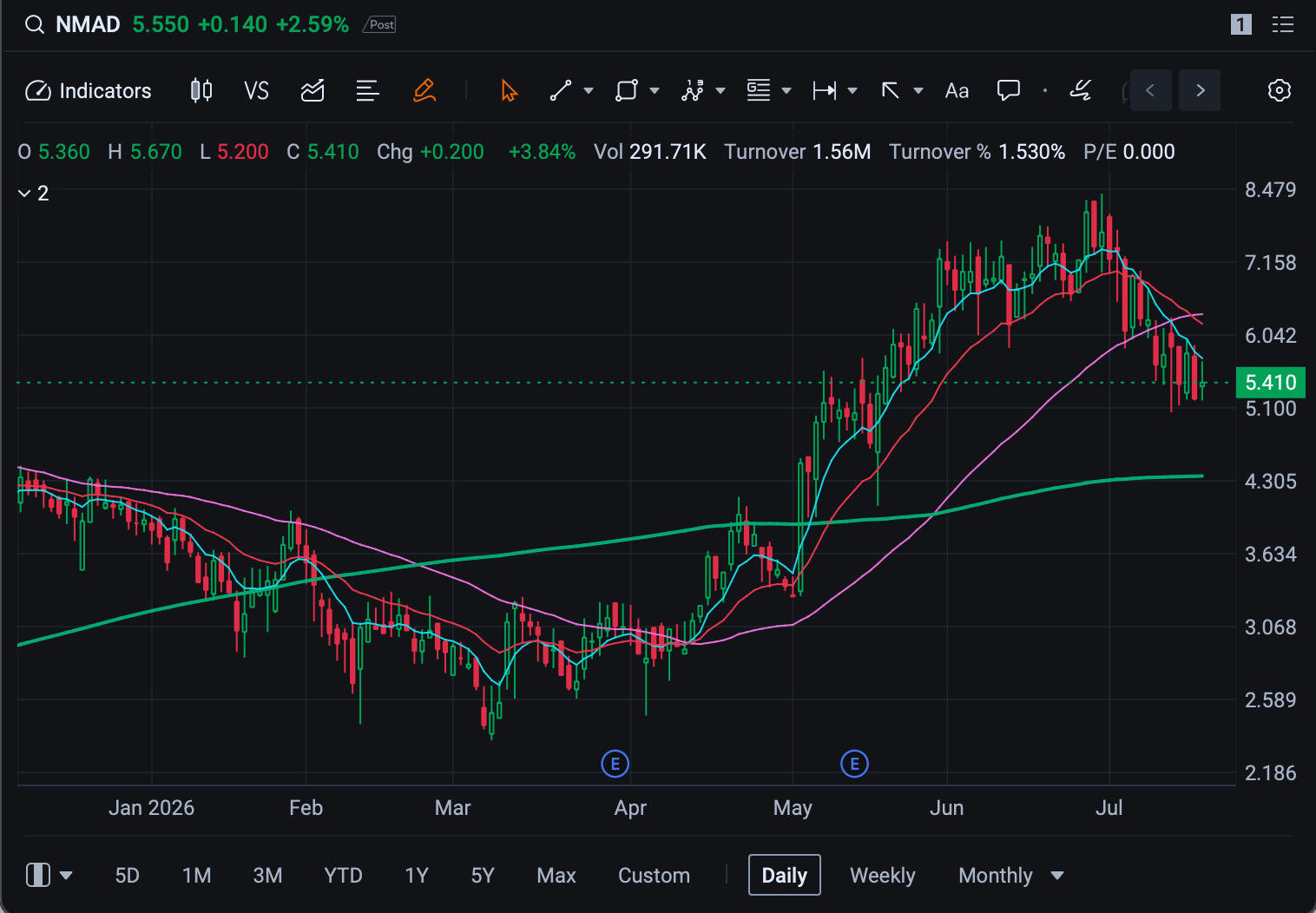
The stock, then trading as LIXT, bottomed near $2.40 in early March and rallied to roughly $8.35 by July 1. Since then, the stock has pulled back to around $5.40, retracing about half of that advance.
Shares are now below the eight-day and 21-day exponential moving averages and the 50-day simple moving average, but remain above the 200-day SMA at roughly $4.35. With the 61.8% retracement near $4.67, I view the $4.35 to $4.67 area as the stock’s most important support zone.
I don’t own Nomad yet, but I plan to begin building a position near current levels. I would add on a pullback toward the 200-day SMA or after the stock breaks and holds above its short-term EMAs and the 50-day SMA.
Because the stock consistently respected its 50-day SMA before the Nomad merger, I’d get more aggressive once it reclaims that moving average, currently near $6.35.
This is an AI infrastructure name I want to own. The volatility will remain intense, with breakneck rallies and portfolio-crushing flash crashes. But the AI buildout is far from over.
Baker thinks the near-term power shortage should begin easing in 2027 and 2028 as new energy sources come online.
He may be right. Capital can solve scarcity.
It cannot repeal construction schedules.
New generation still needs transformers, substations, permits and grid connections. AI companies plan in quarters. Utilities build in years.
Nomad gets paid in the gap between them.
At the time of publication, Byrne held no positions in any securities mentioned. Positions may change at any time without notice.