Buy the Intel Dip? Be Extremely Careful Thinking That Way
'Don't go away mad' after the chipmaker's 'awful' earnings. Just be aware of this important stock price level to watch, and what could really shock investors.
You've reached your free article limit
You've read 0 of 1 free Pro articles.
On Thursday evening, former semiconductor industry leader Intel INTCreleased its second-quarter financial results. To the dismay of those that somehow are still invested in the stock, corporate execution is still awful.
For the three-month period ended June 28, Intel posted an adjusted loss per share of $0.10 (GAAP loss: $0.67) on revenue of $12.859 billion. While the revenue print was up very small and actually beat Wall Street projections by more than a billion dollars, both the GAAP and adjusted bottom-line numbers fell short of the Street's expectations. By a country mile. Dispute the much higher than projected revenue. Yikes.
On the bright side, Intel claims to be on track to achieve its $17 billion target for adjusted operating expenses. The company has completed most of its planned headcount reductions announced last quarter when the plan to reduce its core workforce by 15% was revealed. To help further reduce costs, it has now cancelled or paused major factory projects in Germany, Poland and Costa Rica, while operations in Vietnam and Malaysia have been consolidated.
The $0.57 worth of adjustments made to earnings was primarily driven by restructuring charges and probably a little more share-based compensation than anyone in management deserves. This was slightly offset by some gains of equity investments.
The CEO
Lip-Bu Tan, the still-new CEO of Intel commented (cautioned) in the press release:
“Our operating performance demonstrates the initial progress we are making to improve our execution and drive greater efficiency. We are laser-focused on strengthening our core product portfolio and our AI roadmap to better serve customers. We are also taking the actions needed to build a more financially disciplined foundry."
The CEO added:
"It’s going to take time, but we see clear opportunities to enhance our competitive position, improve our profitability and create long-term shareholder value.”
During The Call...
The CEO was blunt, which was necessary. Early in his address, Lip-Bu Tan said, "We have much work to do in building a clean and streamlined organization, which we have started in earnest and has remained an area of focus for me during Q3. Our goal is to reduce inefficiencies and redundancies and increase accountability at every level of the company."
As the CEO ws wrapping up that address Thursday night, he commented further:
"We will strive to become the compute platform of choice, but we will also work towards a full stack AI solution, and I look forward to sharing more on our strategy in the coming months. Underpinning all of these efforts is a strong focus on improving our balance sheet. We continue to maintain solid liquidity, but despite meaningful capital spending offsets. Our last full fiscal year of positive adjusted free cash flow was 2021. This is completely unacceptable."
Segment Sales Performance
- Total Products generated revenue of $11.8 billion (-1%).
- Client Computing Group generated revenue of $7.9 billion (-3%).
- Data Center and AI generated revenue of $3.9 billion (+4%).
- Intel Foundry generated revenue of $4.4 billion (+3%).
- Other... generated revenue of $1.1 billion (+20%).
Intersegment eliminations amount to $4.4 billion, leaving total net revenue at $12.859 billion, which was essentially flat from the year-ago period.
Operations
As revenue grew just a smidgen to $12.859 billion, the cost of sales increased 12.4% to $9.317 billion. This left a gross profit of $3.542 billion (-22.1%).
GAAP operating expenses grew 3.2% to $6.718 billion. This left a GAAP operating loss of $3.176 billion, versus the yea-ago comp of -$1.964 billion as Intel's GAAP operating margin dropped to -24.7% from -15.3%. On an adjusted basis, operating income dropped from $24 million a year ago to -$503 million as operating margin declined from 0.2% to -3.9%.
After accounting for interest, other income and expenses and taxes, GAAP net income attributable to shareholders came to -$2.918 billion, which worked out to a loss of $0.67 per fully diluted share. This was down from the year-ago results of -$1.61 billion and -$0.38, respectively. After adjustments, Intel posted net loss attributable to shareholders of $441 million which works out to -$0.10 per fully diluted share. This was down versus the year-ago comps of $83 million and $0.02, respectively.
Guidance
For the current quarter, Intel is projecting revenue generation of $12.6 billion to $13.6 billion. Gross margin is seen close to 36%, ultimately producing an adjusted EPS of $0.00.
Targets for operating expenses remain $17 billion for the current year and $16 billion for 2026. Capex guidance is for $18 billion gross and $11 billion net for 2025. Those numbers are expected to drop in 2026.
Fundamentals
For the quarter reported, Intel generated operating cash flow of $2.05 billion. Out of this came net Capex spending of $3.097 billion, resulting in free cash flow of -$1.05 billion. Obviously, the company is in no position to return capital to shareholders.
Turning to the balance sheet, Intel ended the quarter with a cash position of $21.206 billion and inventories of $11.377 billion. That makes for current assets of $43.375 billion. Current liabilities add up to $34.966 billion, including $6.731 billion in short-term debt. This leaves current and quick ratios at 1.24 and 0.92, respectively. This passes muster and is adequate. Intel will be able to meet short to medium-term obligations.
Total assets amount to $192.52 billion, of which $26.969 billion was goodwill and other intangibles. At 14% of total assets, this does not concern me. Total liabilities less equity comes to $86.769 billion, including total debt of $44.026 billion.
This is not an awful balance sheet. Total debt is a bit higher than I would like, but this balance sheet is far from being the firm's most pressing issue.
My Thoughts
Tough quarter. Tough few years.
My opinion is that Intel has not had a competent CEO since Brian Krzanich resigned in June 2018 after violating the firm's non-fraternization policy with an employee.
This new CEO has a chance. At least he understands that Intel is no longer considered an elite American tech firm and that to be competitive a lot of work has to be done.
He has no delusions. He has to improve cash flows, improve the balance sheet and compete against the likes of Nvidia NVDA and Advanced Micro Devices AMD, two chip designers at the top of the industry with an incredible level of corporate leadership stemming from their respective C-Suites. He also seems to understand that the foundry business may grow, but is not competitive against Taiwan Semiconductor TSM and is not close to turning a profit.
Buy the Dip?
Be very, very careful with that kind of thinking.
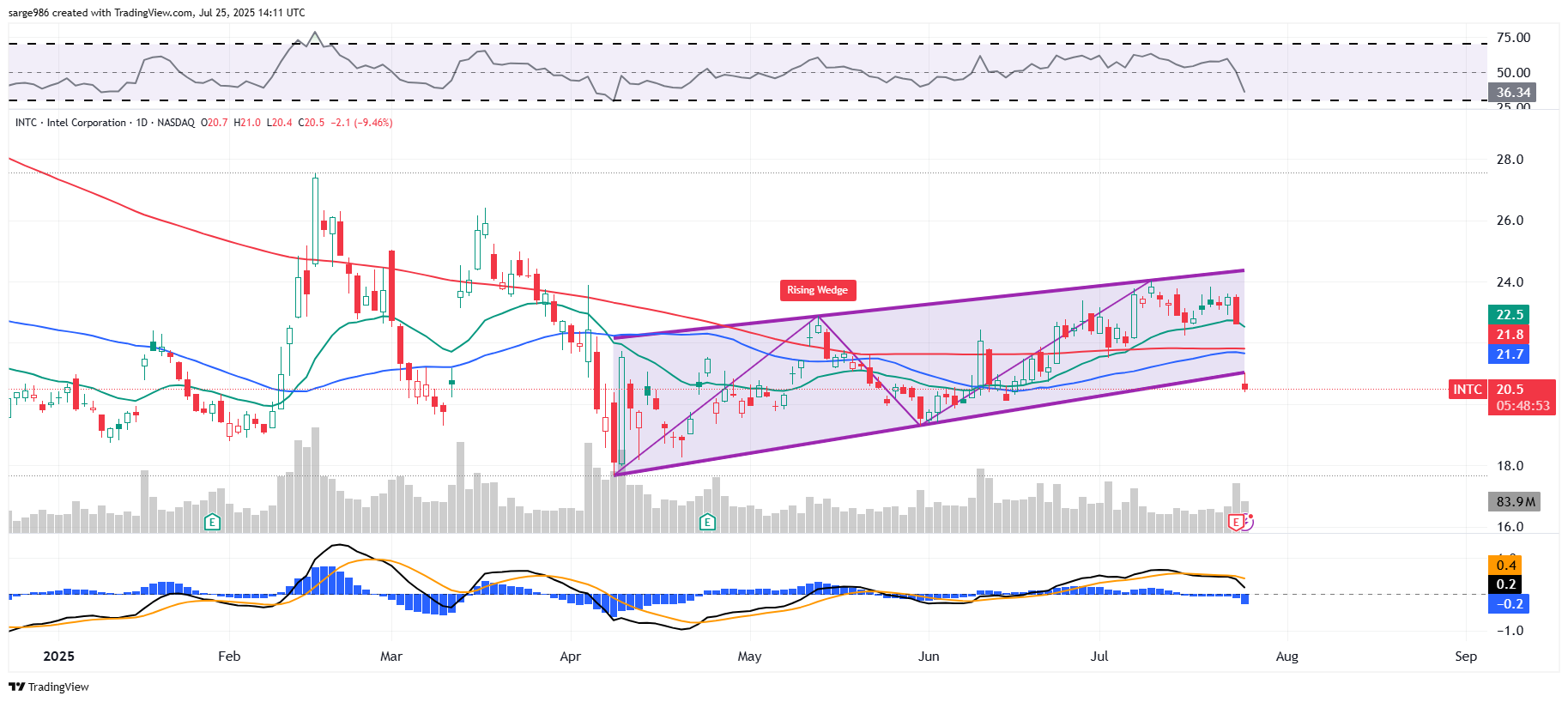
Readers will see that as the shares came out of a sloppy looking Double Top pattern this past spring, they almost immediately developed a Rising Wedge pattern of bearish reversal. Friday morning, INTC has surrendered its 21-day exponential moving average, losing the swing crowd; lost its 50-day and 200-day simple moving averages, which forces professional managers to reduce long side exposure; and has now lost the lower trendline of the Wedge pattern. That will get rid of what technical traders might have been willing to buy this dip.
The low of April 8 is the new level to watch. Lose that spot and the stock could really shock investors. Relative Strength is weak, but not technically oversold. The daily moving average convergence/divergence is very bearish looking, though. The histogram of the 9-day EMA is now well below zero, while the 12-day EMA has broken sharply below the 26-day EMA.
The opportunity to make money on the short side has passed. I don't see any catalyst that would prompt me to invest in Intel any time soon. The other semis are still better plays, in my opinion.
I don't even see viable options related plays here. There's just not enough premium to be paid for taking on the risk over time.
Kind of reminds me of an old Motley Crue song... "Don't Go Away Mad (Just Go Away)."
At the time of publication, Guilfoyle was long NVDA and AMD equity.