Buffett Injected Hope in UnitedHealth. But There's More to the Story.
The stock ran up nearly 12% on Friday, but the Berkshire buy is just one factor at play. Here's my take, the chart and my careful strategy.
You've reached your free article limit
You've read 0 of 1 free Pro articles.
Has the dust settled on United Health? I'm not sure. UnitedHealth Group UNH ran almost 12% on Friday. The stock has been trading higher still overnight Sunday into Monday morning, despite a generally weaker tape. The fun started after the closing bell on Thursday evening. After the parade of second quarter 13-F filings with the Securities and Exchange Commission had been made public, it was learned that Berkshire Hathaway BRK.A, BRK.B, the investment conglomerate/insurance giant run by Warren Buffett, had taken a more than 5 million shares, almost a $1.6 billion stake in UNH.
It was learned the same night that Scion Asset Management, Michael Burry's (of "big Short" fame) firm, had also initiated a new long position in UNH, be it just 20,000 shares. Interestingly, despite the obvious fact that Warren Buffett can still move markets, I haven't seen any sell-side analysts publicly change or even reiterate anything based on this news. UNH posted a rather lousy second quarter back on July 29. From that earnings release on through the next week or so, 14 different analysts took their target prices lower, many of them sizably so.
About Those Earnings...
For the second quarter, UnitedHealth posted an adjusted earnings per share of $4.08, badly missing consensus view, which was for something close to $4.45. Revenue of $11.62 billion was good enough for a slight beat, and also good enough for year-over-year growth of 12.9%. The problem at least at the headline was a massive drop in operating margin from 5.4% a year ago to just 4.6%.
As if the earnings release wasn't weak enough, the guidance was just putrid. The company guided the full year toward revenue of $446.75 billion at the midpoint, which is well below the $449 billion that Wall Street was looking for. Full-year adjusted earnings per share were seen at $16, sharply below the nearly $21 that Wall Street had expected. By Aug. 1, the stock traded at low as $234.60, which was down 28.1% from where it had traded on July 1 and down 61.3% from the stock's 2025 high of $606.36, which occurred in mid-April.
Now, the stock is taking back some ground, thanks to bottom fishers, momentum players and swing traders that hopped on board thanks to Warren. Interestingly enough, Berkshire's 13-F filing was for the second quarter, so Buffett was in at much higher prices than where the stock bottomed out. I would imagine that Buffett may have kept buying the stock as the price withered in response to that earnings release, knowing that his 13-F would impact the stock. We won't really know, however, if that's what he did for another three months.
The Chart
Readers will see two things. One, that while UNH is still mired within a downward sloping Regression model, suggesting that the downtrend could still be in place, the stock has retaken it's 50-day simple moving average on the Buffett news. Should that line be held, portfolio managers will be forced to increase long-side equity exposure. That's a positive.
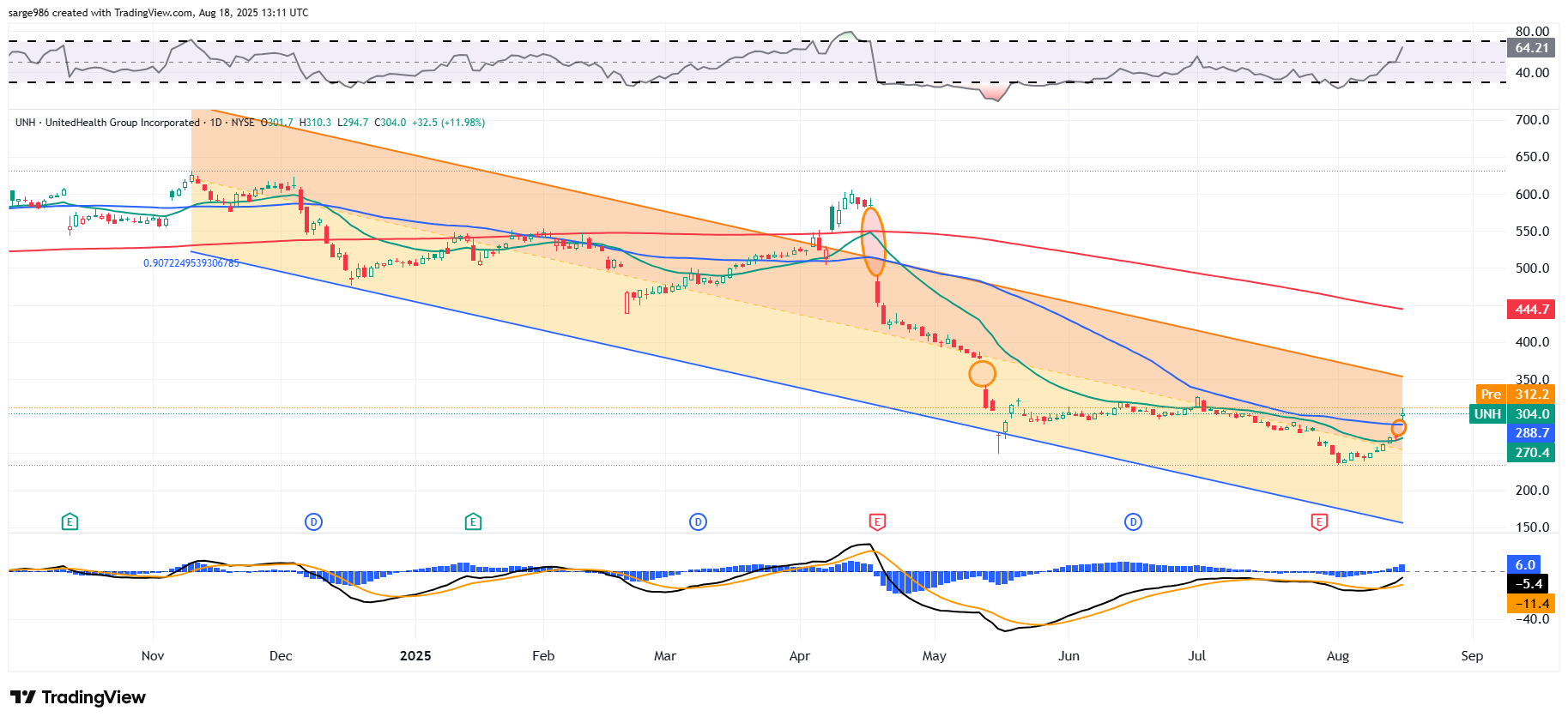
There are other, less noticeable positives. There were unfilled gaps left behind in both April and May. We all know that while unfilled gaps do not have to fill that they usually do. Then there are the indicators that I most rely upon. Relative Strength (above the chart) has gone from a technically oversold reading to a nearly overbought reading in less than a week.
Below the chart, the daily Moving Average Convergence Divergence has gone from grotesque to almost bullish in a short span of time as well. Within the MACD, the histogram of the 9-day Exponential Moving Average has moved into positive territory. That's short-term bullish signaling. Additionally, the 12-day EMA has crossed above the 26-day EMA. That's usually seen as bullish, as well. But I see a problem here. Both of those lines remain in negative territory. A bullish crossover such as this carries more weight when those lines are in positive territory.
My Thoughts
I'd be willing to take on a small, long position should we see that 50-day line hold early this week. I would prefer to wait, however, to see what the stock does after Buffett's cult-like following has taken down their fill, at least for now. I would not be surprised to see the 50-day line pierced as portfolio managers drag their feet a little. The swing crowd would be more active at the 21-day EMA (the green line). That's down around $270 right now.
That's why for now, I think I would be more interested in writing $270 puts expiring on Sept. 19 than in taking on some equity at these prices. Oh, and if I did take on an equity stake, I think doing so in the form of a "buy-write" would be appropriate. In other words, writing something like the $440 calls expiring in December against the position for another $3. That's currently up around the 200-day Simple Moving Average and might be where some of these recent hitchhikers optimistically look to get out.
At the time of publication, Guilfoyle had no position in any security mentioned.