Bond Bulls Are About to Be Tested as TLT Faces a Reckoning
Here are the key price levels to watch as well as the trade approach that may work best.
You've reached your free article limit
You've read 0 of 1 free Pro articles.
At first glance, the iShares 20+ Year Treasury Bond ETF TLT appears ready to shout, “Bond Voyage!” Consecutive days of red candles have taken us from breakout to breakdown. This wedge trading pattern has tightened considerably over the past two-and-a-half months.
Since December, there hasn’t been a discernible trading pattern as TLT traded above $93 and below $85, but 2025 has brought us to a reckoning. Resistance stands at $92.50, and support around $89.50. Bulls have enjoyed a strong trend line of support dating back to mid-January, while bears have etched out declining resistance going all the way back to October.
Bond bulls appear to be about to be tested. A close below $89 will break the trendline support and put us on course to test the February lows. It would also place TLT well below its 10-day and 21-day exponential moving averages (EMAs), where bulls have struggled to gain traction since September 2024.
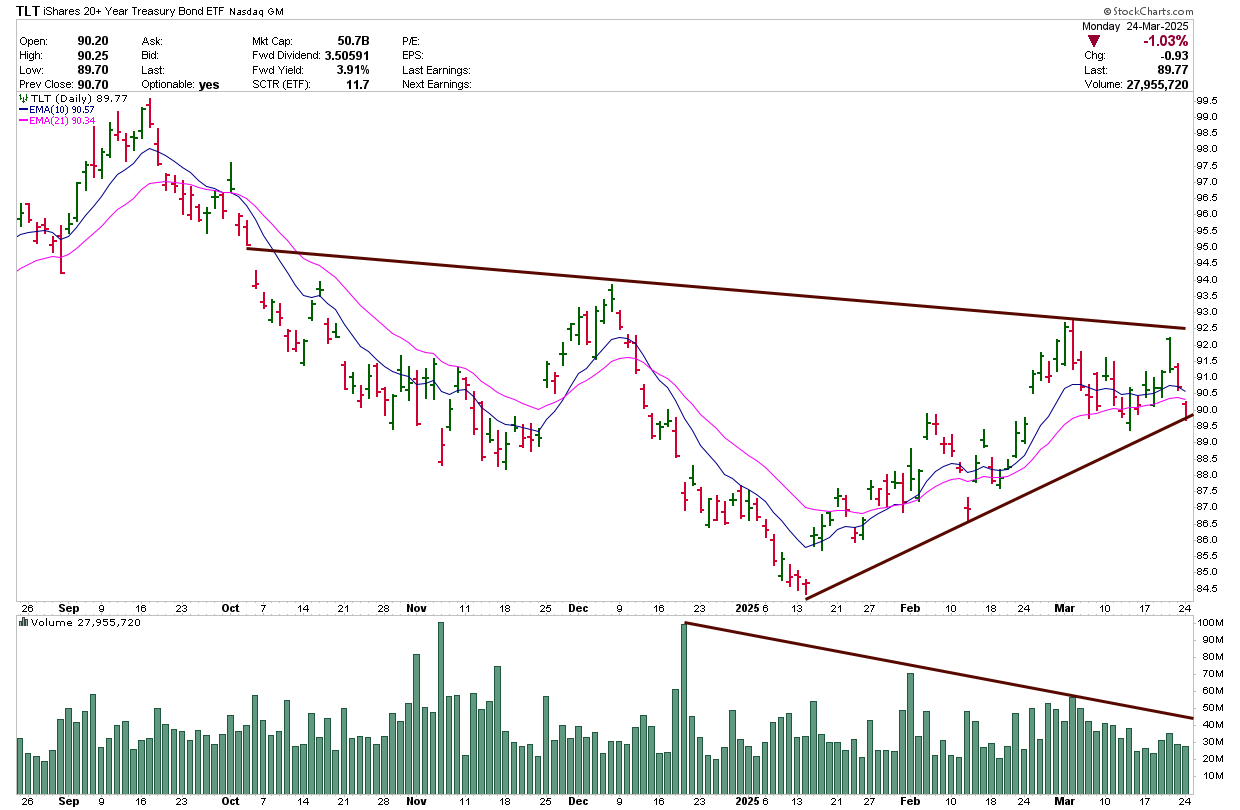
The declining volume in 2025 won’t inspire dip buyers as a whole; however, traders may see this as an opportunity to buy the dip on TLT while using a tight stop. If a trader buys TLT in the $89.50 to $90 range, they should recognize quickly if they are wrong. A close under $88.50 should put them on the sidelines. That’s not a huge amount to risk.
The challenge may be justifying that risk against an upside that may get capped at $92.50. I expect sellers to enter the market again at that level and force the bulls to get aggressive. Of course, if I were a trader short TLT, I would not want to hold that position if TLT broke above $93.50.
Approaching the trade with inverse thinking may work best here. That is, buying a break above $93 or $93.50 and looking at puts or a short trade should TLT break below $88.50. More conservative traders should use those levels as closing levels, while aggressive traders can key on intraday breaks.
At the time of publication, Byrne had no positions in any securities mentioned.