Avoid Buying Taiwan Semi Until the Shares Do One of Two Things
After the largest chip foundry in the world reported impressive earnings, shares jumped. But investors should stay away until further notice.
You've reached your free article limit
You've read 0 of 1 free Pro articles.
Taiwan Semiconductor TSM went to the tape with the firm's fourth quarter earnings very early (U.S. East Coast time) on Thursday morning.
These earnings are watched extremely closely as Taiwan Semi is easily the largest chip foundry in the world and manufactures wafers for some of the planet's elite designers such as Nvidia NVDA, Advanced Micro Devices AMD, Apple AAPL and many others. For the period ended December 31, Taiwan Semi posted a GAAP EPS of NT$14.45 of $2.24 per ADR unit, on revenue of NT$868.46 billion of $26.88 billion. The bottom-line results just beat expectations, while the top-line print both beat Wall Street and was good enough for year-over-year growth of 37%.
Readers should be advised that Taiwan Semi published its results in the company's home currency, which is the New Taiwan dollar. We will convert those numbers into U.S. dollars where and when possible. Readers should also understand that in "per share" references, New Taiwan dollar amounts refer to ordinary shares while U.S. dollar amounts refer to American depository receipts.
The Guts of the Report
For TSM's fourth quarter, shipments of 3-nanometer wafers accounted for 26% of all wafer manufacturing revenue. Five-nanometer shipments accounted for 34% of the total. Seven-nanometer shipments accounted for 14% of the pie. What this means is that more advanced technologies, as defined as 7-nanometers or less, accounted for 74% of total wafer shipment revenue.
On That Matter...
CFO Wedell Huang commented in the press release, “Our business in the fourth quarter was supported by strong demand for our industry-leading 3nm and 5nm technologies. Moving into first quarter 2025, we expect our business to be impacted by smartphone seasonality, partially offset by continued growth in AI-related demand.”
Simply put, demand for higher-margin, high-end chips was driven primarily by those building out generative AI infrastructure. That's a huge positive.
Keep in mind though, TSM has faced and could face more headwinds in 2025 from the Biden administration having implemented U.S. restrictions on advanced semiconductor shipments to China and the uncertainty surrounding both these restrictions and U.S. trade policy as president-elect Donald Trump returns to the Oval Office. Still, the guidance provided was optimistic.
Outlook
The firm sees current-quarter revenue in U.S. dollars at $25 billion to $25.8 billion. At the midpoint, that would be good for growth of 37.3%. Assuming an exchange rate of 32.8 NT$ to 1 US$, gross profit margin for the current quarter is projected at 57% to 59%, while operating profit margin is seen at 46.5% to 48.5%.
Statement of Income
For the period, TSM generated $26.884 billion. Out of that number came a cost of revenue of $11.023 billion, leaving a gross profit of $15.861 billion (+54.4%) as gross margin improved from 53% to 59%. Total operating expenses increased 20.6% to $2.673 billion. After some other minor operating income and expenses, operating income printed at $13.178 billion (+63.6%) as operating margin improved from 41.6% to 49%.
After accounting for non-operating income and expenses as well as taxes, net income attributable to shareholders landed at $11.599 billion (+57%). which works out to $2.24 per ADR, up from $1.44 for the year-ago period.
Fundamentals
In U.S. dollar terms, for the full year, TSM generated operating cash flow of $56.839 billion. Out of that number came capex spending of $26.918 billion, leaving free cash flow of $29.921 billion. Out of that, the firm repurchase $96 million worth of stock for its treasury and returned $11.3 billion to shareholders in the form of cash dividends.
Turning to the balance sheet, TSM ended the quarter/year with a cash position of $73.914 billion, inventories of $8.785 billion which put current assets at $94.249 billion. Current liabilities add up to $38.59 billion, including just $1.827 billion in shorter-term debt. That puts the firm's current and quick ratios at 2.44 and 2.21. These ratios are very strong.
Total assets amount to $204.222 billion, of which very little is labeled as intangible. Total liabilities less equity comes to $72.277 billion, including longer-term debt of $28.278 billion. That's something the firm could handle more than two and half times over just out of cash. This is a very healthy balance sheet.
My Thoughts
Taiwan Semiconductor obviously reported a very strong quarter and projected a solid guide going forward. Margins are expanding rapidly as the sales growth that the firm is experiencing is precisely where its most profitable products are. What's not to like? Well, fundamentally, nothing. This report makes me feel better about my long positions in companies that are known clients of Taiwan Semi.
That said, the technical picture is murkier. Take a look at this:
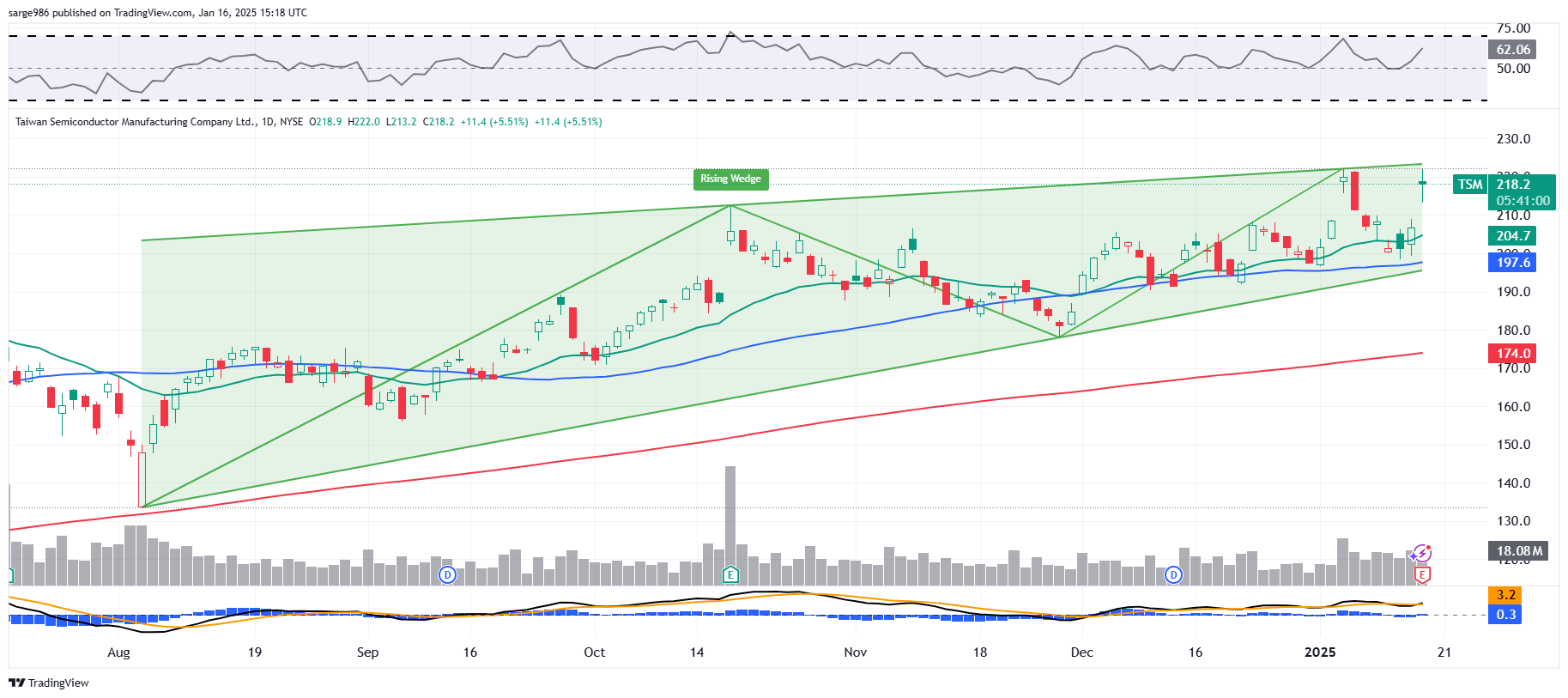
What do we have, but a rising-wedge pattern which often signals a bearish reversal and takes up all of the chart's space from early August into the present. Yes, I see Thursday morning's pop in the share price. That has made both the RSI and the daily MACD look better, but as I said, this is a pattern of bearish reversal.
Now, zoom in and look into what Thursday's action has done:
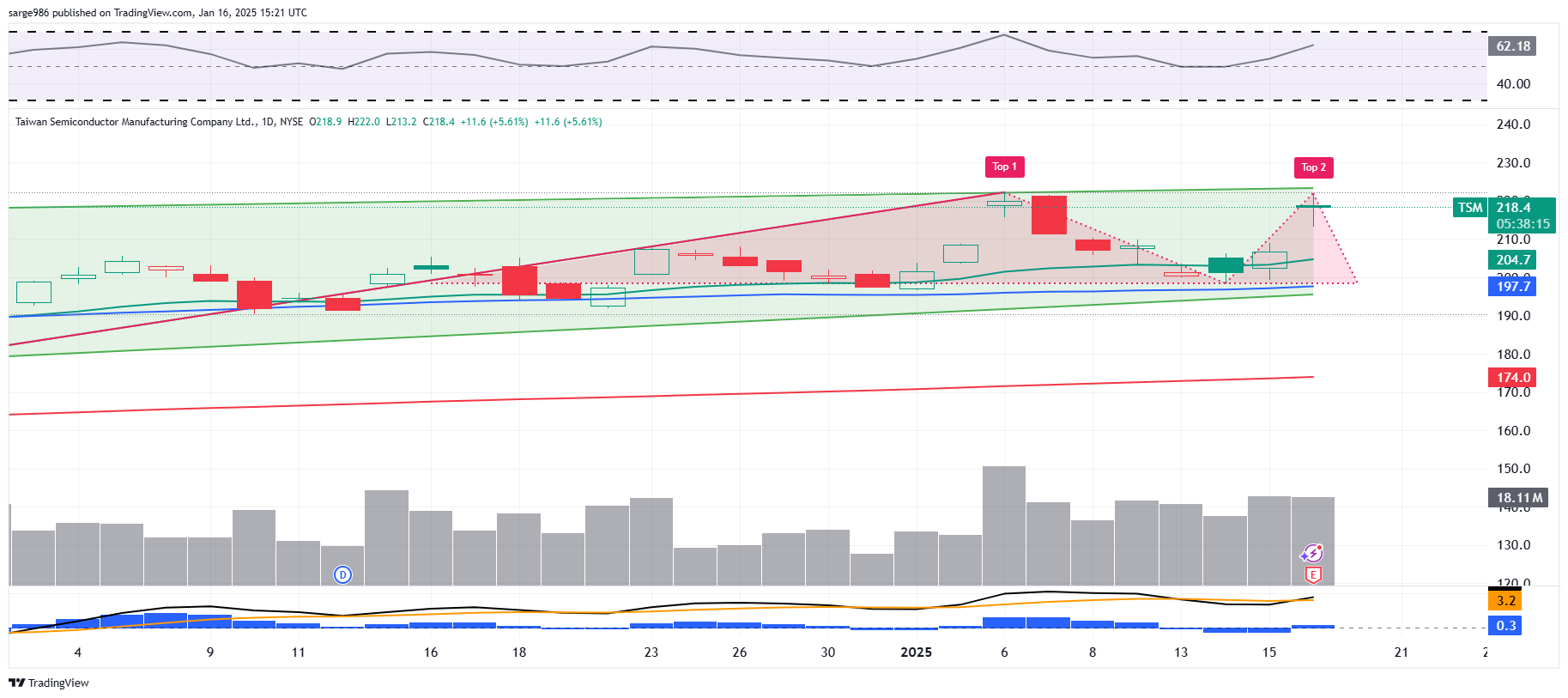
If the stock does not come back and make a new high for Thursday, what this action has done will have been to build a double-top pattern within a rising wedge. You understand what that is, right? That's a pattern of bearish reversal inside of a pattern of bearish reversal. The downside pivot for the double top will be just about $199, which is just above the 50-day SMA. There should be some support there.
Understand this though: I started writing this article with the mindset that I was going to write a bullish article and likely set up my own long-side trade. I will not buy TSM until either it makes a high that changes the complexion of what looks like a double-top pattern or comes in and at least challenges that pivot/50-day SMA.
I will not buy TSM right here, right now.
At the time of publication, Guilfoyle was long NVDA, AMD and AAPL equity.