AT&T Should Be Embarrassed With This Balance Sheet
Investors need to avoid the telecommunications giant even as it rallies after earnings.
You've reached your free article limit
You've read 0 of 1 free Pro articles.
On Tuesday morning, AT&T T released the firm's second quarter financial results, one day after markets seemed generally pleased with rival Verizon's VZ results as that firm raised guidance.
For the three-month period ended June 30, AT&T posted an adjusted EPS of $0.54 (GAAP EPS: $0.62) on revenue of $30.847 billion. These top- and adjusted bottom-line results both beat Wall Street by a smidgen while the sales print was good enough for year-over-year growth of 3.5%.
The GAAP EPS print that benefited from the impacts of the firm's equity position in DIRECTV (which was closed out on July 2) and reduced legal fees, was much better than expected. AT&T generated 401,000 postpaid phone net adds with a postpaid churn rate of 0.87%. The firm also drove 243,000 AT&T Fiber net adds and 203,000 AT&T Internet Air net adds. Consumer fiber broadband revenues increased 18.9% from the year-ago comparison, landing at $2.1 billion.
Operations
As revenue grew 3.5% to $30.847 billion, this growth was supported by growth of 15.9% in the sale of equipment (to $5.555 billion) and growth of 1.1% in services (to $25.292 billion). Total operating expenses including the cost of revenues, grew 1.3% to $24.2346 billion, leaving a GAAP operating income of $6.501 billion (+12.9%). GAAP operating margin improved from 19.3% to 21.1%. After the above-mentioned adjustments, operating income printed at $6.489 billion (+3.3%) as operating margin dropped from 21.1% to 21%.
After accounting for interest, other income and expenses and taxes, GAAP net income attributable to shareholders hit the tape at $4.464 billion (+25.9%), which works out to $0.62 per fully diluted share, up from $0.49 a year ago. The adjusted EPS of $0.54 compares to $0.51 for the year-ago comp.
Segment Performance
- Mobility generated revenue of $21.845 billion (+6.7%), which produced operating income of $6.931 billion (+3.2%)
- Business Wireline generated revenue of $4.313 billion (-9.3%), which produced operating income/loss of -$201 million (down from $102 million)
- Consumer Wireline generated revenue of $3.541 billion (+5.8%), which produced operating income of $335 million (+82.1%)
Guidance
For the full year, AT&T is projecting Adjusted EBITDA growth of 3% or greater and CapEx spending of $22.5 billion. That was quite a bit more than the $21 billion or so that Wall Street was looking for and a main reason why the shares opened on weakness on Wednesday morning. This resulted in a projected adjusted full year EPS of $1.97 to $2.07. Wall Street was up around $2.09 on that number. The firm also sees free cash flow in the low-to-mid $16 billion range.
Fundamentals
For the quarter reported, AT&T generated operating cash flow of $9.763 billion. Out of this came CapEx spending of $4.897 billion, distributions from and taxes paid on DIRECTV and vendor financing payments. This left free cash flow of $4.394, up 11% from the year-ago period. Out of this number came $2.35 billion in cash dividends paid out to shareholders and $1 billion in the repurchase of common shares for the firm's treasury.
Looking over the balance sheet, I see a cash position of $10.499 billion and inventories of $2.357 billion. That puts current assets at $39.306 billion. Current liabilities add up to $48.565 billion including $9.254 billion in current debt (maturing within 12 months) but also $3.999 billion in deferred revenue. That puts the firm's headline current and quick ratios at 0.81 and 0.76, respectively, which is not good. Adjusted for those deferred revenues, these ratios rise to 0.88 and 0.83. This still pretty much stinks.
Total assets amount to $405.491 billion including $68.687 billion in goodwill and other intangibles. At 17% of total assets, this does not concern me. Total liabilities less equity comes to $284.097 billion including a whopping $123.057 billion in long-term debt. That obviously does concern me. Combined with the short-term debt, the firm's debt load sums up to 1,260% of the firm's cash position. Additionally, short-term debt is up $4.165 billion from the end of last year, while long-term debt is up $4.614 billion.
My Thoughts
Operationally, this was not a bad quarter. The company is growing in places it needs to grow. I see that the stock has rallied off of Wednesday morning's lows. Don't be fooled. I have two questions: If the firm had to add almost $9 billion to the debt load in the past six months, and does generate a robust free cash flow, then why on earth is it repurchasing stock for the corporate treasury? Additionally, why is the dividend yield still above 4%?
Is anyone in charge here? Don't bring up chairman and CEO John Stankey. Obviously, he and the board are OK with spending their still impressive free cash flow on returns to shareholders, which I am sure to a great degree, includes the C-suite, when the firm still sports a balance sheet that would and should embarrass almost any other corporate leader. I would not buy stock in AT&T with your money. Even if I hated your guts.
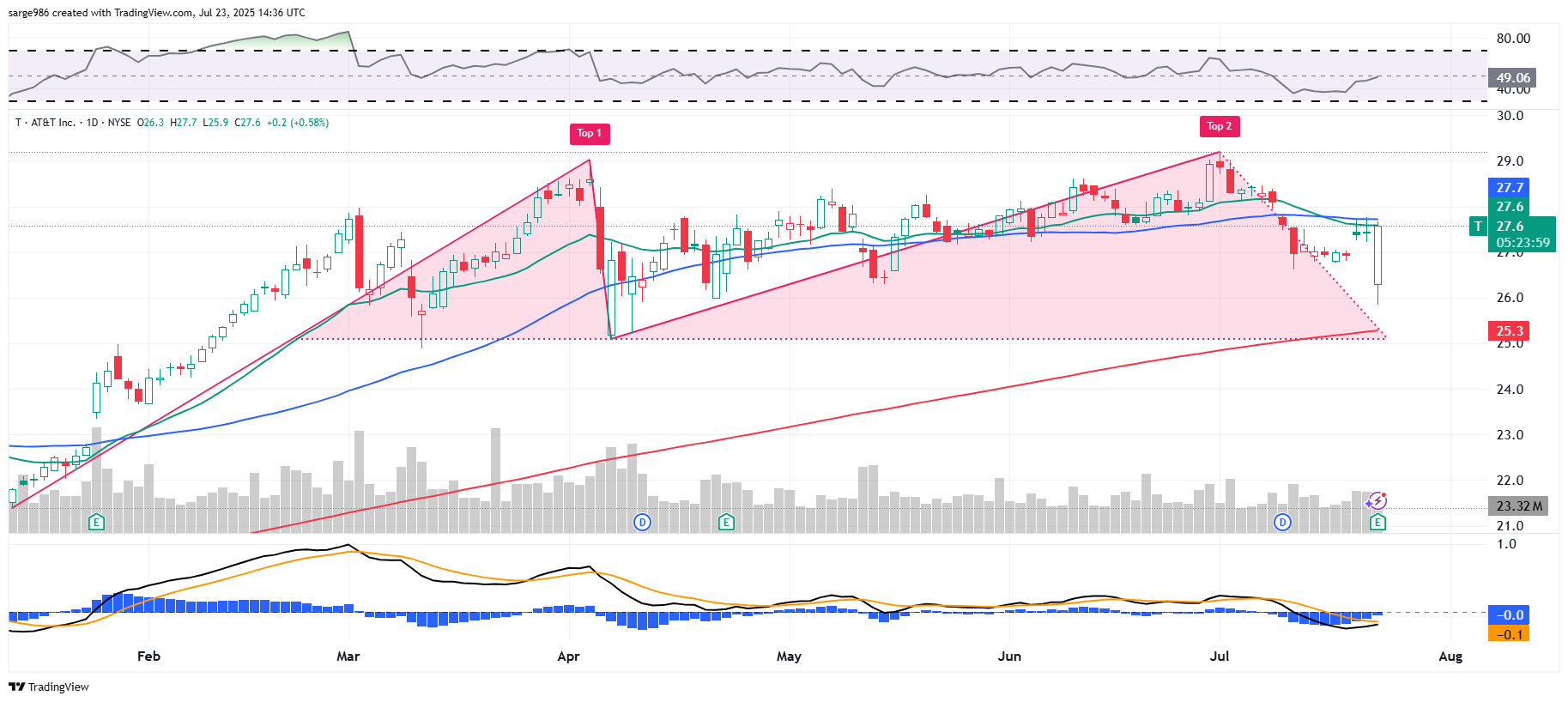
The stock is now up on the day for Wednesday. Good for the shareholders. Should they sell some? I would. The bulls are hoping that the stock can retake its 50-day SMA. That would actually act as a catalyst for increased exposure across professional money management. That said, a bearish double top pattern with a $25 downside pivot is still the technical play. That pivot would also bring the 200-day SMA into play in a negative way.
Relative strength is neutral at the moment, coming out of weakness. However, the daily MACD, while improving, still sports a negative nine-day EMA, a negative 12-day EMA and a negative 26-day EMA. That's with the 26-day EMA above the 12-day EMA. Every single component of the daily MACD is bearish.
Sarge's rating: Avoid
At the time of publication, Guilfoyle had no positions in any securities mentioned.