Applied Materials Sees Price Targets Revamped After CFO's Revenue Warning
Is the dip in AMAT shares an opportunity to buy or a warning to stay away?
You've reached your free article limit
You've read 0 of 1 free Pro articles.
On Thursday evening, semiconductor industry equipment and services provider Applied Materials AMAT released the firm's fiscal third quarter financial results.
For the three-month period ended July 27, Applied Materials posted an adjusted EPS of $2.48 (GAAP EPS: $2.22) on revenue of $7.302 billion. The stock sold off pretty sharply overnight.
These numbers were not the problem. The adjusted earnings print beat Wall Street by more than a dime and the sales number bested expectations as well, while also being good enough for year-over-year growth of 7.7%. This was the fastest pace of year over year sales growth for this firm since the quarter ended October 2022. The problem was the firm's guidance for the current quarter. This is that story.
Operations
As revenue generation grew 7.7% to $7.302 billion, the cost of those sales increased 4.7% to $3.74 billion. That left a gross profit of $3.562 billion (+11.1%) on a gross margin of 48.8% (up from 47.3%). GAAP operating expenses dropped just a smidgen to $1.329 billion, leaving a GAAP operating income of $2.233 billion (+15%) as GAAP operating margin expanded from 28.7% to 30.6%. Once adjusted, operating margin improved from 28.8% to 30.7%.
After accounting for interest, other income and expenses and taxes, GAAP net income printed at $1.779 billion (+4.3%). This works out to a GAAP EPS of $2.22 per fully diluted share, up from $2.05 for the year-ago period. After adjustments, net income grew 13% to $1.989 billion. This worked out to $2.48 per fully diluted share, up from the year ago comp of $2.12.
Segment Performance
- Semiconductor Systems generated revenue of $5.427 billion (+10.2%), which produced operating income of $1.966 billion (+14.8%) on an operating margin of 36.2% (up from 34.8%)
- Applied Global Services generated revenue of $1.6 billion (+1.3%), which produced operating income of $445 million (-4.7%) on an operating margin of 27.8% (down from 29.6%)
- Display generated revenue of $263 million (+4.8%), which produced operating income of $62 million (up from $16 million) on an operating margin of 23.6% (up from 6.4%)
Guidance
OK, here is the catalyst behind Friday morning's weakness.
For the current quarter, Applied Materials is projecting revenue generation of $6.2 billion to $7.2 billion, dragging both the midpoint and high end of that range well below the $7.32 billion that Wall Street was looking for. The firm also sees an adjusted EPS for the quarter of $1.91 to $2.31. Again, both the midpoint and high end of the range provided is well below the consensus view of $2.38. Not good.
On the guidance, CFO Brice Hill commented, "We are expecting a decline in revenue in the fourth quarter driven by both digestion of capacity in China and non-linear demand from leading-edge customers given market concentration and fab timing."
Yikes.
Fundamentals
For the period reported, Applied Materials generated operating cash flow of $2.634 billion. Out of that came capex spending of $584 million, leaving free cash flow of $2.05 billion (down small year over year). Out of that number, the firm repurchased $1.056 billion worth of common stock while dishing out $368 million in cash dividends to shareholders.
Glancing at the balance sheet, the firm ended the quarter with a cash position of $7.014 billion and inventories of $5.807 billion. This left current assets of $19.718 billion. Current liabilities add up to $7.883 billion, which include just $799 million in short-term debt. The firm's current and quick ratios ended the period at 2.81 and 1.76, respectively. These ratios are reflective of a very healthy corporate fiscal situation.
Total assets amount to $34.211 billion. Goodwill and other intangibles make up just 11.7% of that number. However, it should be noted that the firm has long-term investments of $4.133 billion that could be theoretically labeled as part of the cash position which would further boost the firm's current and quick ratios. Total liabilities less equity comes to $14.707 billion, which includes long-term debt of $5.463 billion. The firm has enough in the pocket to take care of its entire debt load this afternoon if need be. This is a well-managed balance sheet.
Wall Street
I see that on Friday morning, a total of four sell-side analysts all rated at five stars out of five have opined on AMAT. All five reiterated "buy" or buy-equivalent ratings. Two of the four reduced their target prices. The other two did not. At the moment, the average target price of these four analysts stands at $213.50, down from $222.25 on Thursday.
My Thoughts
I think this stock is probably a "buy" on weakness. The problems are twofold in my book.
One: the CFO sounded beaten last night. CEO Gary Dickerson did not sound much better. It's hard to knock them if they are just being honest.
The second problem is that the chart I am about to show you is not bull friendly:
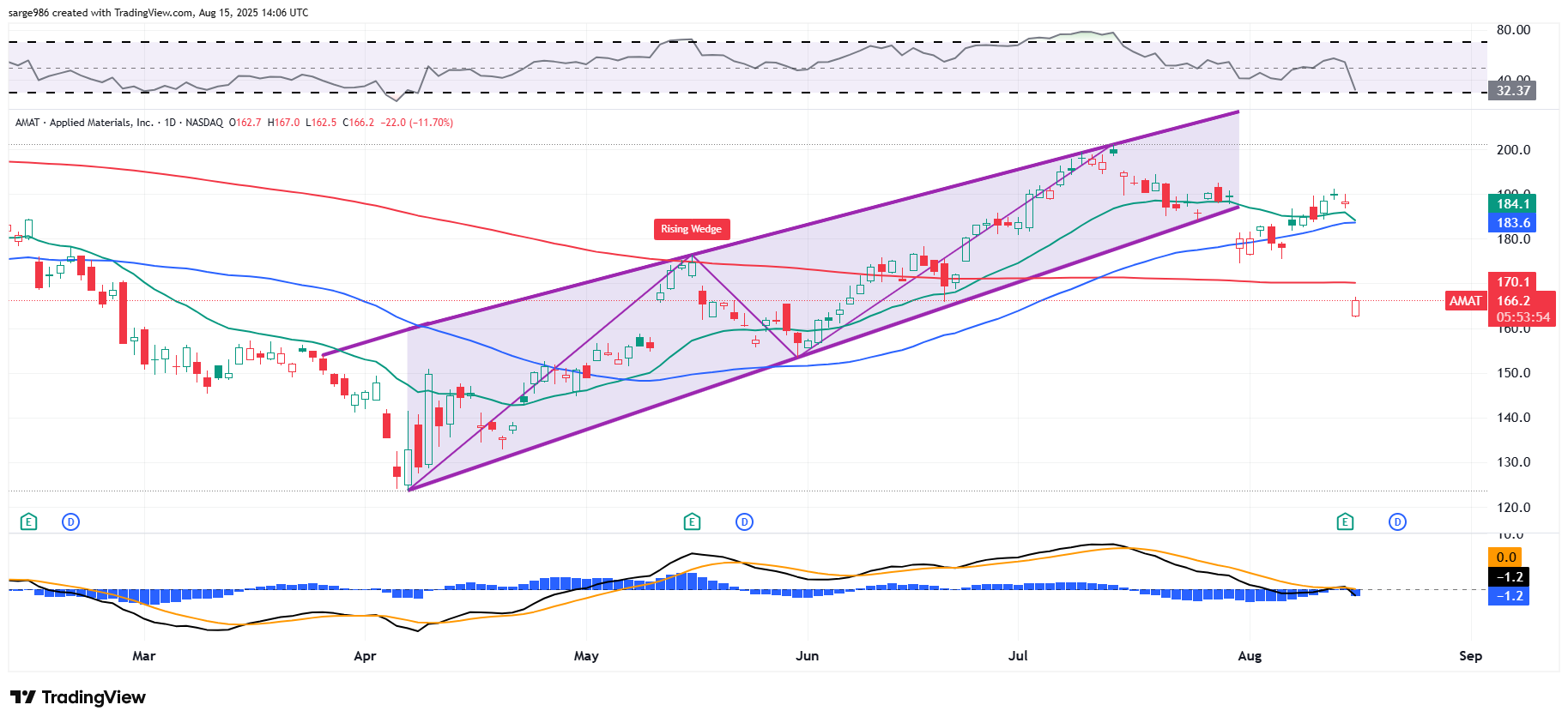
Readers will see that AMAT broke down from a rising-wedge pattern of bearish reversal in late July. I guess that was the hint that many apparently missed. Now, two weeks later, in response to weak guidance and a less than enthusiastic C-suite, the stock has surrendered its 50-day and 200-day SMAs in one fell swoop.
This is forcing risk managers up and down Wall Street to pressure portfolio managers to reduce long-side exposure. The pressure is impacting the entire group. Competitors Lam Research LRCX and KLA Corp KLAC are both trading more than 5% lower on Friday morning.
I would be interested in initiating a small, long position in AMT if the stock can retake its own 200-day SMA ahead of Friday night's closing bell. Otherwise, this stock could go lower from here.
Relative strength is awful. In addition to that, the daily MACD has suddenly taken a turn for the worse with all three components now sending bearish signals. I am, however, interested in adding to my existing long position in lam Research as the pressure on that name is the result of passive investment and not of that company's own making.
At the time of publication, Guilfoyle was long LRCX equity.