AMD Price Target After Surprising Selloff
Here's why I'm buying the dip despite some notable silence on the market in China.
You've reached your free article limit
You've read 0 of 1 free Pro articles.
On Tuesday evening, Advanced Micro Devices AMD, the second-largest designer of high-end, AI-capable processors, released the firm's second quarter financial results.
For the three-month period ended June 28, AMD posted an adjusted EPS of $0.48 (GAAP EPS: $0.54) on revenue of $7.685 billion. The adjusted earnings print just met expectations, while the GAAP number easily beat Wall Street. The top-line print also beat Wall Street and was good enough for year-over-year growth of 31.7%.
The quarter, on the surface, seems strong enough. Guidance was better than expected. Yet, the stock is selling off. There are a couple of issues.
From early April into late July, the shares had run more than 138% (in nearly parabolic fashion), so there are huge profits to protect. Additionally, the pace of year-over-year sales growth specific to the Data Center segment slowed sharply on a sequential basis, and during the call, CEO Lisa Su clearly avoided making any China-centric projections, which is an issue as the firm had previously taken a charge against lost Chinese sales and now, certain chips can be sold to Chinese clients.
Does it make sense? I have been adding to my existing long position overnight trying to get AMD from the ninth-heaviest weighted security in my most actively traded portfolio up to the sixth-largest, even though the shares are trading well above net basis. I am not taking profits alongside many of my colleagues. Let's explore.
CEO Lisa Su
Despite being quiet about China, CEO Lisa Su was not quiet.
Su commented in the press release, “We delivered strong revenue growth in the second quarter led by record server and PC processor sales. We are seeing robust demand across our computing and AI product portfolio and are well positioned to deliver significant growth in the second half of the year, driven by the ramp of our AMD Instinct MI350 series accelerators and ongoing EPYC and Ryzen processor share gains.”
During the call, Su explained what happened with the Data Center segment:
"Turning to our Data Center AI business. Revenue declined year-over-year as U.S. export restrictions effectively eliminated MI308 sales to China, and we began transitioning to our next-generation MI350 series accelerators. We made solid progress with MI300 and MI325 in the quarter, closing new wins and expanding adoption with Tier 1 customers, next-generation AI cloud providers and end users. Today, 7 of the top 10 model builders and AI companies use Instinct, underscoring the performance and TCO advantages of our Data Center AI solutions."
Operations
While revenue was growing 31.7% to $7.685 billion, the cost of sales increased 55.7% to $4.626 billion, leaving a gross profit of $3.059 billion (+7%) on a gross margin of 40%, down from 49%. Total GAAP operating expenses grew 23% to $3.193 billion, leaving a GAAP operating income of -$134 million, down from $269 million as GAAP operating margin dropped to -2% from 5%. On an adjusted basis, operating expenses were up 32%, while operating income dropped 29% to $897 million as operating margin dropped from 22% to 12%.
After accounting for interest, other income and expenses and taxes, GAAP net income printed at $872 million, up from $265 million. That works out to an EPS of $0.54, up from $0.16 for the year-ago comparison. Once adjusted, net income becomes $781 million (-$315 million), which works out to an EPS of $0.48, down from the year-ago comp of $0.69. The lion's share of the adjustments made were made due to the release of reserves for tax purposes, which was partially offset by stock-based compensation expense and the amortization of acquisition-related intangibles.
Segment Performance
- Data Center generated revenue of $3.24 billion (+14%), which produced operating income of -$155 million, down from $743 million
- Client and Gaming generated revenue of $3.261 billion (+69%), which produced operating income of $767 million, up from $166 million
- Embedded generated revenue of $824 million (-4%), which produced operating income of $275 million, down from $345 million
Guidance
For the current quarter, AMD sees revenue generation of roughly $8.7 billion (+/-$300 million). At the $8.7 billion midpoint, that result would amount to year-over-year growth of 28%. Adjusted gross margin is seen at about 54%. The firm did not include any revenue from any potential sales of MI308 shipments to China as the license to make those sales is still under review by the U.S. government. The revenue projection was a significant beat as Wall Street had been looking for something close to $8.3 billion.
Fundamentals
For the quarter reported, AMD generated operating cash flow of $1.462 billion (+147%), as operating cash flow margin from continuing operations increased from 10% to 19%. Capex spending grew 83% to $282 million, leaving free cash flow of $1.18 billion (+169%) on a free cash flow margin of 15%, up from 8%.
Turning to the balance sheet, AMD ended the period with a cash position of $5.867 billion and inventories of $6.677 billion. That put current assets at $24.519 billion. Current liabilities stand at $9.843 billion, which includes no shorter-term debt. That leaves the firm with current and quick ratios of 2.49 and 1.81, respectively, which is very healthy.
Total assets amount to $74.82 billion. This does include $42.895 billion in goodwill and other intangibles. At 57% of total assets, this does make me a bit uncomfortable. That said, $17.812 billion of these intangibles are acquisition related and are subject to amortization, so it is what it is. Remember Xilinx?
Total liabilities less equity comes to just $15.155 billion. This does include long-term debt of $3.218 billion, which is something that the firm could easily take care of out of pocket. This balance sheet is strong. This balance sheet is clean.
Wall Street Highlights
On Tuesday evening, four sell-side analysts rated at four or five (out of five) stars by TipRanks opined on AMD. All four reiterated "buy" or "buy-equivalent" ratings and all four increased their target prices from an average of $157.50 to an average of $188.25. The four analysts are Sujeeva De Silva of Roth MKM, Vijay Rakesh of Mizuho, Tristan Gerra of Robert W. Baird and Joshua Buchalter of TD Cowen.
My Thoughts
Guidance is not only strong, but it sounds like Su is intentionally being conservative. Cash flows are strong and getting stronger. The balance sheet is in excellent condition. The stock had been on a run. I see the sell-off as profit taking, which is neither good nor bad, it is part of the natural ebb and flow of any marketplace and AMD needed to experience some consolidation. I am not seeing any weakness in this stock ahead of any approval of sales to Chinese customers that had previously been prohibited as an opportunity.
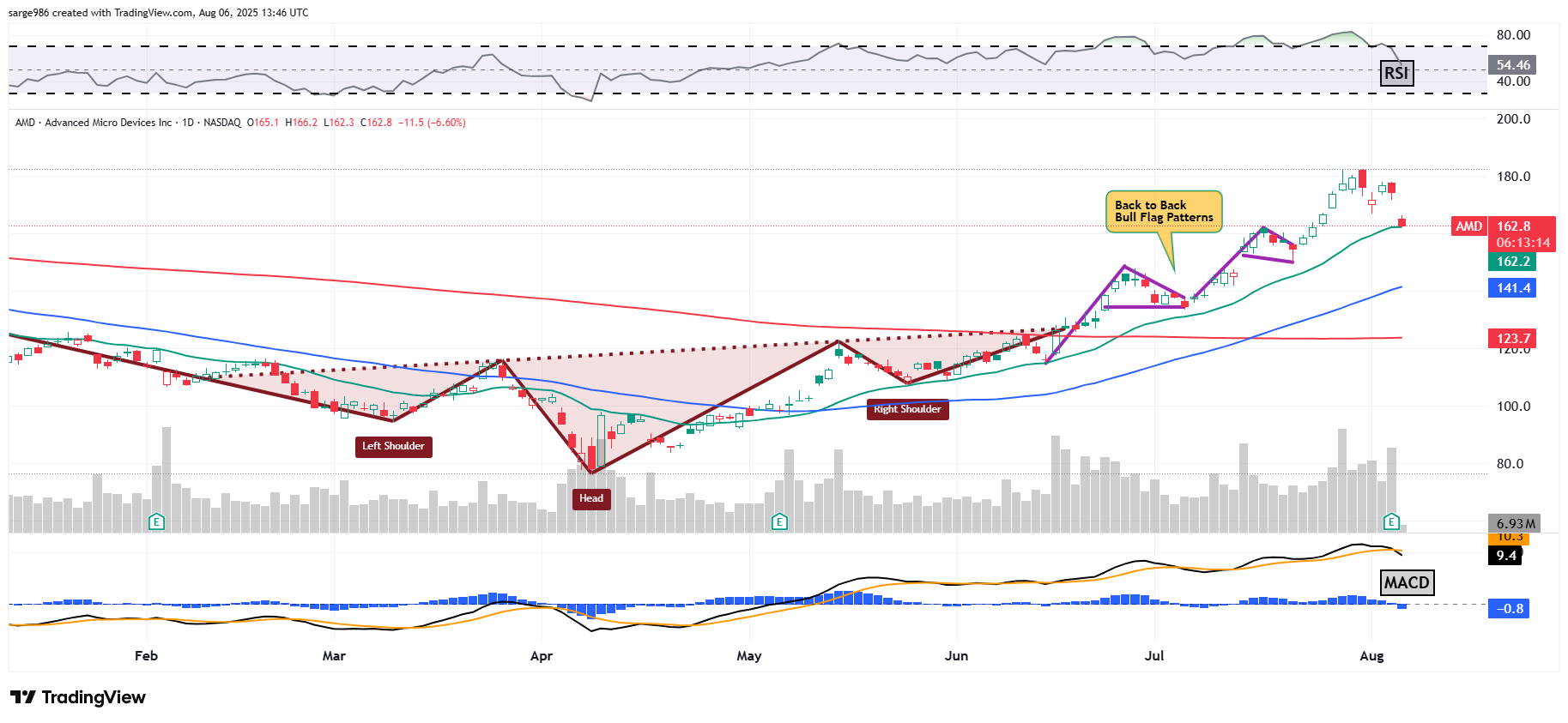
Readers will see an inverted head-and-shoulders pattern of bullish reversal that stretched from February into June. This produced a nice breakout that was accelerated and exacerbated by back-to-back bull flag patterns of bullish continuation. What now?
Relative strength has come in a bit and is no longer reflective of a technically overbought state. The daily MACD, really just this week, has moved toward a more bearish posture with a histogram of the nine-day EMA that now stands below zero and a 12-day EMA that has moved below the 26-day EMA.
However, we do see some support at the 21-day EMA, suggesting that the swing crowd may be buying the dip. Should this stand hold, what we could be seeing is the development of a third successive bull flag pattern. If not, the 21-day line will break, and the stock could test its 50-day SMA. I have been an overnight buyer. I would be an aggressive buyer down there.
Advanced Micro Devices (AMD)
Target Price: $209
Pivot: $182 (recent high)
Add: At or close to 21-day EMA
Add Aggressively: Down to 50-day SMA
Panic: Loss of 200-day SMA
At the time of publication, Guilfoyle was long AMD equity.