Amazon CEO Emerges as Best Bet to Monetize AI Development
I like what I'm hearing from Andy Jassy.
You've reached your free article limit
You've read 0 of 1 free Pro articles.
The Magnificent Seven has had a rough go of it this earnings season. Not much of it has had to do with earnings. A lot of it has had to do with worries over increased capex spending focused on the further development of generative and agentic artificial intelligence.
On those matters, Amazon (AMZN) underperformed the pack on earnings and out-performed it (which may or may not be a good thing) on capex-related guidance. The stock traded lower overnight. This is that story.
For the firm's fourth quarter, tech/retail/ cloud-computing giant Amazon posted a GAAP EPS of $1.95 on revenue of $213.386 billion. While that top-line result beat Wall Street by more than $2 billion and was good enough for annual growth of 13.6%, that bottom-line print fell 1 penny per share short of what had been consensus. While the projection for capex spending shocked some investors, it is key to note that the firm's most profitable business, AWS or Amazon Web Services experienced sales growth of 23.6% and beat Wall Street's expectations by more than $500 million.
The CEO
CEO Andy Jassy commented in the press release, in part to explain the capex up-spend:
“AWS growing 24% (our fastest growth in 13 quarters), Advertising growing 22%, Stores growing briskly across North America and International, our chips business growing triple digit percentages year-over-year — this growth is happening because we're continuing to innovate at a rapid rate, and identify and knock down customer problems. With such strong demand for our existing offerings and seminal opportunities like AI, chips, robotics, and low earth orbit satellites, we expect to invest about $200 billion in capital expenditures across Amazon in 2026 and anticipate strong long-term return on invested capital.”
Operations
As mentioned above, net sales increased 13.6% to $213.386 billion. Within that number, sales of services increased 16.9% to $123.394 billion, while sales of products increased 9.4% to $89.992 billion. Total costs of sales and operating expenses grew 13.1% to $188.409 billion. This resulted in operating income of $24.977 billion (+15.1%) as operating margin expanded from 11.29% to 11.71%.
After accounting for interest, other income and expenses and taxes, net income printed at $21.192 billion (+5.9%). This works out to $1.95 per fully diluted share, up from the year-ago comparison of $1.86.
Segment Performance
- North America generated revenue of $127.083 billion (+10%), producing operating income of $11.472 billion (+24%), which beat expectations
- International generated revenue of $50.724 billion (+17%), producing operating income of $1.04 billion (-21%), falling well short of expectations
- AWS generated revenue of $35.579 billion (+23.6%), producing operating income of $12.465 billion (+17%), which beat expectations
Business Sales Performance
- Online Stores generated revenue of $82.988 billion (+9.8%)
- Third-Party Sellers generated revenue of $52.816 billion (+11.2%)
- AWS generated revenue of $35.579 billion (+23.6%)
- Advertising generated revenue of $21.317 billion (+23.3%)
- Subscriptions generated revenue of $13.122 billion (+14%)
- Physical Stores generated revenue of $5.885 billion (+4.9%)
- Other generated revenue of $1.709 billion (+7.5%)
Guidance
For the current quarter, Amazon is projecting revenue growth of 11% to 15%, to $173.5 billion to $178.5 billion. Wall Street was looking for something close to $175.4 billion, so at the midpoint, this is a slight beat. Current quarter operating income is seen at $16 billion to $21.5 billion. This was a huge miss as the top end of the range fell below the $22.2 billion that had been the consensus view.
For the full year, we know that the CEO mentioned above that the firm is looking to spend about $200 billion on capital expenditures. Hence, the miss on Q1 operating income.
Fundamentals
For the period reported, Amazon generated operating cash flow of $139.514 billion (+20%). Out of that came capex spending of $128.32 billion (+65%), which left free cash flow of "just" $11.194 billion (-71%). The firm does not currently return capital to shareholders.
Moving on to the balance sheet, Amazon ended the period with a cash position of $123.029 billion and inventories of $38.325 billion. That puts current assets at $229.083 billion. Current liabilities add up to $218.005 billion, including $20.576 billion worth of unearned revenue (not a true financial obligation) and no short-term debt. This lands the firm's current and quick ratios at 1.05 and 0.88. Once adjusted for deferred revenues, these ratios rise to 1.16 and 0.97. The current ratios are fine and, remember, we do cut retailers some slack on their quick ratios due to the inventory-centric nature of that business.
Total assets amount to $818.042 billion, of which only 2.8% can be considered intangible. That's outstanding given what the brand name alone must be worth. Total liabilities less equity comes to $411.065 billion. This does include long-term debt of $65.648 billion, which is something the firm could take care of out of pocket nearly two times over. This is a much stronger balance sheet than the merely adequate ratios imply.
Opinion
So far, the dip purchase of Alphabet (GOOGL) on Thursday is working out. I intend to add to my Amazon long after this article is public. I would have loved to have grabbed some in the $190s during the overnight session, but knowing that I was going to have to write about the name on Friday morning, I need to be careful about front-running my own thoughts if I know my thoughts will become part of the news cycle and, hence, public information.
Profitability and free cash flow are suffering due to the AI up-spend. That said, I see what Jassy is selling and I think I believe him. On top of that, of all of the Magnificent Seven hyperscalers, Amazon is the one carrying an oversized payroll and, hence, has the most to gain from investing heavily in the development of artificial intelligence. I will be sticking with AMZN.
Choose Your Poison
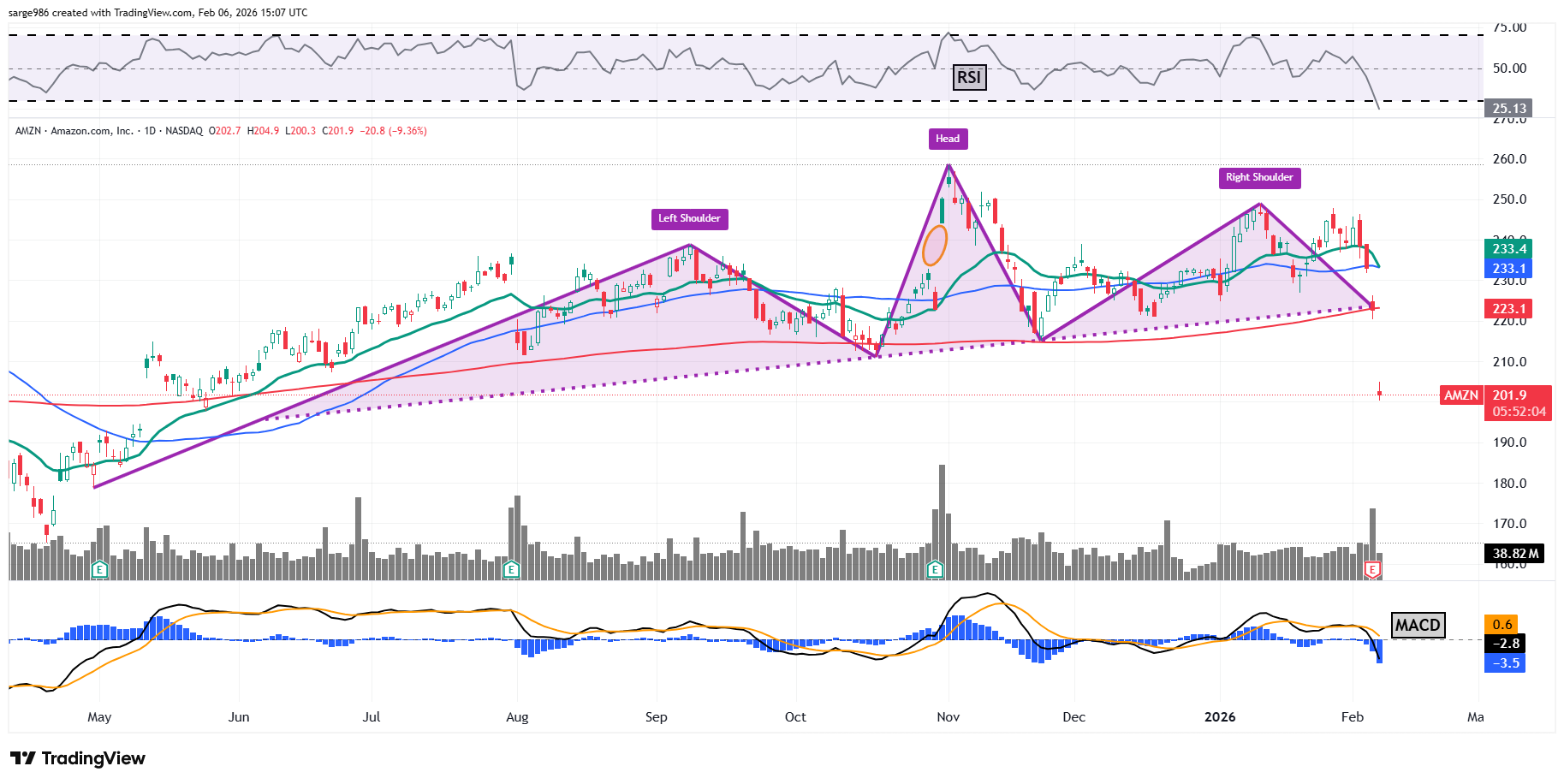
Head-and-shoulders pattern of bearish reversal:
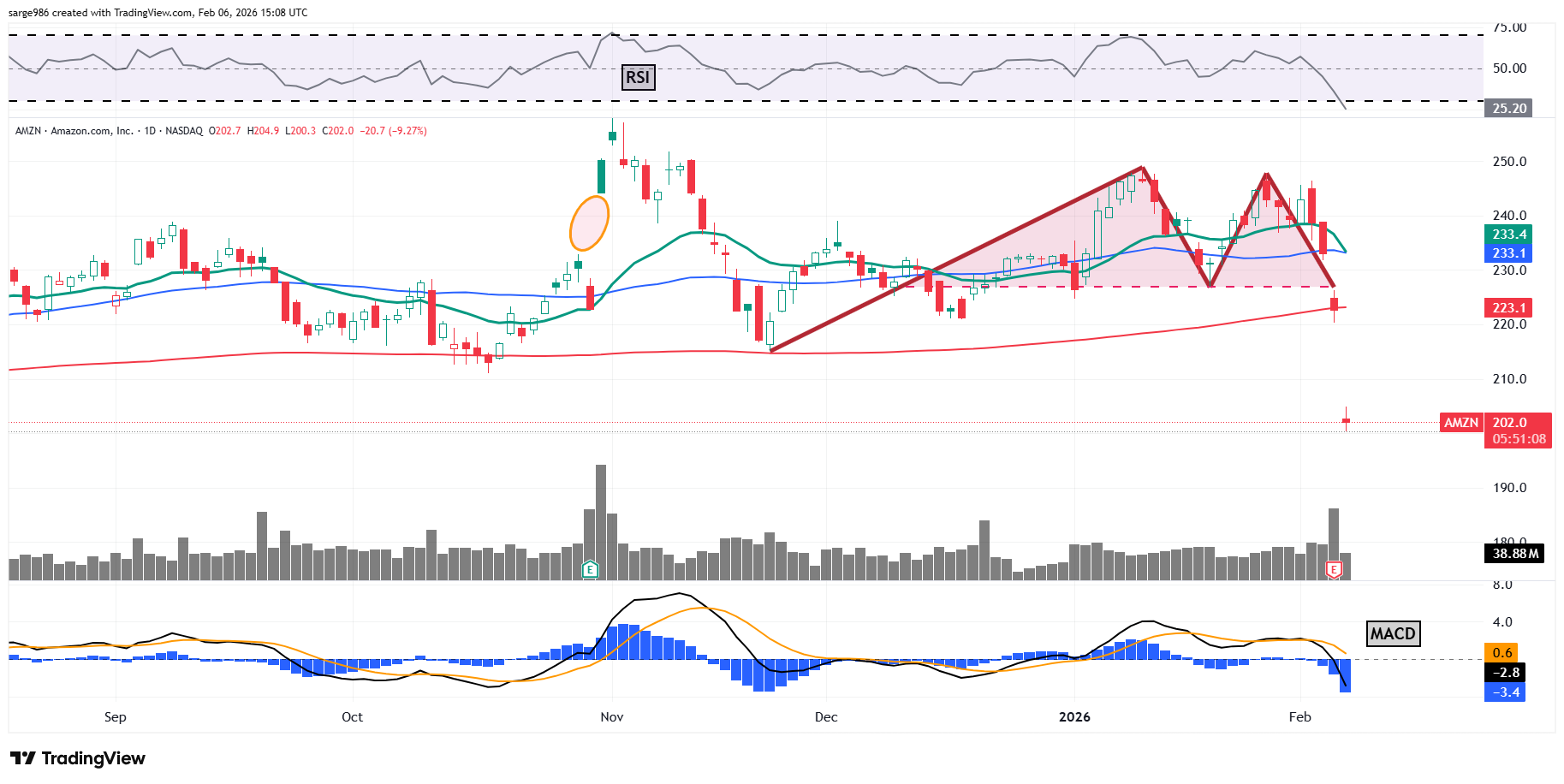
Double-top pattern of bearish reversal:
Triangle-of-pennant pattern foretelling coming volatility:
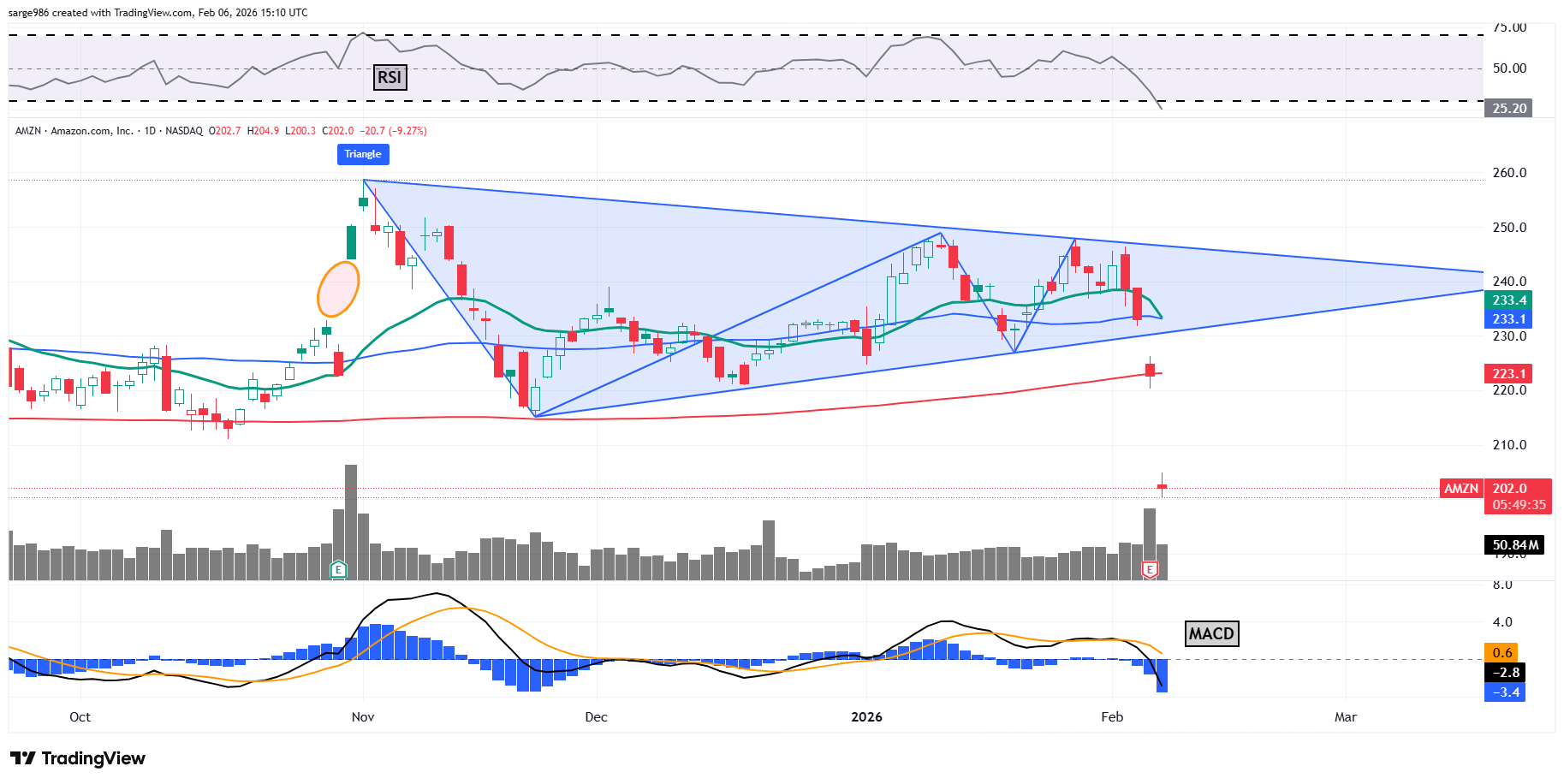
Regardless of which chart you pick, there was a reason to look for trouble.
The real damage done here is the loss of the 50-day SMA earlier this week and the loss of the 200-day SMA overnight. The loss of either and especially the loss of both forces professional managers at firms with a rigid process for risk management to reduce long-side exposure. Does that exacerbate this sell-off? Potentially. It could also force downside momentum in coming days.
Personally, I think I am pretty confident in the idea that Amazon will monetize the development of AI best. I just may have to manage this position for a little bit, which I am OK with as it is not yet a large position. This period of weakness will allow me to get this position to the kind of size I would like by the time it matters most. I have never been all that crazy about Jassy, ever since he took the job. I now think that he sees best where the puck is going and not where it has been.
At the time of publication, Guilfoyle was long AMZN and GOOGL equity.