After Lousy Results, No Room for Nike in My Portfolio
The athletic wear giant has a lot of work to do to become an investment again.
You've reached your free article limit
You've read 0 of 1 free Pro articles.
On Thursday evening, athletic footwear, apparel and equipment giant Nike NKE released the firm's fiscal third quarter financial results. Those results were lousy, but better than expected. The reason the stock caught an overnight beat-down was in the guidance provided, which was putrid. Let's begin...
For the three-month period ended February 28, Nike posted a GAAP EPS of $0.54 on revenue of $11.269 billion. These top- and bottom-line numbers both exceeded Wall Street's estimates, while the earnings per share print absolutely crushed projections. That said, these numbers compare poorly to the year ago comparison of $0.77 on a year over year 9.3% contraction in revenue generation.
Sales were lower across the firm's Nike Direct and wholesale channels, while sales of the Converse brand simply fell off of a table. Gross margin plummeted due to increased discounting, obsolete inventories, increased product costs and changes in the firm's channel mix. Oh, Nike shareholders should probably read this in a quiet room. This stuff is ugly.
Operations
As revenue was dropping 9.3% to $11.269 billion, the cost of sales dropped 4% to $6.594 billion, leaving a gross profit of $4.675 billion (-16%). This took the firm's gross margin down to 41.5% from 44.8%. Demand creation expenses increased 8% as overhead expenses contracted 13%. This put operating expenses at $3.887 billion (-8%) or 34.5% of revenue, up from 34%.
After accounting for interest, other income and expenses and taxes, GAAP net income printed at $794 million, down 32% from the year-ago comparison of $1.172 billion. This works out to $0.54 per fully-diluted share versus $0.77 a year ago.
Revenue Breakdown
- Footwear sales contracted 12% (9% in constant currency) to $7.208 billion
- Apparel sales contracted 3% (1% in cc) to $3.193 billion
- Equipment sales contracted 2% (flat in cc) to $477 million
- Nike Branded sales contracted 9% (6% in cc) to $10.89 billion
- Converse branded sales contracted 18% (16% in cc) to $405 million
- North America sales contracted 4% to $4.864 billion
- Europe, Middle East and Africa sales contracted 10% (6% in cc) to $2.811 billion
- Greater China sales contracted 17% (15% in cc) to $1.733 billion
- Asia Pacific and Latin America sales contracted 11% (4% in cc)
Earnings Before Interest and Taxes
- North America: -21%
- EMEA: -35%
- Greater China: -42%
- Asia Pacific and Latin America: -27%
- Nike Brand: - 41%
- Converse Brand: - 60%
EBIT Margin across the firm dropped from 10.9% to 7.3%.
On Inventories
During the call, CFO Matt Friend commented on the firm's inventory issues. Friend said:
"We are cleaning up the marketplace. For NIKE Digital, we are tightening our buys to support a full-price business model. For NIKE factory stores, we are increasing markdowns to drive velocity of higher volumes of closeout inventory. And for our wholesale partners, we are making investments in sales-related returns, reducing forward supply, and providing higher wholesale discounts to liquidate aged inventory. We expect these actions will continue through the first half of fiscal 2026."
Fundamentals
Nike did not release a statement of cash flows with the other pertinent material. This has often been the firm's custom in the past despite the fact that it is highly inconvenient for both investors and analysts alike. I don't like it one bit, but it is what it is.
Turning to the balance sheet, Nike ended the period with a cash position of $10.393 billion and inventories of $7.539 billion (which is problematic). This values current assets at $24.609 billion. Current liabilities stand at $11.223 billion including $1 billion in debt due to mature within a year. That puts the firm's current ratio at a very healthy $2.19. The quick ratio, which matters greatly here due to the questionable worth of the firm's sizable inventories, stands at a still strong enough 1.52.
Total assets amount to $37.793 billion including very little in the way of intangibles or goodwill. Total liabilities less equity comes to $23.786 billion, including $7.956 billion in long-term debt, which is something that the firm has the ability to cover out of pocket. The balance sheet is in decent shape.
Guidance
CFO Matt Friend offered up some guidance for the current quarter during the call. It wasn't pretty. Friend said:
"We expect Q4 revenues to be down in the mid-teens range, albeit at the low end. This includes several points of unfavorable shipment timing in North America, as well as two points of negative impact from foreign exchange headwinds. We expect Q4 gross margins to be down approximately 400 basis points to 500 basis points, including restructuring charges during the same period last year. We have included the estimated impact from newly implemented tariffs on imports from China and Mexico."
This is considerably worse than Wall Street was prepared for. Wall Street was looking for a year-over-year sales decline of 11.4% or so. Friend added, "We will continue to tightly manage expenses, while we increase investment to fuel our win now priorities, most notably demand creation."
The Chart
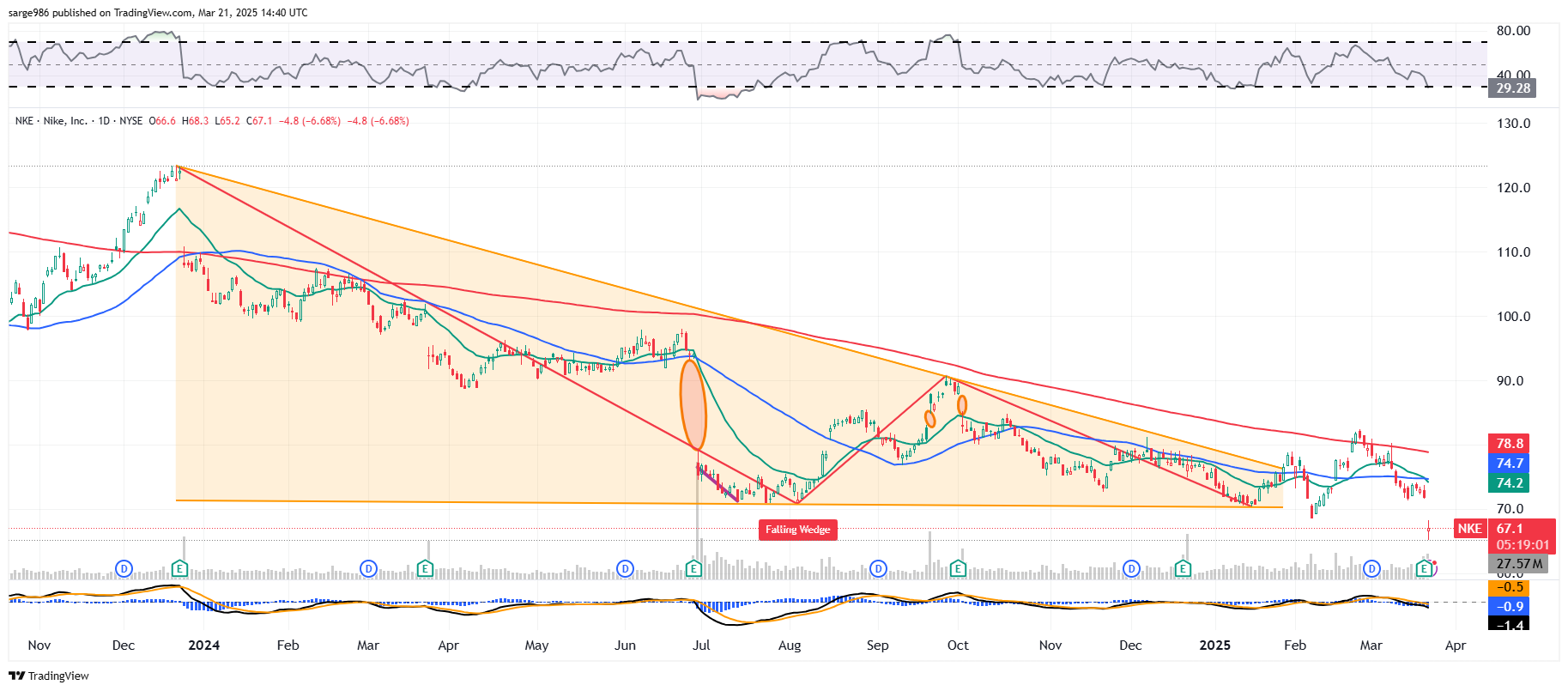
Readers will see a giant falling-wedge pattern of bullish reversal that goes back to late 2023 and culminated in January. The stock tried to break out at that time, possibly in response to the return of Nike loyalist Elliott Hill to the company as CEO. We're six months into his tenure. I would think that the firm would be making better strides toward success by now. I also would have liked to see a little more leadership from Hill during the call and maybe a little less reliance upon the CFO to do the talking.
Long story short, the breakout from the falling-wedge pattern failed. The stock lost its 200-day SMA, 50-day SMA and 21-day EMA in late February/early March after having taken all three in February. Relative strength is at its weakest level of 2025 and close enough to its weakest level since mid-2024. The stock's daily MACD is bearishly postured with all three components once again below zero.
The Verdict
Nike, even with a decent balance sheet, is at least for now, uninvestable. At a time when investors have to be more careful with their capital than ever, there is no room in my portfolios for the stock of a firm largely selling things that people don't need, whose businesses are all in decline. Not to mention that stock still trades at 34 times forward looking earnings with the S&P 500 down around 21 times. Nike now lives in Missouri. They have to show us.
At the time of publication, Guilfoyle had no positions in any securities mentioned.