After Another Year of Outsized Gains, This Energy Name Is My Stock Pick for 2026
Next year is shaping up to be a more challenging one for investors.
You've reached your free article limit
You've read 0 of 1 free Pro articles.
2025 brought the third straight year of outsized gains for equity investors. Other than a sharp but mercifully short selloff following the announcement of reciprocal tariffs in early April, there has been only one direction for the major indexes. That was up.
And despite major handwringing from most economic pundits and the financial press about the impacts of the new tariff regime, their impact on inflation and economic growth have been quite muted to this point.
One reason for this is the massive surge of tech spending in connection with the AI infrastructure buildout, which has been the key economic engine in the U.S. throughout 2025. And for the third straight year, that has been reflection by action in the markets. Most of the price appreciation from equities has come from the largest 10 stocks in the market which now account for roughly 40% of total U.S. market capitalization.
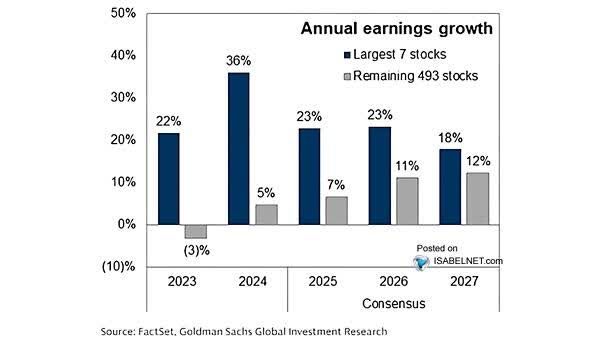
These names, like Microsoft (MSFT) and Nvidia (NVDA) , have also been responsible for the majority of profit growth within the markets since ChatGPT debuted late in 2022. Earnings growth from the "S&P 493" have averaged approximately 3% annually from 2023 to 2025. However, based on bottom-up analysis compiled from FactSet and Bloomberg, that profit growth is projected to rise significantly to just over 10% for both 2026 and 2027. I would take those estimations with a substantial grain of salt.
GDP growth in the second and third quarters of this year has been robust after a minor contraction in Q1 as corporations attempted to front run incoming tariffs by boosting imports. GDP growth in the U.S. is generally projected to come in between 2% and 2.5% in 2026. This is not the annual 4% GDP growth that was the norm in the back half of the 1990s powered by the widespread implementation of the internet. However, U.S. demographics were much more conducive to economic growth a generation ago. The Baby Boomers were in their prime earning years, and the labor participation rate was also 500 basis points higher.
That said, the U.S. remains the best house in the global neighborhood and should see higher growth than the rest of the G7. After three years of a market rally, equities start 2026 in overbought territory, per views from numerous historical valuation metrics. It is hard to see the overall market as anything but pricey when names like Starbucks (SBUX) and Chipotle Mexican Grill (CMG) are trading at roughly 35 times earnings despite declining same-store sales and various other challenges.
As noted recently in Doug Kass’s Daily Diary, mid-term years tend to have at least one significant draw down historically. I believe that is a likely scenario that will play out in 2026.
What triggers that pullback is anybody’s guess. Leading candidates would be the AI bubble bursting, more cockroaches emerging in the private credit markets, and increased write-downs and defaults from commercial real estate.
I am growing more concerned around the multi-family space, which has approximately $2.2 trillion in debt outstanding. CMBS delinquency rates for the sector have roughly doubled over the past year to around 7%. National rents have declined for four straight months on a year-over-year basis — a trend I expect to continue in the first half of 2026. The Federal Reserve also should also be largely on hold in the coming year as well.
A Refuge?
As I noted in my column on December 21, the energy sector has been a market laggard in 2025 and could offer refuge in 2026, especially given that natural gas-fueled electrical generation should get a huge boost from the massive AI data centers being built across the U.S.
Devon Energy (DVN) , which was profiled in that piece, makes it as my stock pick for 2026. The stock offers a low valuation, Devon should benefit from the significant infrastructure coming online throughout the Gulf Coast in the coming year, and the shares also sport a just over 2.6% dividend yield. DVN is the type of value stock I am increasingly targeting as we head into 2026.
The year ahead is likely to be much more challenging than in recent years and a cautious portfolio stance is warranted to start the year given current valuations.
At the time of publication, Jensen was long DVN.