$82 Billion Warner Bros. Deal Won't Save Netflix's Ailing Stock
Here's why I wouldn't touch the streaming giant with a 10-foot pole, even as it seeks to extend its entertainment dominance.
You've reached your free article limit
You've read 0 of 1 free Pro articles.
The news broke on Friday morning. Netflix (NFLX) , the former FANG stock that was never invited to join the Magnificent Seven, posted a press release to the firm's website.
Netflix would acquire Warner Bros. Discovery (WBD) to include that firm's television studios, HBO Max and HBO for a total enterprise value of roughly $82.7 billion (equity value of $72 billion). That comes to $27.75 per share.
Interestingly, Netflix has announced that it will maintain Warner Bros current operations. However, the deal is expected to close after the already announced split of the Discovery Global operation from the Warner Bros Discovery parent. Discovery Global will become its own publicly traded company, most likely at some point in Q3 2026. The big deal won't close for a year to a year and a half.
Under the terms of the deal, each WBD shareholder will receive $23.25 in cash and 4.501 in Netflix common stock. In theory, the acquisition would reinforce Netflix's commanding position in the streaming entertainment universe, which to put it bluntly means that this deal could face some regulatory resistance. Netflix will pay WBD a termination fee of $5.8 billion should this deal never see completion. WBD will owe Netflix a fee of $2.8 billion should the deal fail due to certain reasons on their end.
Hmm...
It appears that Paramount Skydance (PSKY) , which is a competitor in the streaming space, but obviously not in the commanding position that Netflix is, had offered as much as $30 per share for all of Warner Bros Discovery to include Discovery Global. Warner Bros Discovery, after the split, will include Warner Bros. studios, DC Studios, DC Entertainment, Cartoon Network Studios, HBO, HBO Max and Turner Classic Movies (TCM).
The eventually spun-off Discovery Global would include Discovery+ and WBD's linear or cable TV brands. Those brands would include CNN, TNT, TBS, HGTV, Food Network, TLC, Animal Planet and more. Paramount was also willing to pay a $5 billion breakup fee to shareholders if that deal did not get through the regulatory obstacle course within 10 months.
From Right Field
Huber Research downgraded Netflix in response to the deal from an "Overweight" rating to "Underweight" while reducing the firm's target price from $137.50 to $92. Huber views this as "a very risky transaction," particularly given its announced size of $82.7 billion enterprise value and sees that it marks "a significant change in strategy at Netflix" that the firm does not think is needed.
From Left Field
Senator Elizabeth Warren (Mass-D) said that Netflix's deal to acquire Warner Bros. "looks like an anti-monopoly nightmare." This deal "would create one massive media giant with control of close to half of the streaming market," Warren posted to her X (formerly Twitter) account. Warren added, "It could force you (consumers) into higher prices, fewer choices over what and how you watch, and may put American workers at risk."
Problem Child
Just a refresher: Netflix executed a 10-for-1 stock split on November 17, 2025. The split was announced on October 30. The stock has been mired in a tailspin not only since the split but since late June. After adjusting for the split, which did nothing to improve investor sentiment, the stock is now down 23.2% from its June 30 apex of $134.12. The S&P 500 has rallied 10.9% over that same tie frame.
This deal will require a firm with a cash balance of $9.324 billion and a debt load of $14.463 billion to secure more than $59 billion in bank loans while also deploying cash. In other words, this deal will put Netflix at some not insignificant risk and will almost certainly weaken the quality of the firm's balance sheet in a potentially substantial way.
My Thoughts
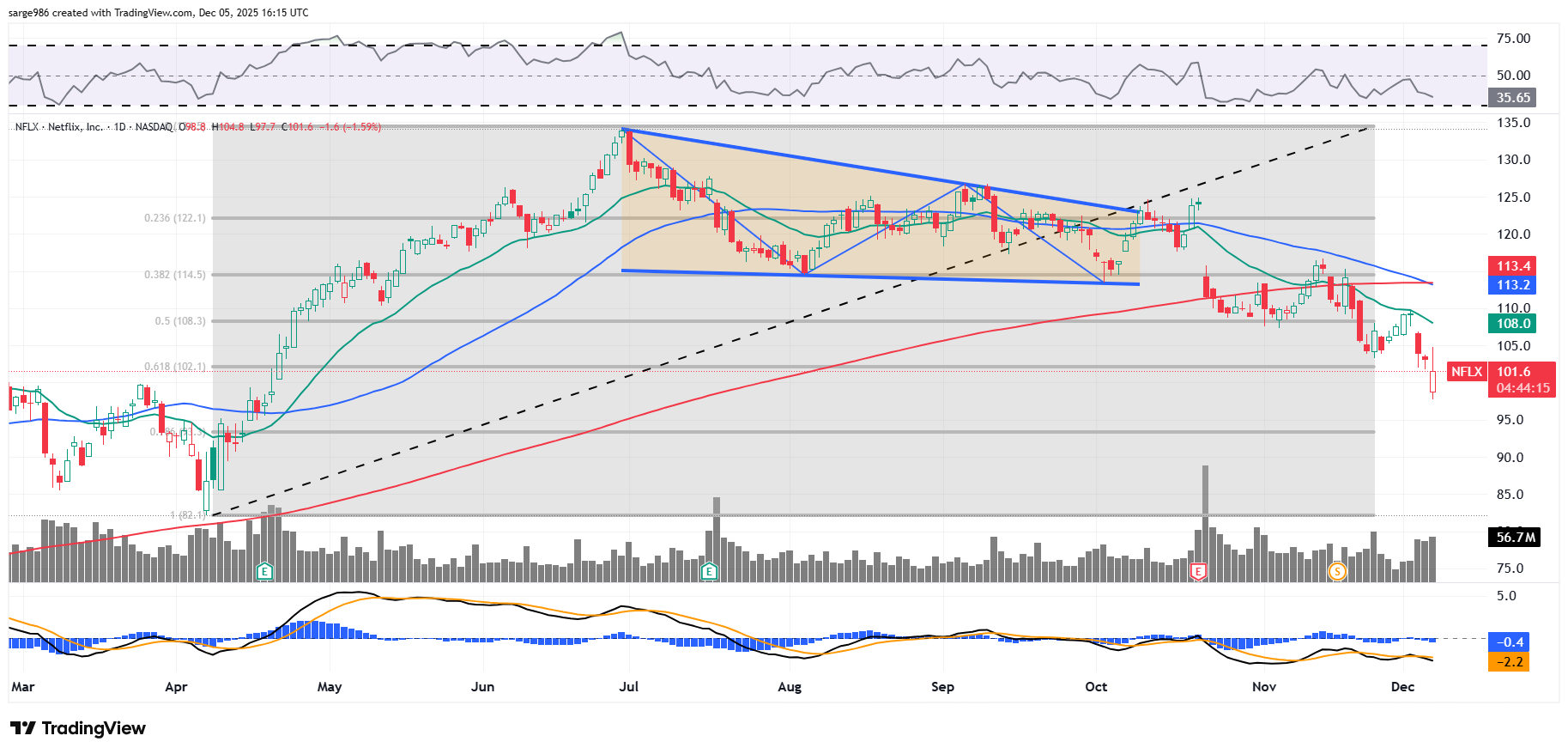
Readers will see that NFLX developed a falling-wedge pattern of bullish reversal coming off of that June high. The stock broke out from this bullish setup to the downside. Think about that for a minute.
Not only is relative strength soft, but the daily MACD is postured quite bearishly. The histogram of the nine-day EMA is negative. That's a short-term bearish signal. The 12-day EMA is running below the 26-day EMA with both of those lines also in negative territory. That's more of a medium-term bearish signal.
Want more? OK. On Thursday, Netflix suffered a death cross as the stock's 50-day SMA fell below its now (literally just now) declining 200-day SMA. This next item is really important. NFLX is fighting on Friday to hold onto the 61.8% Fibonacci sequence retracement level of its early April into late June rally. Losing this level would possibly set up a fall to the stock's 78.6% Fib retracement level (close to $93).
What do I think? I hate to be blunt, and I could be wrong, but if I was long NFLX, I would sell it. If I were short NFLX, I would hold out for prices in the low-to-mid $90s and if I were flat NFLX (which I am), I would not touch it with a 10-foot pole.
At the time of publication, Guilfoyle had no positions in any securities mentioned.