Stock Market Today

Market updates and conversation from TheStreet Pro team. Follow the latest and join the conversation below.

Stock Market Today: October 28, 2026

Newest first · All times Eastern · 12 updates

DATE:
By Neil Sethi

Microsoft Rises on Double Beat as Azure Growth Accelerates

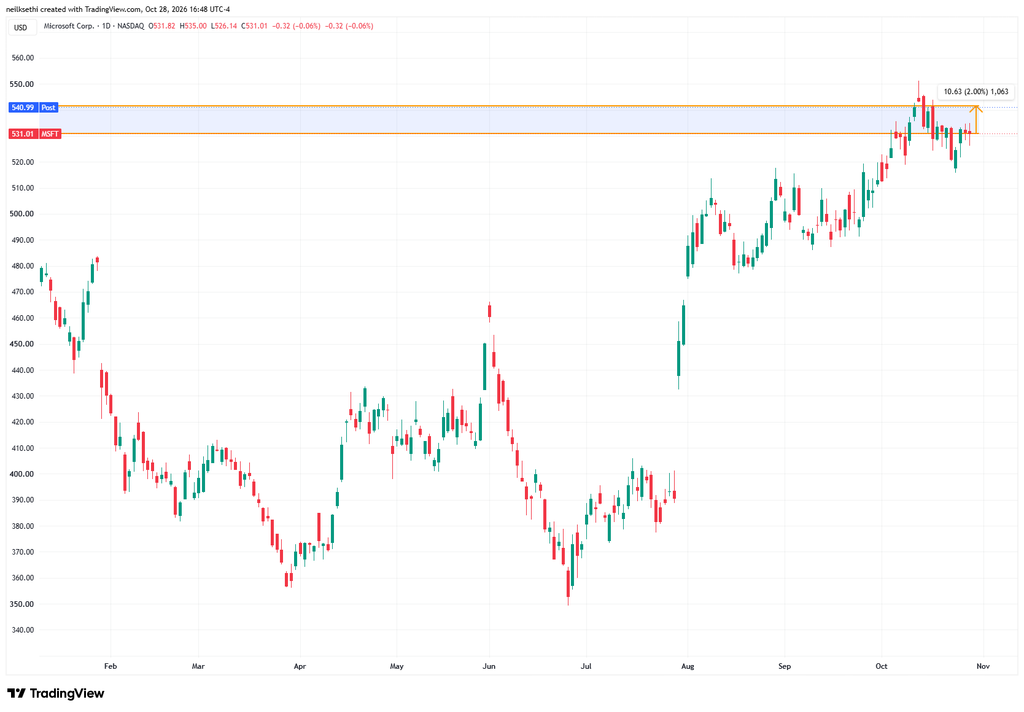
Microsoft (MSFT) shares were up about 2% in after-hours trading Wednesday, off their highs, after the company’s fiscal first-quarter results topped Wall Street estimates on revenue and earnings, led by faster growth in its Azure cloud business, according to TipRanks. Shares came into the report up nearly 35% over the past three months.
Results Beat on Both Lines

Adjusted earnings came in at $4.89 per share versus the $4.73 consensus, and revenue was $92.28 billion against the $90.69 billion expected, according to TipRanks. Revenue rose 19% year over year and landed $1.33 billion above the top of the company’s own $89.85 billion to $90.95 billion guidance range, per TIKR. GAAP earnings rose 32% to $4.92 per share, including a $207 million net gain from Microsoft’s OpenAI investments, according to the company’s earnings release.

Margins widened even as depreciation climbed. Operating income rose 21% to $45.9 billion, lifting the operating margin to 49.8% from 48.9% a year ago, per the release. Gross margin slipped to 67.8% from 69.0% as depreciation and amortization rose 44%, but operating expenses grew just 6%.

Azure Accelerates

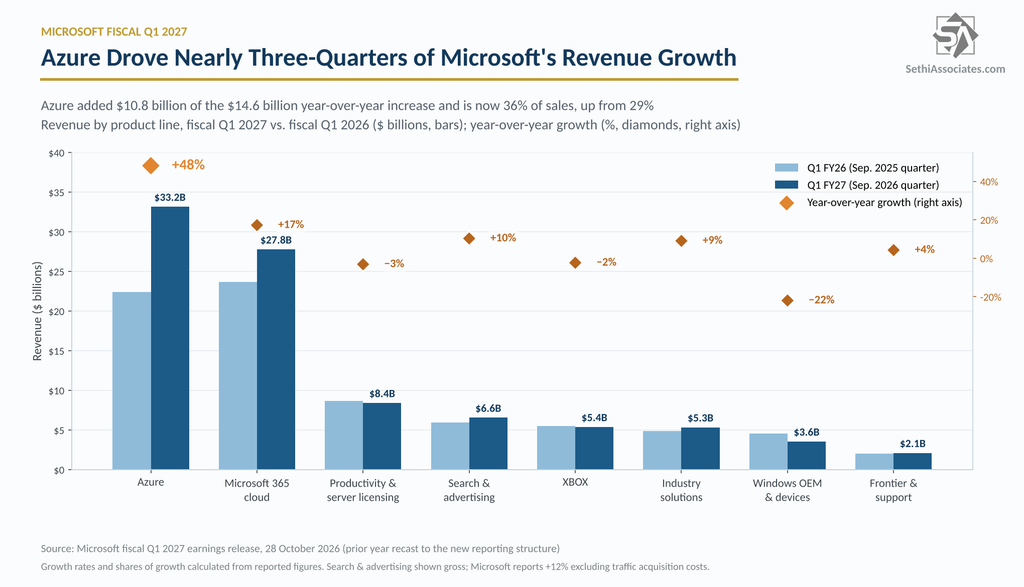
Azure (cloud) revenue grew 48% to $33.17 billion, the first quarter Microsoft has reported Azure in dollars, according to the release. That topped the $32.32 billion analysts expected, per TipRanks, as well as the 44.8% growth rate analysts had modeled, per TheStreet, and the roughly 47% “whisper number” among institutional investors, according to MarketWatch. Azure grew 42% in the June quarter under the new, narrower definition, per CNBC.

Per Claude, Azure supplied $10.8 billion of the $14.6 billion year-over-year revenue increase, or about 74%, and now makes up 36% of total revenue versus 29% a year ago. Revenue outside Azure grew about 7%. Microsoft Cloud revenue rose 30% to $63.9 billion, with Chief Financial Officer Amy Hood noting growth accelerated, per the release. Microsoft 365 cloud revenue of $27.78 billion also topped the $27.37 billion consensus, according to TipRanks. Azure is now Microsoft’s largest product line, ahead of Microsoft 365 cloud.
Spending and Cash Flow

Capital spending came in about $5 billion below expectations even as Azure beat. Capital expenditures including finance leases rose about 30% to $45.2 billion, short of the $50.67 billion StreetAccount estimate, according to TipRanks, and below the more than $50 billion Microsoft had signaled for the quarter, per TIKR. Cash spending on property and equipment more than doubled to $39.4 billion from $19.4 billion, according to the release. Microsoft attributed the faster growth in cash spending to timing differences between receiving and paying for goods and “a lower mix of finance leases,” according to CNBC.

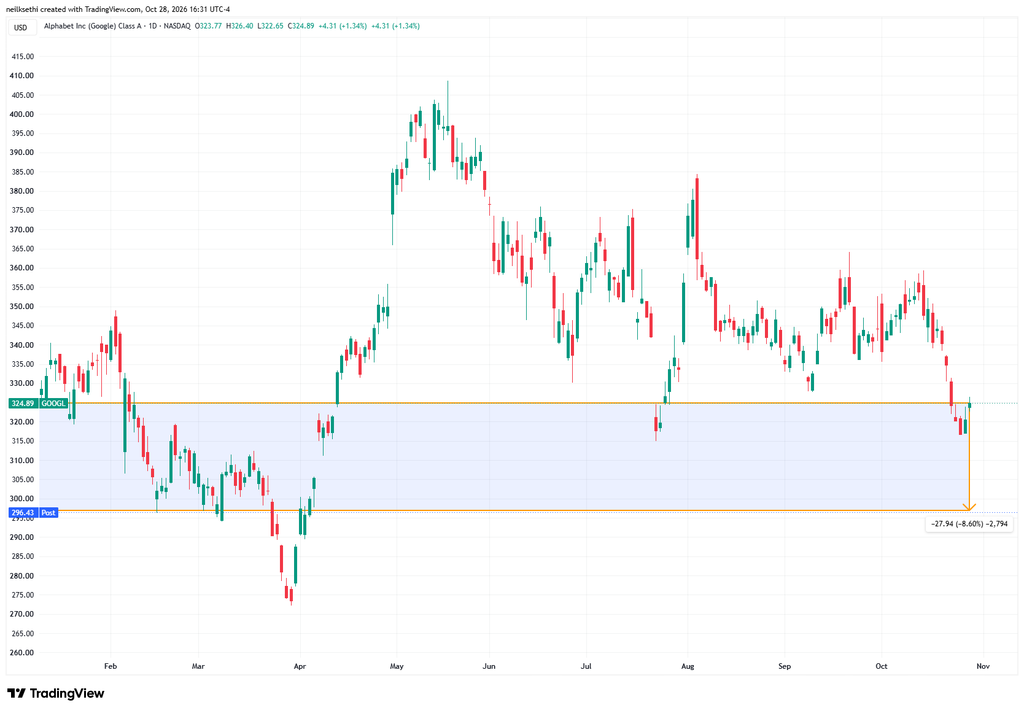
Free cash flow fell 27% to $18.63 billion but stayed positive, according to TipRanks. By contrast, Alphabet (GOOGL), which also reported Wednesday, posted negative free cash flow for its quarter, per TipRanks, and shares are down over 8%.

Microsoft returned $10.2 billion to shareholders through dividends and buybacks, per the release.

Backlog and Segments

Commercial backlog stalled sequentially. Commercial remaining performance obligation rose 73% year over year to $677 billion, according to the release, but that was little changed from $678 billion at the end of June, per Quartz, and short of the roughly $706 billion estimate cited by Wall St Engine.

This was the first report under Microsoft’s new two-segment structure. Agents and Infra revenue rose 25% to $76.8 billion, ahead of the $75.6 billion expected, according to Yahoo Finance. Devices and Consumer revenue fell 3% to $15.48 billion but beat the $15.05 billion consensus, according to TipRanks. Within it, Windows OEM and devices fell 22%, which CNBC attributed to higher memory and storage costs pushing up device prices. Xbox content and services fell 2%, while search and advertising revenue excluding traffic acquisition costs rose 12%, per the release.

What to Watch on the Call

Microsoft holds its conference call at 5:30 p.m. ET, where it will provide forward guidance, according to the release. Some key items on the call are the fiscal second-quarter Azure growth outlook, whether the capital spending shortfall reflects timing or a slower build, and what explains the flat sequential backlog. Wall Street rates the stock a consensus Strong Buy with an average price target of $611.85, per TipRanks.
By Neil Sethi

Alphabet Drops on Earnings Miss, Cash Flows Turn Negative

Alphabet (GOOGL) shares are down over 8% in after-hours trading Wednesday after third-quarter revenue and earnings missed expectations, and a blowout quarter from Google Cloud was overshadowed by softer core advertising and a swing to negative free cash flow.

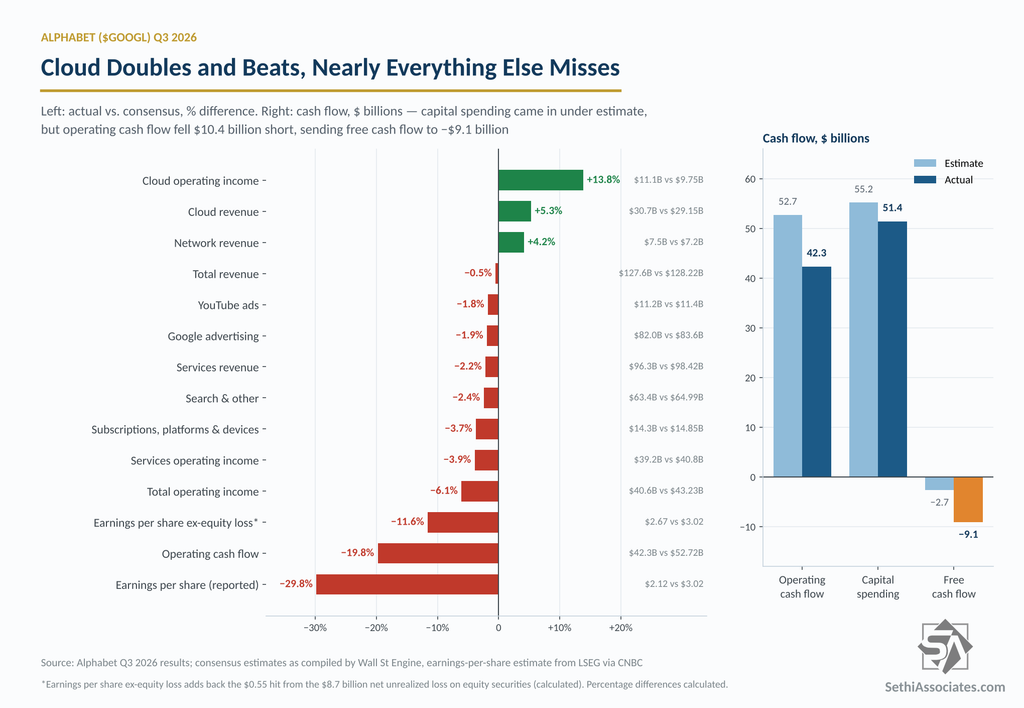
Revenue climbed 24.7% year over year to $127.58 billion, missing expectations of $127.96 billion, according to TipRanks. Earnings came in at $2.12 a share against the $3.02 consensus estimate. Much of that gap came from about $8.66 billion in losses on stakes Alphabet holds in other companies, which cut 55 cents from earnings per share after taxes. Without that hit, earnings would have been about $2.67 a share, still short of the estimate.

Cloud was the standout. Google Cloud revenue more than doubled to $30.7 billion from $15.16 billion a year earlier, topping the $29.15 billion analysts expected, per TipRanks. The unit’s $11.1 billion in operating income puts its margin at about 36%. The company said its custom-chip business was a “meaningful contributor to revenue growth.”

The rest of the business was mixed. Search revenue rose 12% to $63.35 billion but missed the $64.96 billion estimate, according to CNBC. YouTube ad revenue of $11.21 billion fell short of the $11.5 billion Wall Street expected, per TipRanks. Subscriptions, platforms and devices revenue grew 11% to $14.29 billion. Cloud revenue has now climbed past YouTube’s ad revenue, per TipRanks’ segment data.

Operating income still grew 30% to $40.58 billion, even as research and development spending jumped to $20.64 billion from $15.15 billion, TipRanks noted. That operating income figure missed the $43.19 billion FactSet forecast, though, per CNBC.

Cash flow was the sore spot. Capital expenditures more than doubled to $51.36 billion from $23.95 billion a year earlier, and free cash flow fell to negative $9.07 billion, against the negative $2.70 billion analysts expected, according to CNBC. Alphabet bought back no stock in the quarter.

“Google Cloud revenues grew 103%, powered by huge demand for our AI infrastructure and AI solutions,” CEO Sundar Pichai said in the earnings release. He added that the Gemini app has reached 1 billion users, making it the company’s fastest-growing product ever.

I’ll put an update out in the morning if anything notable comes out on the call.

By Neil Sethi

FOMC Holds Rates Steady; Governor Cook Dissents

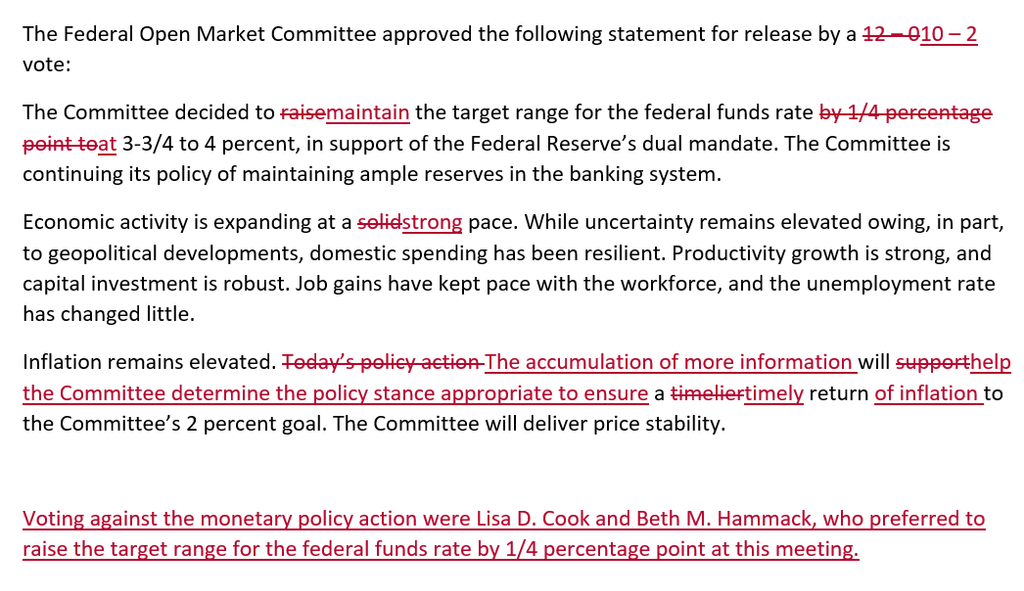
As expected by most, the Fed held rates unchanged this afternoon, reiterating their commitment to bringing down inflation, but not offering a clear signal on December.

The statement remained short but upgraded the assessment of the economy to a “strong pace” from a “solid” one in September.

The committee went on to say that the the “accumulation of more information will help the committee determine the policy stance appropriate to ensure a timely return of inflation to the committee’s 2% goal.”

There was one big surprise, though. I mentioned in my preview there would likely be dissents, particularly from Cleveland Fed President Hammack, who did dissent, but there was also a dissent from Governor Lisa Cook, her first dissent since becoming a Board member in 2022. As you may recall, President Trump has recently renewed efforts to remove Cook from the Fed, following an earlier effort blocked by the Supreme Court.

From the press conference

Warsh starts on economic growth, noting the strong numbers fueled by consumer spending and business investment. Unemployment rate down from a year ago. Says later that the investment boom is “broadening”.

“Not willing to call financial conditions tight” but they have moved “in the direction of achieving a longer and more durable period of economic growth”.

There will be eight meetings next year, but one will focus “exclusively on broad monetary policy strategy with neither a vote on the Federal Funds rate nor a policy statement anticipated” and sees that growing to two meetings on strategy and six on policy in 2028.

Interesting moment at the presser: before answering a question from Colby Smith of The New York Times, Warsh said, “I have been reading your stories this week.” Smith was seen by some as an outlet the Fed used to signal coming moves during blackout periods when she covered the Fed for the Financial Times. The remark could raise her standing as a potential “Fed whisperer,” a title long held by The Wall Street Journal’s Nick Timiraos. Timiraos seems to have lost some favor after his report that Governor Waller wasn’t a fan of Warsh’s task forces which drew harsh criticism from Treasury Secretary Scott Bessent.

Warsh on the impact of interest rates on the AI buildout: “On the thrust of your question of — with respect to the new technology and this investment surge — do interest rates matter? I believe they do. And I don’t believe that they’re somehow divorced from the rest of the economy.”

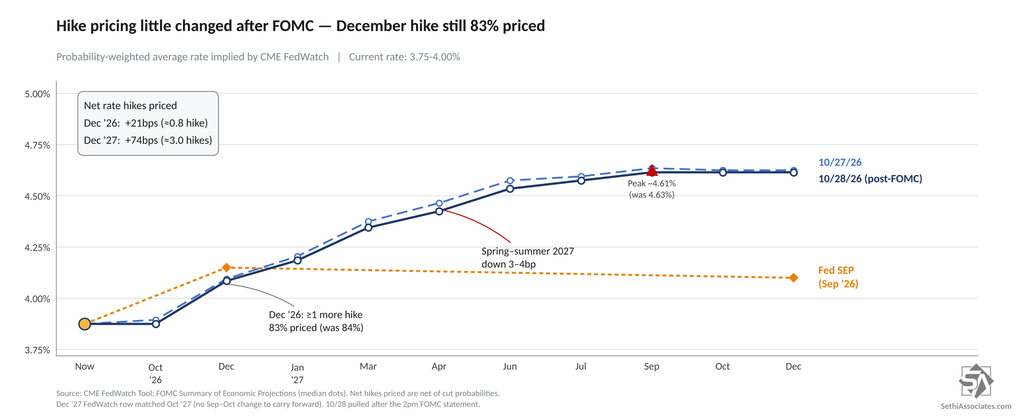
Post-FOMC rate hike expectations are little changed:

  • December: the odds of a hike are 83%, from 84% yesterday.
  • Hikes priced by Dec ‘26: +21bps (about 0.8 hikes), from +22bps.
  • Hikes priced by Dec ‘27: +74bps (about 3.0 hikes), from +75bps.
By Jason Meshnick, CMT

Question: How Do You Trade FOMC Releases?

I’ll be honest. Throughout my career as a trader, I was never able to catch the swings that followed an FOMC meeting. I was better as a trend follower, or even better at trading low-frequency movements that didn’t coincide with news events. Later, I grew to prefer the technicals and quant-related analyses because I like things that are rules-based. They say there are old traders and bold traders, but no old, bold traders. If I’d stayed on Wall Street, I think I would’ve become an old trader, since I was never a bold trader.

That brings me to today. I think trading FOMC releases require a level of boldness.

So, here’s my question: how do you trade the FOMC release?

Please leave an answer in the comments section below.

By Neil Sethi

2-Year Treasury Shorts at Risk?

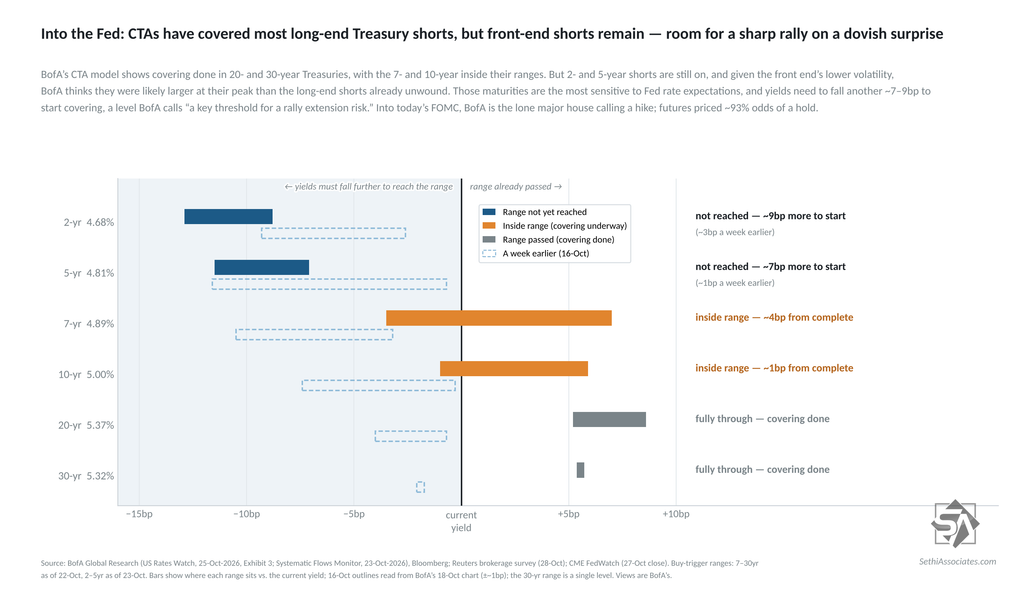
Into today’s FOMC, BofA’s CTA model shows while trend followers have mostly covered their long-maturity Treasury shorts, there remains a healthy amount of short-maturity shorts which could be at risk from a dovish Warsh:

▪ 20- and 30-year: covering done
▪ 7- and 10-year: inside their covering ranges, the 10-year ~1bp from finishing
▪ 2- and 5-year: shorts still on

The 2-year in particular is highly sensitive to Fed rate expectations. Because the front end is less volatile, BofA thinks those shorts were likely larger at their peak than the long-end ones already unwound. Yields there need to fall another ~7–9bp to start covering, a level BofA calls the “key threshold for a rally extension risk.”

So an unexpectedly dovish Fed could set off a sharp move lower in front-end yields, as covering adds to the rally.

By Neil Sethi

Earnings Misses Getting Light Treatment

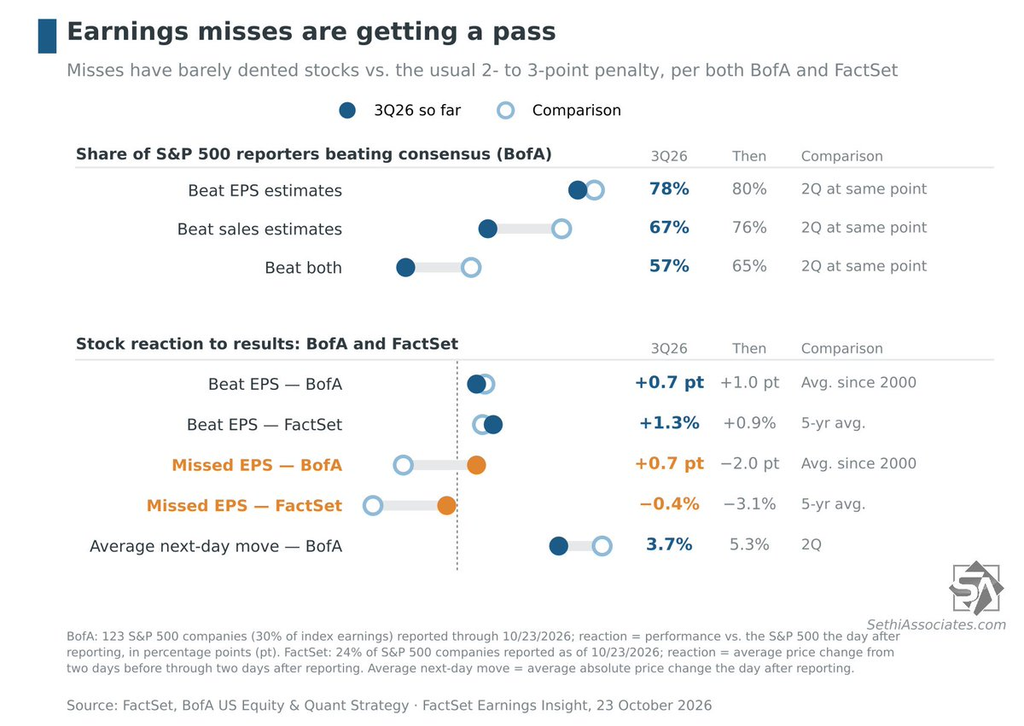
Ahead of this week’s batch of earnings, a little surprisingly, misses have been getting a relative pass.

Per BofA, companies missing EPS estimates have outperformed the S&P 500 by 0.7 percentage points the day after reporting, vs. a typical 2-point lag since 2000.

FactSet finds the same: misses have fallen just 0.4% from two days before their reports through two days after, vs. a 3.1% five-year average.

Beats, in contrast, are being rewarded at roughly normal levels (BofA +0.7 pt vs. +1.0 average; FactSet +1.3% vs. +0.9%)

Overall, the average next-day move is 3.7% vs. 5.3% in 2Q.

By Chris Versace

Another 2027 Inflation Warning

In today’s 8 Key Items alert, we mentioned expected 2027 pricing action from several companies as they look to cover rising costs. Now we can add the U.S. Postal Service (USPS) to that list.

In 2027, USPS will adopt a FedEx (FDX) and UPS (UPS) pricing tactic as it contends with high fuel prices.

In January, the agency will start levying a fuel surcharge on domestic shipments under Ground Advantage, Priority Mail, Priority Mail Express and Parcel Select. The surcharge will update weekly based on diesel and jet fuel prices.

Read more here

By Neil Sethi

AI Imports Push Goods Trade Gap to 18-Month High

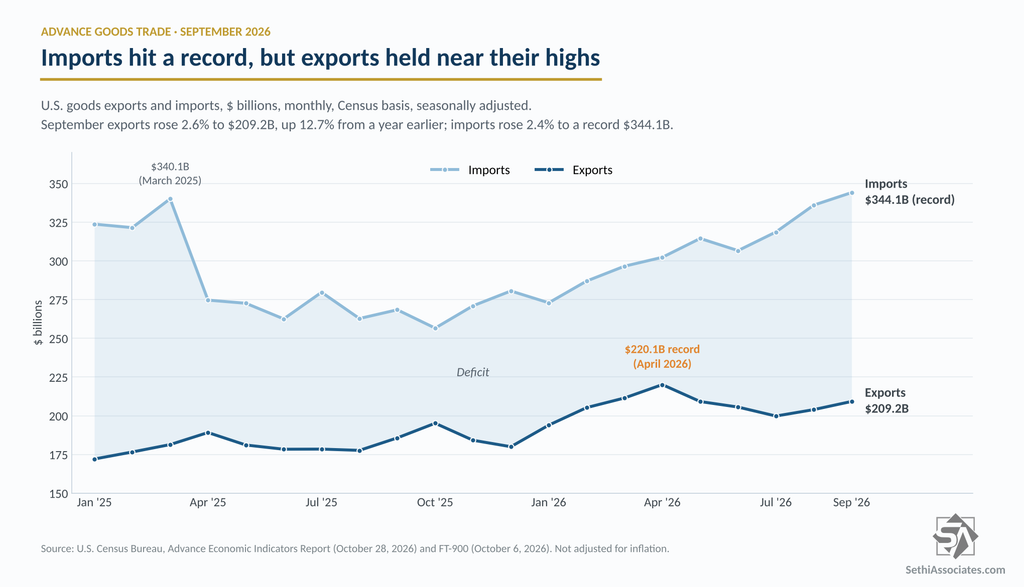
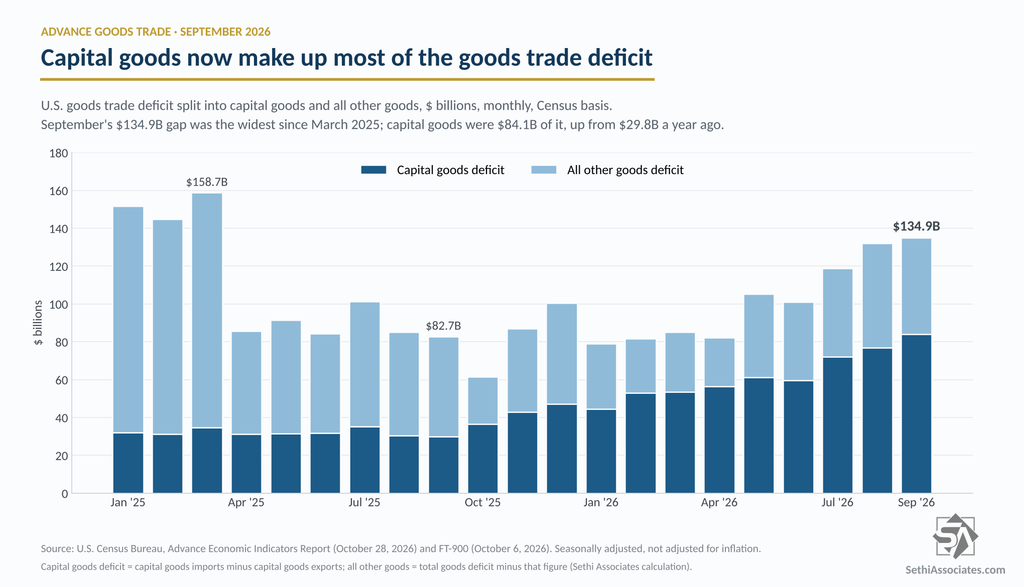
The U.S. goods trade deficit (goods are approximately three-quarters of U.S. trade) widened 2.1%, or $2.8 billion, to $134.9 billion in September, the largest since March 2025 and a third straight monthly increase, according to the Census Bureau’s advance report. Economists surveyed by Bloomberg had expected the gap to narrow to $130.2 billion. August’s deficit was revised to $132.1 billion from $132.6 billion.

Positively, goods exports rose 2.6% to $209.2 billion, but because exports are about 40% smaller than imports, the 2.4% rise in imports to $344.1 billion still widened the gap. That was the third-highest on record for goods exports, up 12.7% from a year earlier, while imports hit a record.

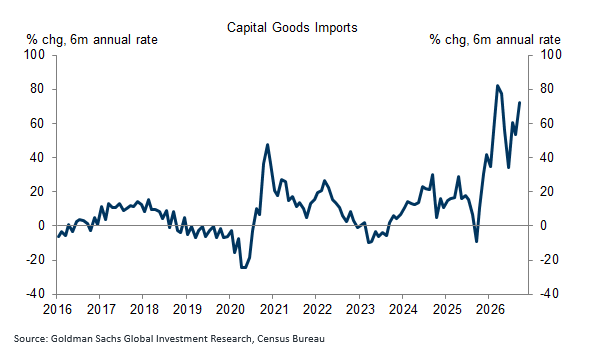
Notably, capital goods imports jumped 7.5%, or $10.9 billion, to a record $157.4 billion, up 77.2% from a year earlier. The category includes the computers, semiconductors and telecommunications equipment going into the AI buildout. The capital goods deficit is now $54.3 billion larger than a year ago, more than the $52.2 billion widening in the overall goods deficit over that period. Goldman noted: “The capital goods category has been a primary contributor to the widening trade deficit this year and has partially offset the impact of rapidly rising AI business investment on GDP growth.”

Consumer goods imports rose 3.1%, the most in four months, but were still 12.0% lower than a year earlier. Industrial supplies imports, which include petroleum and nonmonetary gold, fell 6.0% after jumping 17.1% in August, and auto imports fell 4.0%.

On the export side, foods, feeds and beverages jumped 12.8% to $16.0 billion, consumer goods rose 6.5% and capital goods rose 5.4%. Industrial supplies exports fell 1.6% and autos fell 5.6%.

Before the release, the Atlanta Fed’s GDPNow model had net exports subtracting 2.86 percentage points from third-quarter GDP, after they subtracted 1.10 percentage points in the second quarter.

The full trade balance report, with services and inflation-adjusted figures, is due November 4.

By Neil Sethi

The Fed and the 1-Day VIX

I mentioned in the Week Ahead that my expectations for the Fed today were for no major fireworks:

The Fed has never hiked with less than a 10% chance priced into markets, so we’re either going to get the biggest surprise to markets the Fed has ever delivered (on par with the surprise 75 basis point hike in 2022) or a relative snoozer that is already priced. It would be quite something though if they did hike (which is what BofA still calls for by the way) as it would not only be a huge hawkish surprise – a handful of days before the election – but it would also mean the long-standing “troika” at the top of the Fed in Chair-Vice Chair-NY Fed President (Warsh-Jefferson-Williams) had been busted wide open.

In terms of the rest of the meeting it is expected to also follow the “snoozer” pathway, particularly as there is no new Summary of Economic Projections and Chair Warsh has consistently been cutting back the length of the press conference and providing little information. Again, a change to that would be a big surprise. But the one thing that won’t surprise is dissents. The other regional Fed Presidents (Hammack in particular) have expressed a preference for continued rate hikes.

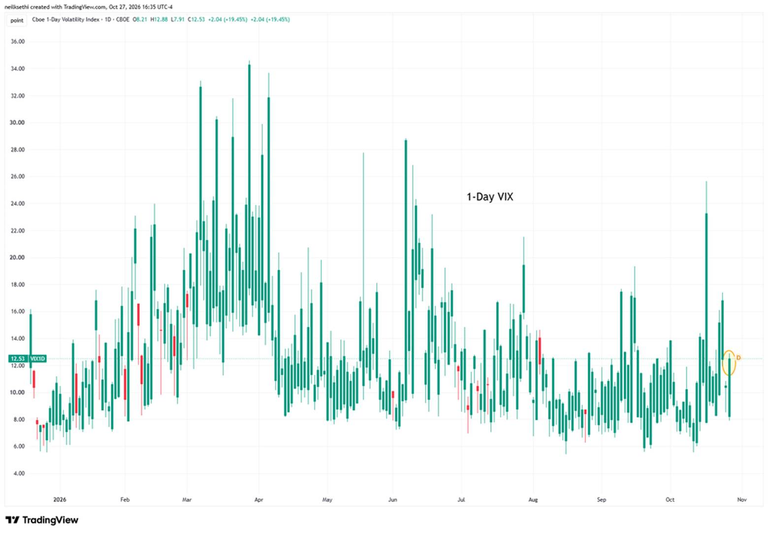
It seems markets are expecting a relative snoozer as well. I mentioned in last night’s update that “the 1-day VIX rose to 12.5 Tuesday, implying a move of about 0.79% for the S&P 500 today, pretty subdued.” I went ahead and looked back, and it’s the lowest pre-Fed day reading since April.

By Neil Sethi

SK Hynix Gives Another Boost to Chip Stocks

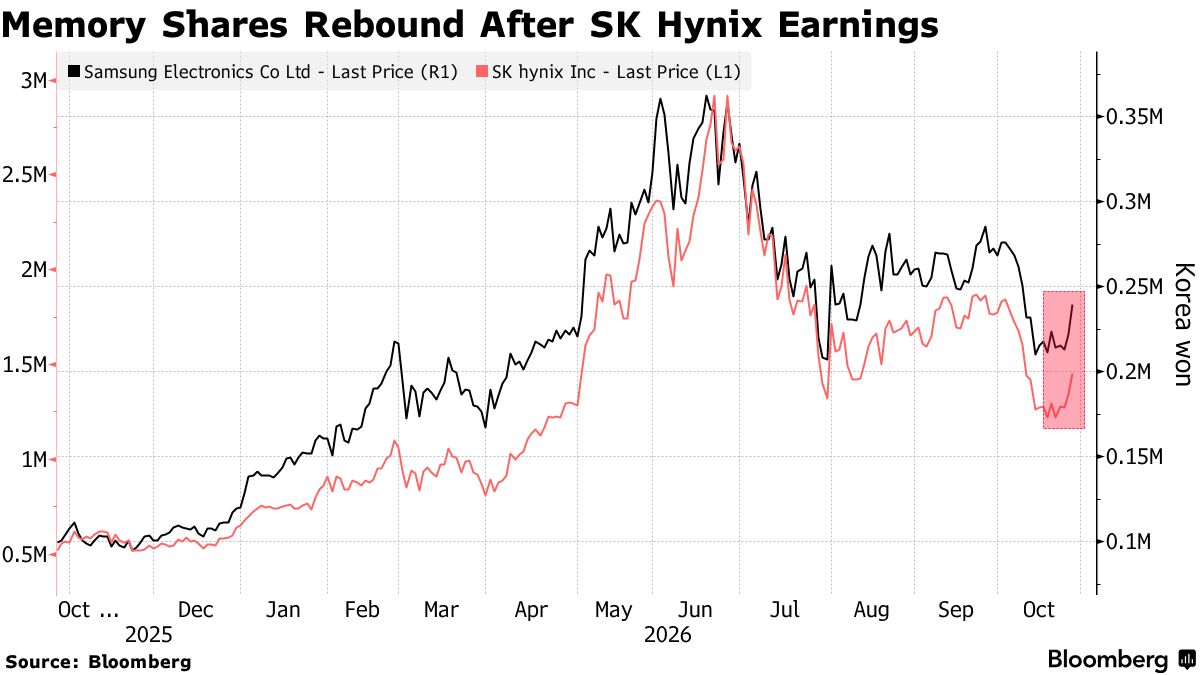
The chip rebound got another boost overnight as SK Hynix (SKHY) reported record third-quarter results, saying it has sold out of DRAM and high-bandwidth memory (HBM) through 2029 and that HBM demand is double what it can supply, per Reuters. It also unveiled about 60 trillion won (roughly $45 billion) of additional buybacks and dividends. Its shares closed up 10.9% in Seoul, Samsung Electronics rose 9% and the Kospi gained 6.6%, per CNBC. The iShares Semiconductor ETF (SOXX) is indicated up another 1% premarket as of 8:30 a.m. ET after gaining nearly 7% over the past two sessions.

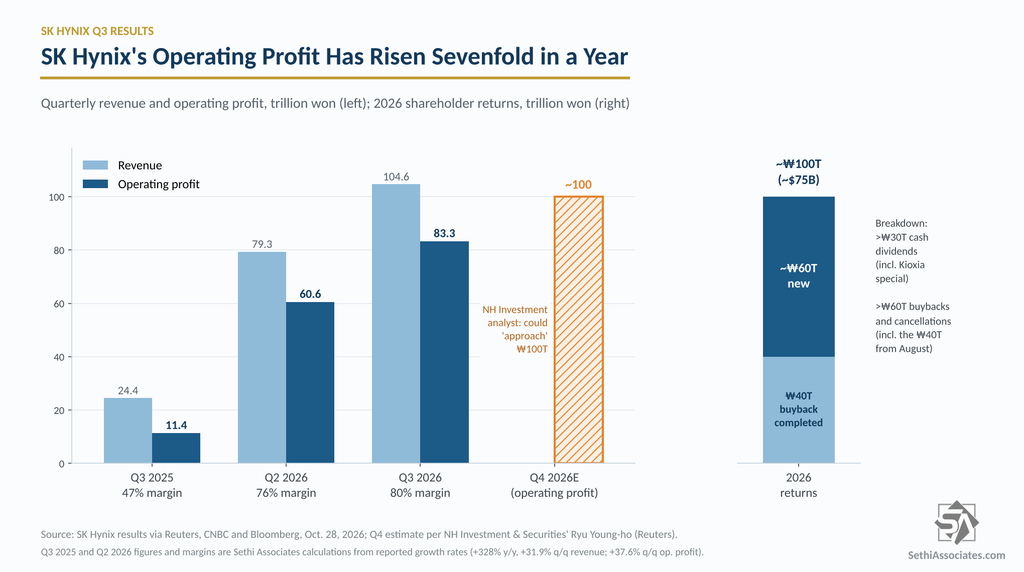
SK Hynix, which holds almost half the HBM market and supplies the memory for Nvidia’s (NVDA) AI chips, saw revenue more than quadruple from a year earlier to a record 104.6 trillion won ($78.9 billion), beating the 98.3 trillion won LSEG estimate. Operating profit rose more than sevenfold to a record 83.3 trillion won, versus 76.7 trillion won expected. DRAM average selling prices rose by a high-20s percentage from the prior quarter, and server DDR5 shipments jumped more than 40%, per CNBC. One analyst though sees that accelerating through the end of the year: “Given that the fourth quarter is traditionally stronger, operating profit could approach 100 trillion won,” NH Investment & Securities’ Ryu Young-ho told Reuters. Not everything beat, though: net profit of 39.8 trillion won fell well short of the 61.4 trillion won FactSet consensus, per the WSJ.

The outlook is moving the group. SK Hynix expects the memory shortage to last through 2030. It has long-term agreements, typically five years, with 14 major customers covering more than half its 2027-2028 capacity, and it plans to raise capex “significantly” next year from at least 40 trillion won this year. Memory already accounts for about a third of AI data center costs, and Macquarie expects HBM prices to more than double in 2027, per Bloomberg.

And in a sharp contrast with Meta’s equity raise, SK Hynix is sending money to shareholders. After Meta Platforms (META) announced this week it is raising $98 billion from investors to fund its AI spending, SK Hynix is returning about 100 trillion won (roughly $75 billion) to shareholders this year. That comprises more than 30 trillion won in dividends and more than 60 trillion won in buybacks and cancellations, including the 40 trillion won announced in August.

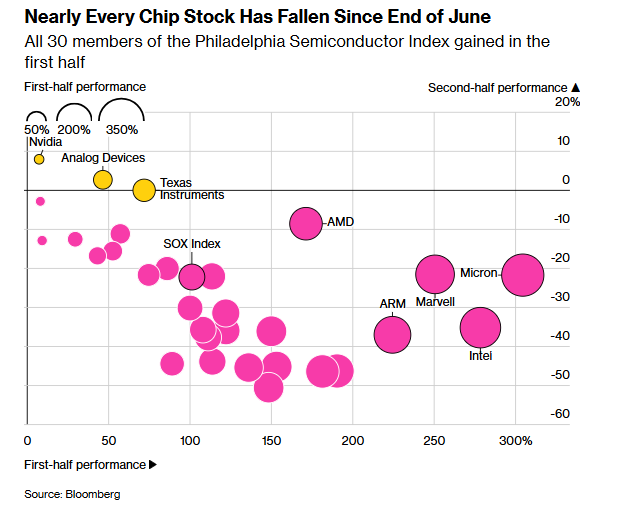
The rebound has ground to make up. SK Hynix shares have more than doubled this year but are still about half their June record, per Reuters, and nearly every chip stock has fallen since the end of June, per Bloomberg. Samsung reports Thursday.

Conversation 0 Comments

One ongoing discussion across all days. Everyone can read; sign in to take part.

Your voice matters. Discussions are moderated for civility. Read our guidelines .

Log in to join the conversation

Loading comments...