Netflix Shareholders Won't Like How the Stock Looks After Earnings
Taking a closer look at the streaming giant as the report drove some pressure.
You've reached your free article limit
You've read 0 of 1 free Pro articles.
Uh oh. The numbers released were good enough.
For the period ending March 31, streaming entertainment giant Netflix (NFLX) posted a GAAP EPS of $1.23 on revenue of $12.25 billion. The top-line print beat expectations and was good for annual growth of 16.2%. However, the bottom-line number fell a rough 11 cents per share short of what had been the consensus view.
Additionally, the guidance provided would make matters worse. As if all of that was not enough to discourage investors, the firm announced on Thursday night that Chairman Reed Hastings, who founded the firm, would not seek re-election to the chair and would step away from a leadership role in the company. Let's dig in...
Operations
As revenue increased 16.2% to $12.25 billion, the cost of those revenues increased 11.9% to $5.888 billion and operating expenses increased 24.4% to $2.405 billion. That left a GAAP operating income of $3.957 billion (+18.2%). This took the firm's operating margin from 31.8% to 32.3%. After accounting for interest, other income and expenses and taxes, net income printed at $5.283 billion, up from $2.89 billion for the year-ago period.
This works out to a GAAP EPS of $1.23 per fully diluted share, up from the year-ago comparison of $0.66. A more than significant part of this increase was due to $2.852 billion in interest and non-operating income, up from just $50.9 million for the year-ago print. $2.8 billion of that $2.852 billion came via the termination fee that Netflix received after losing the Warner Bros Discover (WBD) sweepstakes to Paramount Skydance (PSKY) .
Geographic Revenue Performance
- U.S. and Canada generated revenue of $5.245 billion (+14%)
- Europe, Middle East, Africa generated revenue of $3.998 billion (+17%, +12% FX neutral).
- Latin America generated revenue of $1.497 billion (+19%, +18% FX neutral)
- Asia/Pacific generated revenue of $1.509 billion (+20%, +19% FX neutral)
Guidance
For the current quarter, Netflix is projecting revenue of $12.57 billion, falling short of the $12.63 billion that Wall Street was looking for. The firm also sees its GAAP EPS for the quarter at $0.78, which is well below the $0.84 consensus view. Investors took these misses very seriously.
For the full year, the firm issued guidance unchanged from what had been released prior, which was disappointing to investors. The firm still sees 12% to 14% revenue growth to put that total at $50.7 billion to $51.7 billion. That takes the midpoint of the range below the $51.38 billion that Wall Street had in mind.
Fundamentals
For the quarter reported, Netflix generated operating cash flow of $5.29 billion. Out of this number came capex spending of just $196.1 million, leaving free cash flow of $5.094 billion. Out of that number, Netflix repurchased $1.271 billion worth of common stock for its corporate treasury. Netflix does not pay its shareholders a dividend.
Turning to the balance sheet, Netflix ended the period with a cash position of $12.289 billion and current assets of $17.071 billion. Current liabilities add up to $12.132 billion. This includes $999.1 million in shorter-term debt but also deferred revenue (which is not a true financial obligation) of $1.743 billion. That puts the firm's headline current ratio at 1.41. Adjusted for those deferred revenues, this ratio rises to 1.64. These numbers pass muster.
Total assets amount to $61.016 billion. The firm claims no value for intangible assets, which we like. Total liabilities less equity comes to $29.885 billion. This does include longer-term debt of $13.361 billion. This is not a great, not a pristine, but a healthy enough balance sheet.
My Opinion
The business is doing well enough. The problems are twofold. One is perception after losing out on the Warner Bros acquisition, even though that was probably one game where the loser ends up being the winner. Second is that the firm itself expects to underperform Wall Street's expectations.
One would have thought that with robust cash flows in hand that the firm could have sprung a surprise dividend announcement on the public in order to prevent the shareholder exodus from the stock that we are seeing this morning. That tells me that the firm very likely wants to stay in acquisition mode and use that dough to replace Warner Bros with something else.
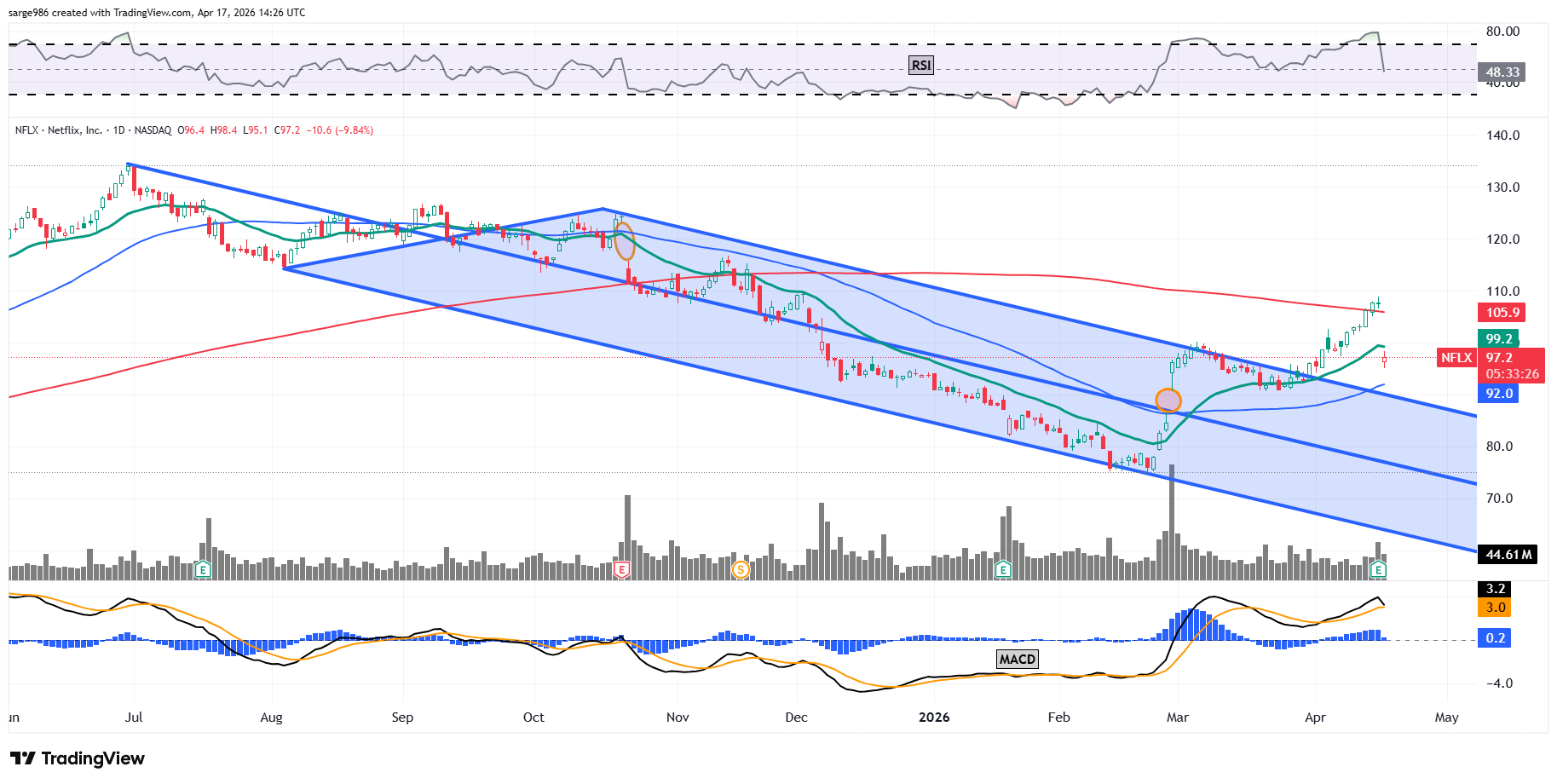
Readers will see that NFLX had broken out from a downtrend, represented here by an Andrews' pitchfork model, in early April. The stock has lost its 200-day SMA after retaking that line earlier in the week.
That likely forces some institutional selling overnight into Friday morning. The stock has also lost its 21-day EMA. That gets some of the swing trades out of the name. Additionally, there is an unfilled gap from back in February that if filled would take the share price as low as $86.50. This would involve losing the 50-day SMA as well, which might be enough technically to get that done.
Moving on to the indicators, relative strength has retreated from being technically overbought just Thursday to a "neutral" reading. The daily MACD is in trouble as well. The histogram of the nine-day EMA appears to be set to go negative, while the 12-day EMA appears to be ready to cross below the 26-day EMA.
Bottom Line?
I would not pay above $86.50 for shares of Netflix at this time. If one does buy this dip, be ready for a new acquisition-related headline that would be negative for the stock.
The May 15 $87 puts are only paying $0.33 a contract at the time, so for those thinking of getting paid to wait, the premium paid does not, in my opinion, justify the risk.
Related: China’s Surprise Growth Shows Silence on Iran, U.S. Trade Can Be Golden
At the time of publication, Guilfoyle had no positions in any securities mentioned.