What Visa’s September Spending Momentum Index Tells Us About the Consumer
Given the continuing government shutdown we are examining and relying on other data sets for clues.
You've reached your free article limit
You've read 0 of 1 free Pro articles.
Today marks the ninth day of the federal government shutdown, and with indications that Congress remains deadlocked, it looks to continue. Per Polymarkets, there is an 85% probability that the shutdown will end sometime after October 15.
When the shutdown is over, we will have a lot of catch-up data to review, but until then, the shutdown means much of the data we and others utilize will go unpublished. Looking at the calendar for next week, September reports for CPI, PPI, Retail Sales, and Housing Starts were originally scheduled.
Given the current environment, we are examining and relying on other data sets at least until we have all that catch-up data to sift through. The September jobs data from Carlyle showed job creation of only 17,000, much lower than the 54,000 forecast for the September Employment Report.
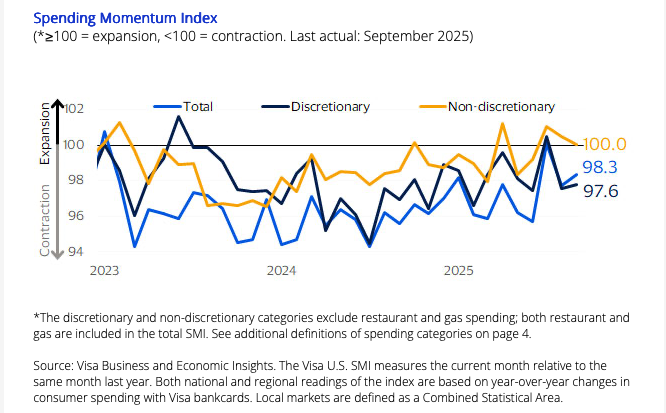
When it comes to assessing consumer spending activity, we are looking at multiple data points, including Visa’s (V) U.S. Spending Momentum Index reading for September, which rose to 98.3 from August’s 97.7. Spending momentum decreased sequentially in Visa’s non-discretionary and restaurant categories but was offset by growth in the discretionary and gas categories.
To ensure we’re on the same page, here is what Visa includes in its discretionary and non-discretionary categories:
Discretionary — airlines, lodging, auto rental, appliance retail, computer retail, fashion retail, florist, general department store, home goods retail, leisure goods retail, luxury goods retail, repurposed goods retail, sporting goods retail, attractions & amusements, duty free, entertainment, gambling, marina services, sport & recreation, transportation, travel agencies, construction services, electric goods repair, home repair services, personal services, professional services, spa/beauty services, telecommunication, charity, direct marketing, membership clubs).
Non-discretionary — medical/health services, pharmacy, food retail, supermarkets, postal/courier, utilities, education, tolls/fees, wholesale.
Our Take on Visa’s Findings
Visa’s findings show that consumers opened their wallets more in September than they did in August, and much more than they did in April and May when Trump’s tariffs first went into effect. While that and the recent bottom in June in the index likely reflects some pull forward in spending, we can see greater momentum in spending in Q3 2025 compared to Q2 2025.
Looking at the historical data, we also find the implied Spending Momentum Index for Q3 2025 averaged 98.7 compared to 95.3 in Q3 2024, with year-over-year gains in both discretionary and non-discretionary categories. That’s a nice supportive data point for our positions in TJX Companies (TJX) and Amazon (AMZN) , and Costco (COST) .
What’s missing, however, are data on pricing and inflation, which makes it difficult to tell if consumers are buying more in volume. That delineation doesn’t matter for companies like Visa, Mastercard (MA) , and American Express that earn fees on the dollar value of transactions carried across their network. For us as investors, it means that consumers are spending more, but we’ll want to find other data that tell us where they are cutting back on that volume and where they are spending it.
Sizing up recent inflation data against Costco’s September comp sales report points to Costco being a volume gainer. Another reason why we picked up some additional shares earlier today.
At the time of publication, TheStreet Pro Portfolio was long TJX, AMZN and COST.