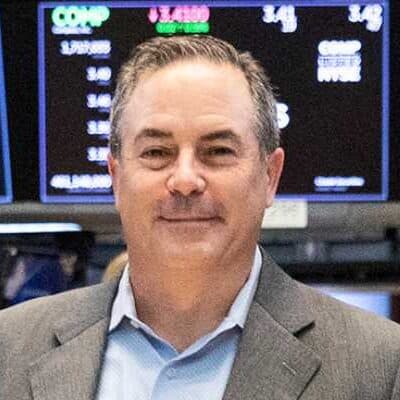
VIDEO: Predicting Next Fed Policy Decisions With Bob Lang
Plus, why price action and volume trump seasonal factors for the market.
You've reached your free article limit
You've read 0 of 1 free Pro articles.
In today’s Daily Rundown video, Chris Versace is joined by Bob Lang and the two discuss the market’s current technical setup and why price action and volume are more important than seasonal indicators.
Bob explains how he examines key support levels for the market and individual stocks and touches on the difference between a successful test and confirmation versus a failed test. The two also discuss their takes on the December PPI and CPI reports and the resilient U.S. economy, and how those may influence upcoming Fed policy decisions.
Transcript
CHRIS VERSACE: Hey, folks. Chris Versace here. It is Wednesday, January 15. Halfway through the month of January and the first few weeks of trading. Getting back to, when we were closing out 2024, I shared with you a number of things that we did well for the year. I also shared some things that we could have done better.
But I also teased that we would look to bring some things back that we'd done previously. We've already started to do that with the poll of the week. And now, we're going to do it again with today's video by bringing Bob Lang back on to talk about the market technicals, some of the things that he sees unfolding in the market. And we'll also get his take on the Fed. Bob, welcome back.
BOB LANG: Great to be with you, Chris. And great to be with all the members as well, too. And a very hearty and healthy happy new year to you and everybody. I think here we are on January 15, I guess after today we could stop saying "happy new year," perhaps.
CHRIS VERSACE: I was a little.
BOB LANG: [INAUDIBLE]
CHRIS VERSACE: I was a little surprised you led with "happy new year," but we are where we are, Bob. Let's talk turkey because I know we only have a short time together today. Coming into January, when we look at the S&P 500, like you do every Monday, you had kind of said earlier this week that it's kind of on, like you said for December, shaky ground. Now, what did you mean by that?
BOB LANG: Well, what a lot of investors and traders were expecting in December, Chris, was a follow-through from November. November was a really strong month-- a very strong month for not just the S&P 500, but also the Russell 2000. As we've often stated in a lot of the work that we put together is that the Russell 2000 tends to lead the rest of the market. And this is because there's 2,000 stocks in this universe of small caps.
Now, the Russell 2000 had a dreadful month of December. And we can certainly look at the cause of that as being higher interest rates. Higher interest rates are kind of a poison for the small cap stocks-- and for the large cap stocks, but mostly for small caps. And so Russell 2000 did poorly.
And, in kind, much of the rest of the market, the NASDAQ and the S&P 500, followed in line and had a miserable month of December. And that set up for, potentially, a weak year ahead. Now, we talked about, for a while, the Santa Claus rally. It was the end of-- the last five trading days of December into the first two trading days of January. That failed miserably.
And so there's a lot of worry coming into January. If that particular anecdote held firm, which 78% of the time over the past 70 years, the markets were down after a failed attempt on the Santa Claus rally. If that was going to hold, Chris, then I think we were looking at a dire situation.
Now, of course, we have a lot of time left to let that play out. But I think the setup there was for negative-- and sentiment was really poor as well.
CHRIS VERSACE: Well, let me just continue with the seasonal indicators, because you did talk about the Santa Claus rally. But the first five days did close positive. So we're 1 for 1 on the seasonal indicators. I guess the question, Bob, just given your history with the markets-- and I know you pay very close attention to the seasonal factors-- how much weight do you, or should we, put in the January effect? Which is, essentially, how the market does in January kind of dictates, we think, how it should do for the year.
BOB LANG: Yeah. I don't put a whole heck of a lot of weight into it, Chris. I know a lot of people do follow these things. But a lot of people follow astrology when it comes to picking stocks, too. So I'm--
[CHRIS LAUGHING]
I'm not a big fan of following astrology, but some people use it. And you have to respect the fact that it's there, and people will trade on it. So I'm all about price action, Chris.
I'm all about price action and volume. And that is going to tell us where we are at a certain point in time, and where we've been, and where we can go. So the seasonal factors being somewhat important, not the most important thing-- it is a secondary indicator for me that I look into helping support my thesis or idea of where I think the markets are going to go.
CHRIS VERSACE: All right. So price action and volume-- talk to me about what we've seen kind of unfold this week. Because the last two days, the market has started to move higher.
We got a nice arguable sigh of relief with the December PPI. And today's December CPI, I would argue, also still sticky, still elevated. But there were some nice surprises on the core CPI. So the market, I think, kind of wants to rebound a little bit here. But what are you seeing in terms of the price action and the volume?
BOB LANG: Well, we often see strong money flows coming into the markets around the beginning of the month. And we probably saw that happen at the beginning of January. But, as you noted, the first five days of January were poor. I mean, they were positive, but they started off poor.
The last trading day, which was last week, actually turned it from a negative to a positive. But I think some of that money flow, Chris, that came in at the beginning of the month was waiting for a home to put that money. And with rising interest rates with a rise in volatility, the VIX tagged 20% earlier in the week, Chris.
And we certainly see a problem there with people putting money to work when volatility is high when a lot of uncertainty is happening here. We have a new administration that's going to be coming in in about five days. Who knows how things are going to unfold?
And so I think more people were kind of in a wait and see mode. But a lot of that money flow that started coming in at the beginning of the month is now getting put to work in a big way. And, further, we saw a rise, Chris, in the beginning of the month, of short selling.
And so a lot of that short selling gets reversed-- we call that short covering. So when that gets reversed, it just brings the markets right back up again. And the buyers see that, and they start piling on, and you see a big tornado effect with the markets going up.
CHRIS VERSACE: So in terms of your point about paying attention to price action and volume, are you seeing the volume levels pick up? Does this give you a little more confidence with where the market is now?
BOB LANG: Yeah. So to the upside, we've seen the last couple of days, volumes starting to pick up, especially at the end of the day. Now, that's sort of been a change or a switch from what we saw in December. We saw a lot of that volume picking up and with the markets going down towards the end of a trading day.
So I kind of micro-analyze this sort of stuff to see basically where the major trends are at. I don't look at one or two days in a row. I look at 7, 8, 9, 12 days in a row to see where things are falling every single day. So the last couple of days, Chris, we've seen some good volume to the upside, which has been great.
Towards the end of the day, we're seeing better breadth. And breadth is also a key indicator that tells us how well the market is performing at a certain point in time. So I think that those trends, especially the technical trends when it relates to volume, especially, are starting to improve.
CHRIS VERSACE: OK, great. Now, you, of course, look at the technicals. I look at fundamentals and thematics. But one thing that we both like to talk about is the Fed. And I'm just going to ask you point blank-- I alluded to it a second ago-- December PPI, December CPI. In your view, does this change anything, at least in the near-term, with the Fed?
BOB LANG: I really don't think so, Chris. I think the Fed as a unit takes a much more gradual long-term approach to things. And one of the things that you and I have talked about in the past is one of the tools that Chair Powell likes to use is moving averages. They look at maybe a three-month moving average.
And so one particular data point is not going to move the needle for them in terms of changing monetary policy. I think looking at a three-month average over a period of time is going to really have much greater effect for the Fed to consider policy moves going forward. So I think that this first meeting of 2025, which is coming up in a couple of weeks, which also has four new voting members on the committee, they swap out in January. And four of those are either moderate, neutral, to somewhat hawkish, I would say.
CHRIS VERSACE: I would say the only dove that we got recruited this year is Goolsbee, but that's about it.
BOB LANG: I agree with that. And so, perhaps, maybe another month or two of cooler numbers than the CPI and the PPI are going to change Fed policy in terms of being a little bit more aggressive to the rate cutting mode. But I think, as of now, I can't see them cutting interest rates off of this number.
CHRIS VERSACE: Yeah, I don't either, especially coming off delivering 100 basis points between September and December last year. I think they're going to take their time. I think the consensus expectation, tracked by the CME FedWatch tool, is let's call it third quarter-ish. But I also do, though, think, Bob, that given the sigh of relief we saw with the December PPI report and the somewhat better core CPI data in the December CPI report, that perhaps the market's expectations for inflation were almost too elevated going into those reports.
And the one thing that I want to pay attention to as we move through the first half of the year is if the inflation numbers really do start to come down on a sustained basis, all of a sudden, we could see the market expectation for rate cuts do a 180-- what we saw in the first half of this year compared to last year.
Remember, in January of 2024, you and I were sitting there going, good god, six rate cuts, seven rate cuts? Don't see it. And the expectations dwindled. And then they started to pick back up again in the second half of 2024. I think we could see, potentially, the flip of that this year.
BOB LANG: I also think that, Chris, you have to remember about the demand side of the equation, right. And the demand side has been very, very strong. We had a really good jobs report that came out for December, that came out last week on the 10th of January. And we've had good, strong job growth for the past few years. And that has fueled a good, strong economy-- 2.5% to 3.5%.
I think it's pretty safe to say that's where we're probably going to lie for the fourth quarter of 2024. And that would be, like, the fifth consecutive quarter of 2%-plus growth in a row. So the demand side of the equation is still very, very strong. So as long as that demand side, Chris, has remained strong.
Why does a company need to cut prices? Because the basic economic equation there for demand and supply is if demand is reduced, then prices have to come down to meet some sort of equilibrium or price level where they can start selling products. So why do these companies have to cut prices?
CHRIS VERSACE: So, generally speaking, I agree with you. But I also think that when we looked at the holiday shopping season, we did see a lot of discounting across a sea of retailers. And I've said it before, I'll say it again, that kind of sets us up having to watch not just the top line, but, really, the margin line to see the impact of those sales efforts and discounts.
But, I mean, logically, I do understand what you're saying. So, Bob, as we move from the first half of the week into the second half and we get ready for the Martin Luther King Day weekend, what's on your radar screen? What are you watching?
And I'm asking because in your analysis of the S&P 500 chart, you talked about a channel potentially watching it, looking to see if it was broken and confirmed. What are you looking for in English? And why is it important?
BOB LANG: Well, the S&P 500 has different levels that I watch very, very closely. And they're based on moving averages. So, like, I'll look at shorter term moving averages like the 10 and the 20-day moving average. I'll look at longer term moving averages, Chris, like the 50-day, which is about 2 and 1/2 months' worth of activity, and the 200-day moving average.
And the 50 and the 200-day are really important markers for me as a technician, because that is what the big money players are looking at. They're looking at, as long as the price action is well above or at least slightly above these two moving averages, then it's OK to go ahead and continue to buy stocks going forward.
It's when price action is below those levels, Chris, that it's dangerous to get in there and start buying stocks, because a lot of other big institutions are going to use any rallies up to those levels to sell. Hence, they become resistance points as opposed to support levels. So I'm looking at those levels.
So more recently, Chris, the S&P 500 tested the 100-day moving average-- so, obviously, right in between-- not quite right in between the 50 and 100, but about five months worth of action was the 100-day moving average. So the 100-day moving average was around the 5,780, 5,800 marker. We tested that level earlier this week and successfully bounced above it.
And here we are in January 15, we're moving well above that level, and even past the 20-day moving average, which is a key level in the short-term that I like to look at. What is 20 days? 20 days is about four weeks' worth of action. It's about a month's worth of action.
And it gives us plenty of data points-- 20 days of trading that gives us an idea of where the short-term trend is going to be. So I look at that, I look at those levels very critically. And as long as we're above those levels, we're bouncing above there and we can continue on moving forward, Chris, I think we're in good shape.
CHRIS VERSACE: OK. So one of the things that we've talked about, and I know when we do the Portfolio Office Hours, sometimes we get questions about it. It's when a stock or even a market indicator S&P 500 breaks through a support level, the question always becomes, it's testing it. Does it successfully test it? Or does it fail the test? So can you kind of clear those things up for folks?
BOB LANG: Yeah. So a failure on a test means that it's made a lower high and a lower low in that particular sequence. So when the prices break those levels, those especially support levels that we look back on maybe a month, two, or five months ago that we can identify levels where buyers started picking up the stock. If those levels break, there's certainly a lot of room for some downside for that stock to go to now.
On the flip side, when the stock breaks through some resistance levels that we'd seen from the past, maybe a couple of months ago, and breaks through, and it follows through, I look for confirmation in terms of a follow-through. Now, a lot of people out there who are, I'm going to call them amateur technicians, Chris, they look at these moves that happen in one day, and they get excited, and they say, OK, this is it. We're going to move.
No, I have to wait for another day of confirmation that tells me that there's some conviction from the big money that comes in, and they're looking for higher prices going forward. Remember something-- the big money works slowly. They're not very-- they're not the fast money. The big money is the slow money.
And that's where 80% of all the dollars are moved around in the market. So those are the ones that I tend to want to follow.
CHRIS VERSACE: So I just want to be clear on this-- when you say, for example, stock x, y, z breaks through a resistance level, comes back down, tests that resistance level, and moves higher, that is a successful test.
BOB LANG: That's correct. That's right. Yeah. That's a successful test.
Now, on the downside, if it comes down and tests the support level, bounces, and then breaks that support level, just the flip side of what you were talking about. That's bearish. And that would tend to lead to lower prices ahead.
CHRIS VERSACE: OK. All right, Bob. Anything else we should talk about before we close out our time together today?
BOB LANG: Well, I think it's going to be interesting, Chris, to see what sort of policies are going to be in place from the new administration. I heard just a couple of days ago that President-elect Trump-- or is going to be new President Trump next week-- wants to make the United States the best, the biggest energy country in the whole entire world.
And there's a lot of competitors out there. The world is not an easy place to do business. But it's going to be interesting to see how that helps. And we're going to see.
We had some of these horrible fires in California. We're going to see a lot of rebuilding going on over there and for years to come with. I mean, some of the floods that, Chris, that happened back in the fall in Florida, North Carolina, they're still trying to recover from those.
So, I mean, how much inflation is going to be coming in over the long haul on the horizon here that the Fed is going to have to be concerned about? They're obviously looking at month-to-month. And we talked about the three-month moving average. Those are [INAUDIBLE] important. But looking out in the future, Chris, I mean, there's going to be a lot of product that's going to be sold, a lot of manufacturing that's going to be done.
Again, we talked about the demand side of the equation. The demand is going to be there. Maybe the inflation is still not going to go away. It's still going to be sticky.
CHRIS VERSACE: Well, I think we'll have to see, right? I mean, there's a lot of things that are going to get answered or start to be answered in the next couple of weeks on Trump policies going forward, everything from tariffs to tax cuts.
They're going to have implications not only on demand for the economy, inflation, but also on earnings and, potentially, earnings expectations, which S&P 500, up 14.6%. That's the current expectation as we start, really start, I should say, the December quarter earnings season.
These numbers are going to move around. And it just means, Bob, that we're going to have to do what we do, pay attention to the data, course correct as needed, keep an eye on the fundamentals, keep an eye on the technicals, and just adjust the portfolio as we need to. Pretty simple, I hate to say it.
BOB LANG: I agree. Yeah, it's very simple.
CHRIS VERSACE: All right. Well, Bob, thank you so much for joining us. And, members, we're going to continue to do more of these types of videos moving around the pro contributors that are bringing their insights, and stock picks, and other things to you each day, each week. So if you have any suggestions, please use the comments below. Thanks for watching.