We're Updating Our Plan for This Holding After PPI Surprises
Like others, shares of this name are on the cusp of being overs sold as consumer confidence takes a hit.
You've reached your free article limit
You've read 0 of 1 free Pro articles.
Following Wednesday's rebound, the market looks to start Thursday by giving back some of those gains despite the finding in the morning’s February Producer Price Index (PPI) report.
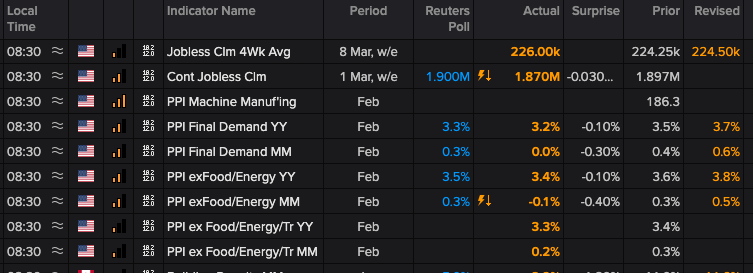
As we can see in the table below, both headline and core PPI for the month were softer than expected, and the sequential print for core PPI contracted compared to January.
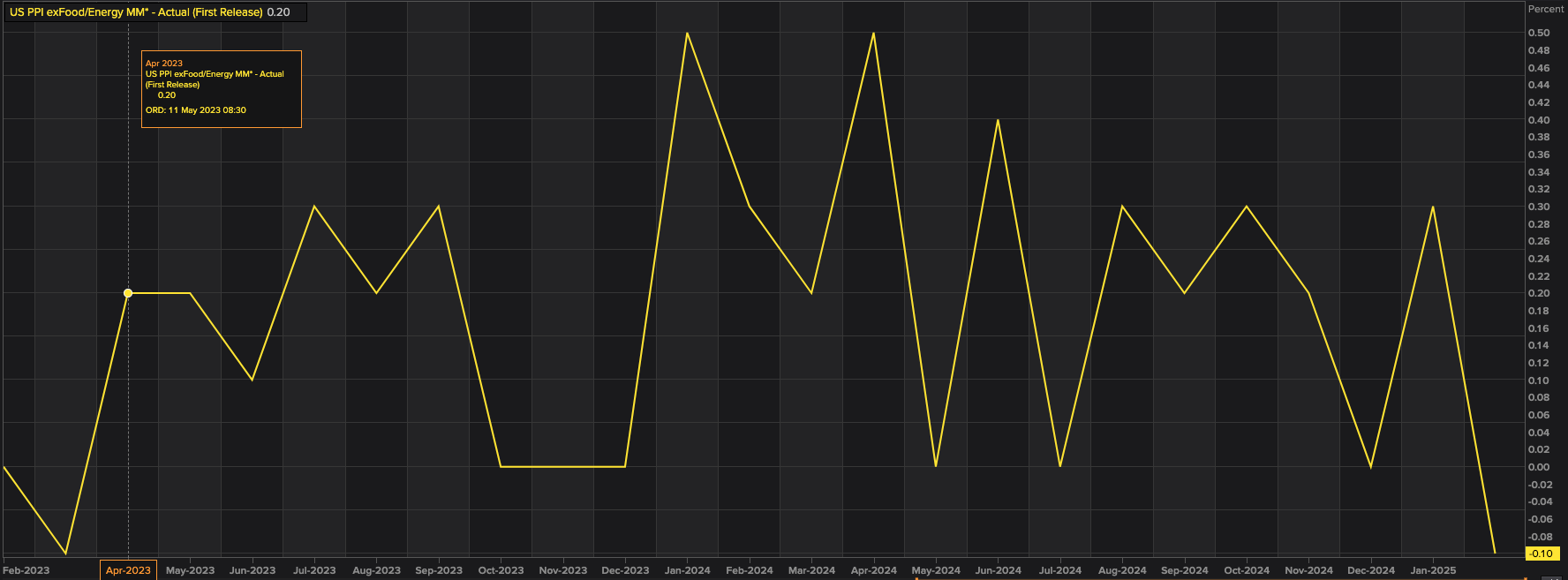
We’ve seen sharp moves in sequential core PPI figures (see the graph below) and that alone should warrant some caution, but overshadowing the PPI report is another round of tariffs announced by President Trump and fresh concerns for the consumer.
On Wednesday, we discussed the pending Trump tariff countermeasures announced by the European Union that are set to begin on April 1 and expand mid-month. In response, on Thursday morning, Trump threatened to enact a 200% tariff on European wine, champagne and other alcoholic beverages, potentially escalating the brewing trade war even further. Keep in mind that these are on top of the telegraphed reciprocal tariffs Trump is targeting for April 2. So, while we saw some favorable data in the February PPI and CPI reports, it’s the view ahead that we should be more concerned about.
Mounting Consumer Spending Concerns
Turning to concerns for the consumer, Dollar General DG forecasts annual comparable sales growth largely below Wall Street’s estimates as still-high inflation and economic uncertainty dent consumer spending.
That builds on the expanding list of retailers that have cited weaker consumer spending prospects as they issued weaker guidance that fell short of Wall Street expectations. Hammering that home, on Wednesday Colgate Palmolive CL shared that it is seeing some hesitancy in the consumer and some de-stocking across various channels.
Shortly thereafter, American Eagle AEO issued downside guidance for the current quarter, with comp sales expected to fall mid-single digits, calling out the quarter is off to a slower start than expected. Moreover, “ongoing consumer uncertainty and changes in the operating landscape, including tariffs and strength in U.S. dollar, are also creating factors for us to navigate.”
That led American Eagle to guide fiscal year revenue and profits down on a year-over-year basis.
It indeed takes more than one company to make a trend, and as the saying goes, three to tango, but when we string together comments and disappointing outlooks from Colgate Palmolive, American Eagle, Macy’s M, Kohl’s KSS, Abercrombie & Fitch ANF, Target TGT and Walmart WMT, it’s time to question the outlook for a key part of the U.S. economy: consumer spending.
Viewed from another angle, Visa’s U.S. Spending Momentum Index (SMI) declined 2.1 points month-over-month to 96.1 (seasonally adjusted) in February, with spending momentum also declining in all four sub-categories. Discretionary spending momentum had the steepest decline, falling 2 points, while declines in non-discretionary and gas were more modest, each falling 0.5 points. The restaurant SMI declined 0.7 points in February. The drop in discretionary spending was attributed in large part to the significant decline in consumer expectations for future economic conditions, which fell 9.3 points in February.
Other data has shown rising inflation expectations among consumers, which raises renewed questions about spending power. Pairing that with record consumer debt levels, the explosion in February layoffs captured in the latest data in the Challenger Job Cuts report, and overall uncertainty emanating from Washington, D.C., it stands to reason consumers are likely to rein in spending. And that’s before today’s Trump tariff proclamations and expected tariffs from Trump and the European Union in April.
Updating Our Plan for Mastercard Shares
All of this reinforces our recent decision to downgrade Mastercard MA shares to a Three rating.
Like others, MA shares have fallen hard lately and are on the cusp of being oversold. Wednesday's market action lifted the S&P 500 out of oversold territory and from a technical perspective, we could see a rebound emerge. Should that come about, we would likely use that market strength to trim back the Portfolio’s exposure to MA shares, especially if they rebound in the process to resistance levels near $532 to $533, and again near $545.
More Pro Portfolio
- We're Adding More Shares of These 5 Portfolio Holdings
- Weekly Roundup: Here's Our Game Plan as We Focus on Our Updated Shopping List
- Big Spenders Vs. Cash-Strapped Shoppers, AI, Hacks and Other News for Investing
At the time of publication, TheStreet Pro Portfolio was long MA.