Tracking Airline Capital Spending in 2026 Can Go a Long Way
The International Air Transport Association is forecasting a 4.9% year-over-year growth in passenger traffic next year; here's why we're watching this data closely.
You've reached your free article limit
You've read 0 of 1 free Pro articles.
The International Air Transport Association (IATA) is forecasting a 4.9% year-over-year growth in passenger traffic next year, led by the Asia Pacific region’s expansion by 7.3%. Supply constraints are expected to continue to keep load factors at record highs, projected at 83.8%, and by supply constraints, we are talking about travel-related pains you may have experienced this year or last. The IATA believes that high-load factors and fleet utilization, along with airlines increasingly charging for services that were once included, should allow for what it calls healthy profits.
Looking at consensus EPS expectations, we see that Wall Street tends to agree with the IATA’s outlook:
United Airlines (UAL) : 2025 consensus EPS of $10.53 rising to $12.87 in 2026
American Airlines (AAL) : $0.62, $1.87
Delta Air Lines (DAL) : $5.88, $7.26
Southwest Airlines (LUV) : $0.99, $2.88
Alaska Air Group (ALK) : $2.15, $5.62
Allegiant Travel (ALGT) : $2.85, $6.33
SkyWest (SKYW) : $10.27, $11.09
Two airlines that are expected to deliver continued losses in 2026:
JetBlue (JBLU) : EPS of -$1.61 in 2025 and -$1.06 in 2026
Frontier Group Holdings (ULCC) : EPS of -$0.75 this year, and more modest -$0.01 expected next year.
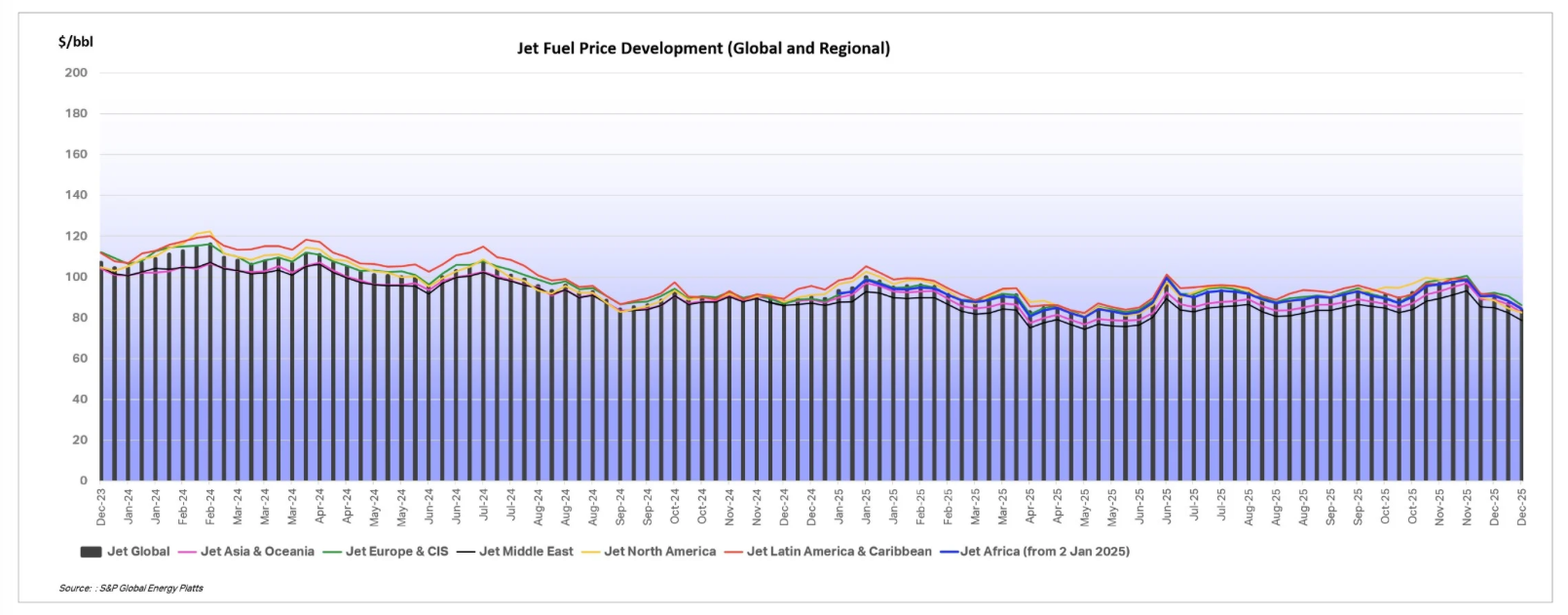
As an investment, it’s no secret that airlines can be a tricky business with two obvious levers being consumer spending and jet fuel prices, which are closely tied to crude oil prices. If you’ve filled up your gas-consuming car recently, then you’ve likely noticed the drop in gas prices over the last few months. Data from S&P Global shows a similar decline in jet fuel prices over the last few months.
But we’ve had numerous reports of consumers trading down, data points that keep us bullish on Costco (COST) and TJX (TJX) . TransUnion (TRU) sees car-loan delinquencies rising for a fifth-straight year next year, and household debt ballooned to a record $18.6 trillion during Q3 2025, per Federal Reserve figures. And as Boeing (BA) calls out in its 2025-2044 Commercial Market Outlook report, airfares relative to income levels matter.
This suggests that if we see the jobs market continue to soften in 2026, expectations for those airline EPS figures could be vulnerable. If that happens, it means we could see current tight capacity levels soften, a development that could impact new aircraft demand. And with airlines, all it takes is an unexpected accident to sabotage the shares.
Should airline capacity levels remain tight, however, the follow-up question becomes one about capital spending levels for additional aircraft, and that triggers one about the average age of the U.S. commercial aircraft fleet.
Starting with the fleet’s average age, the data indicates it is around 14-15 years old, up from 13 years a few years ago. Some carriers, like United, have a higher median age around 19.4 years old for their fleet, due to it having more than 200 of its 950 planes having been in operation for at least 25 years. But consistent maintenance and upkeep mean those airlines are not in a position where they need to replace aircraft at a brisk pace in the next few years. Long-term, that will be the case.
That means demand for aircraft in the near term will primarily be driven by new capacity requirements. If the economy remains robust in 2026, the job market rebounds, and consumers continue to spend, that could tighten airline capacity levels further, prompting the need to add aircraft. As we move into 2026 and airline companies deliver their December-ending quarter results and initial views on 2026, we’ll want to pay close attention to their capital spending plans and how they stack up against those for 2025. We’ll also want to track those capital spending expectations as we move through the ensuing quarters.
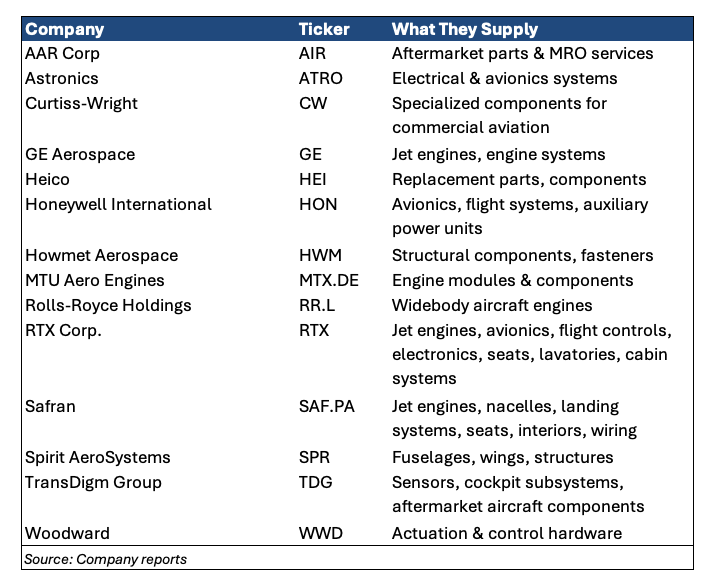
What we learn could spark interest in Boeing (BA) , Airbus (EADSY) , or suppliers like the ones in the above table.
More Pro Portfolio:
- Shuffling Our Chip Mix, Setting a Broadcom Price Target With 4 Trades
- Stocks & Markets Podcast: The Market Setup and Pro Picks for 2026
- Weekly Roundup: The Market Rebounded and Now We'll See if Santa Claus Comes This Year
At the time of publication, COST, TJX were holdings in the Pro Portfolio.