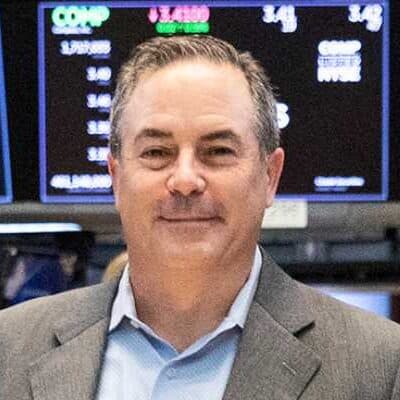
TheStreet Stocks & Markets Podcast #3: Manage Risk Like a Pro With Bob Byrne
Chris Versace and veteran trader Bob Byrne discuss managing market uncertainty, valuation, why small IPOs are the future, and answer member questions.
You've reached your free article limit
You've read 0 of 1 free Pro articles.
In this week’s Stocks & Markets Podcast, TheStreet Pro Portfolio Manager Chris Versace is joined by veteran trader and TheStreet Pro contributor Bob Byrne. Byrne shares how his time as a short-term swing trader has shaped his long-term investing strategy, and why he likes mixing fundamentals and technicals.
The two talk valuation metrics, trade deal uncertainty, why clarity for investors is likely several weeks away, and how to deal with a position gone wrong.
Chris also poses TheStreet Pro member questions to Byrne about his 2025 pick of the year, the Amazon AMZN-Trump brouhaha, and his take on the Newsmax NMAX IPO and the shares.
Other Recent Podcast Episodes:
TheStreet Stocks & Markets Podcast #2: Bear Market Blues With Jay Woods
TheStreet Stocks & Markets Podcast #1: Buy the Dips, Sell the Rips With Peter Tchir
Transcript
Chris: Folks, welcome to the latest episode of the Street Stocks and
Markets podcast. I'm Chris Versace, the portfolio manager of TheStreet Pro
Portfolio. Joining me this week to tackle what's driving the markets,
discuss what's confounding investors, and help you move forward as we
navigate tariffs, trade deals, and the March quarter earnings season is
Bob Byrne. Bob is a StreetPro contributor, and in his writings, he brings his experience
as a long-term and short-term swing trader to members. Bob, thanks for joining me today.
Bob: Oh, Chris, it's great to be here.
Chris: Now, Bob, you know, you have been a Street contributor for a long
time, just like myself. But, you know, what we're trying to do here is really
kind of set the table for the conversation that we're going to have. To do
so, just give us a thumbnail sketch of your background, how you trade,
how you invest.
Bob: Yeah, so I began as basically a day trader. First part of my career, 20
years, was day trading equities and futures. Began in the late 90s, 97, 98.
Dialed back my day trading portion around 2018. So today, I will still do
short-term trading, but it's definitely around volatility. But I also manage a
long-term book and a lot of private investments.
Chris: OK, so just out of curiosity, you said that you kind of put day trading
to the side a few years ago. Was there something in the market that led to
that?
Bob: Yeah, no, that's a great question. On the equity side of day trading,
everything changed. If you guys remember when they adopted hybrid in 2007, right, when they took the NYSE and they really tried to make it electronic, get rid of the
specialists. That completely changed because prior to that, it was me
versus you. It was me versus another human. And, so it was a lot more psychology. It was a lot more, it was a lot easier, to be honest.
Chris: Bob, why do I sense a Terminator reference coming?
Bob: I wasn't
competing against Hal, the supercomputer. And that's what it became after 07. So around 07, 08, me, like a lot of day traders, active day traders, we did shift from individual equities more toward ETFs or futures.
Chris: OK. All right. So today you just mentioned that you do manage a long
book. So kind of what's your strategy, your style for managing that?
Bob: So longer term investments for me kind of fall into two buckets.
You know, I think a little dirty secret among active traders is they actually
are hidden value investors. It's a lot easier to value something off of cash
flow, free cash flow yield, even simple things like dividend yields. But we
don't, I don't look at a dividend yield and say, I want to own the stock. I'm
going to look at a free cash flow yield, dividend, payout ratios, all these
things. But I'm going to chart them. So where is the dividend yield in
relation to where it typically is?
Chris: Right, right.
Bob: So I am looking for something that I believe is a value, has sold off.
Maybe the fundamentals are bruised, but not broken. OK. And so I'm
looking for something that is paying out more than it ordinarily would over
a 10 plus year horizon.
Chris: So you're kind of looking for compressed valuations. I mean, that's
really what you're saying, right? I mean, it's funny that you mention that,
because typically before I, you know, begin a new position, I will look back
historically at a variety of multiples, you know, PEs, PEGs, EBITDA
revenue, EBITDA, EBITDA, but also, too, as you pointed out, for dividend
payers, dividend yields. And that that's really why I shouldn't say why, but it is another reason why I really do prefer companies that not only pay dividends, but they have a
rising dividend bent because it's just another tool.
Bob: Totally agree. You know, one of the examples I like to give, and it's a
while back, but back in 2012, the free cash flow yield on stocks like Microsoft, Intel, Cisco.
Chris: Yeah, yeah, yeah, yeah.
Bob: They were off the charts. No one wanted these things. And it doesn't
happen very often. You can't you can't think you're going to sit down
every day and say, I'm going to go find those great payers today, but
you're looking for them. They do happen. They do appear.
Chris: OK, so that's kind of some of the financial metrics that you look at. I
guess I guess my next question would be, are there any others? And then
just stepping back, when you look at companies, sectors, what have you,
are there particular characteristics or business models that you look at or
look for?
Bob: yeah. So I mentioned kind of two buckets there, the value dividend. But I
also like out of favor growth, out of favor technology. But when I say out
of favor, it's kind of the wrong way to put it. You know, take today's
market in particular. Everything fell apart together in unison. It didn't matter how well your business was doing two or three months ago. You basically got sold on unless you're maybe McDonald's or something.
Chris: OK, we'll see. We'll see. I'll see about that.
Bob: But I want to look at companies that reported really good earnings in
the couple quarters prior to this kind of downdraft and then figure out, is
there something should that change dramatically into the next quarter?
One example, I'm not long it now, but it's I'm actively watching a
Snowflake. Snowflake was completely out of favor after it came public,
had a ridiculous valuation, really ludicrous. But in the two quarters, the
two most recent quarters, they completely surprised everybody because
they they pivoted entirely toward AI. And based on their, you know, their
customer metrics, they're doing really well at it. And after both earnings
releases, the stock exploded.
Chris: So I'm going to toss one to you just to get your reaction. Because I
felt like, you know, ServiceNow was the exact same thing.
Bob: So ironically enough, I was on a panel about nine months ago and
ServiceNow was one of my picks. I was blown away by how poorly it was
getting hammered. I was not surprised by how well it did after earnings.
Chris: Yeah, totally agree. Totally agree. All right. So with those two
buckets and you mentioned a couple of names just now, Snowflake, are
there any other companies that are your kind of warming up to just given
what we've seen over the last few months? And it appears that as we go
through earnings that, you know, so far, maybe they're a little better than
expected or shall we say not as bad as feared?
Bob: I don't think I think earnings are going to be fine this quarter.
Chris: Hang on. Hang on. Let's bifurcate this. Right. So there's the March quarter earnings. And there's the June quarter guidance. Which one are you more concerned about?
Bob: Oh, well, June and forward.
Chris: So next. So second half of the year. Yeah.
Bob: Second half of the year, I think is going to be scary.
Chris: OK, why? Now, I've talked about this quite a bit and I'm curious, you
know, for what your reasons are.
Bob: I mean, I think the most obvious is when you don't know what to
expect you, the smart move is to typically do very little. And I think
that's where a lot of companies are. I mean, look, you don't just up and
move a manufacturing plant. You don't up and make multibillion dollar
allocations around the globe on a whim. You really do have to have some
certainty. I think it's a little bit silly to expect companies to up and move
all their manufacturing in very, very short order. It takes a while.
Chris: So short order that that's an interesting point because, you know,
I'm having conversations with folks, you know, and they're like, you know,
one year, two year, three years, you can't build a world class auto facility
in, you know, that short a period of time. You know, there's just a lot of, I
guess, questions over whether or not you can what we're hearing and
whether or not how viable it is over the long term.
Bob: Yeah. Best example I can give is there's a small company that I was
working with recently, the semiconductor company and a scientific materials. Took these guys six months just to get a small little bench test up and run.
Chris: Yeah.
Bob: And these guys have proper funding, brilliant people behind them.
You want to talk about building a fab or building an auto manufacturing
plant or any of these things? They're not fast. They're doable, but they're
not fast.
Chris: Then they're way more complicated than I think, let's just say
building an office building is a frame of reference of one of the folks in
Washington that are great developers.
Bob: I want to go back. You asked for a couple of stocks that I was looking
at now and haven't done anything with them, but I am looking at them.
Nike and Target, both those companies have been killed, obviously,
because of tariffs. China in particular. Nike has their own issues outside of
tariffs. You know, there's been a couple of hedge funds that are accumulating
Nike quite a bit. Part of me thinks there might be something done there on
the activist side. More than anything, if you look at Nike, it's basically, for
example, being priced as though they're never going to make any money
again.
Chris: Correct.
Bob: Now, I don't want to own something that's just going from the upper
left to lower right. But I want to find something that is interesting to me,
might have an interesting thesis, and then I'm going to start looking for a
reason to buy it. I don't fundamentals alone are never going to get me anywhere. They're never going to get me into a position, right? I was born and bred a
technical trader. So I want a reason to want to own something and then I
need a reason to actually act on it.
Chris: What about a reason not to own something?
Bob: Oh, I've got lots of reasons.
Chris: So walk me through the Bob Byrne litmus test. Right. So, you know,
there's a lot of folks out there, you know, and PMs especially, where
they're going to run a book of 20, 30, maybe is, you know, 40 names. But
the number of stocks that they look at, the number of stocks that they get
pitched by sell-siders, far greater than that. So they're always looking for
reasons to say no. So what are some of the Bob Byrne reasons to say no?
Bob: On a technical standpoint, I am a very, very basic, basic trader. I
don't use a bunch of indicators. Helene Meisler, one of my favorite people
to read.
Chris: She's the best. She's the best.
Bob: Look, it's it doesn't have to be complicated. I mean, higher highs,
higher lows. If you want, if you insist on a couple indicators, a couple
moving averages. If you're a short term trader, something like a five or
eight period simple moving average and a 20 or 21 day, whichever people
go either way, they're the same. You're not you are not going to get very
different results with this. You're a longer term investor. Kind of I can't remember who first told me this, but good things tend to happen above a
200 day moving average and bad things tend to happen under it.
It's a really simple way to look at things. I'm not saying you got to bail on
everything under a 200 day moving average. And I'm not saying buy it
above it. OK, but it's a very good litmus test to begin with.
Chris: Agreed. Agreed. I feel like I'm channeling our mutual friend, Bob
Lang. But but so let me ask you this, though. So in the current market
environment, right? Tariff uncertainty, questions about trade deals. We're
kind of migrating through the earnings season. And, you know, like you
said, you think that, you know, the March quarter will be OK. June quarter
guidance is the question. I agree with that. But the market that we're in,
we're off our, you know, April lows. We're kind of careening with the S&P
500 towards the 50 day moving average. Could have resistance ahead.
How are you navigating the market, you know, near term?
Bob: So from a from a short term trading standpoint, if there's not a lot of
volatility, I'm not trading it for a couple reasons. One, you know, in my kind of 20 years of day trading, there were two groups of people. There were the there were the people that traded in the first two hours and maybe the last 90 minutes of the day. They typically made money. Then there were the people that traded all day, every day.
OK. Right over lunch, when you had a lot of random chop, random chop, it's random. You're going to make mistakes. You're going to see patterns where patterns don't exist. I think that's what we are right now in the market as well. When a market's when it when it compresses back down, there's not a lot of sense to most strategies. If you have a strategy that works in it and you can see it in your own results. Great. Most people need volatility and price moves. I need it. So for right now, when the volatility comes back, which I think it will, I think volatility is going to be back in another week or two. I don't know.
Chris: Why that time frame.
Bob: We've rebounded sharply. I don't know if we're in a bear market, but
we're certainly in a bear pulse, if you will. What's been settled? Like what?
What? There's no clarity.
Chris: There's no clarity. None. Everything that sent us lower, it's still
there.
Bob: It's just that the bond market and maybe the equities, but the bond
market scared, you know, the president and the administration, whether
they want to discuss it or not. And they had to pull back and say, OK,
maybe we need to not rip the bandaid quite so hard.
Chris: Right.
Bob: Right. Nothing has changed.
Chris: Well, you know, it's interesting because, you know, the
conversations that you hear in these, at least this week, the 100 day
briefings that we're getting at 830 in the morning, you know, there are
questions around, oh, is there potential progress with, you know, India, Japan, Korea, you know, Japan and Korea have elections that are coming
up. So we may not see anything on that front until, you know, July. Right.
China is obviously going to take their time. My understanding is that they
are talking about the bully in Washington and how they are warning
people not to appease him. So it tells me that there's going to be a slow
road to this. And on the, you know, the sorry, the topic of tax reform, you know, there's conflicting stories there, too. You know, you know, the administration
wants July 4th. But if you look at different comments, it's likely to be later
than that. And then deregulation later in the year. So, you know, if I'm gaming out the current quarter, I don't really expect all that much.
Bob: No, not at all. I mean, going to the tariffs in particular. It's all it
seemed like from kind of the. I won't say the very beginning, but right
around that whole 90-day pause time frame, the administration wants to
put China in a box. OK, when you look at all the other countries and their
tariffs, and we're negotiating tariffs, but at the same time, want
manufacturing back in the States, which is it?
Chris: Right.
Bob: I don't think anybody knows, because if I have a business and you're
going to put a 50 percent tariff or whatever it is on me. Well, maybe I
might think about moving manufacturing. But if it's down at 5 percent, 2
percent, 10 percent, right. Right. Why would I move? So we don't even
know what the actual goal is except to isolate China. So maybe that maybe the ultimate agreement is tariffs go somewhere near zero or approaching zero as long as those other countries also agree to put China in a box and if they do that, that still makes things very, very complicated.
Chris: Agreed. One hundred percent. All right. We're going to have to wait
and see how all this plays out. But I want to ask you a different question, Bob. You know, I think for folks, it's really easy to deal with stocks that are doing well for them. But in a challenging market, how do you handle? I guess the only way to call it is a
call gone wrong?
Bob: So I think it comes down to two things, whether it's a short term
trading call, which I think are easy. You know, you know you're wrong. If
you buy something without knowing where you're wrong and where you're
out, you shouldn't have bought it in the first place. And I think that kind of
realization comes from getting stung a whole bunch of times when you
start out as a trader. When I started, I was in college and I had a string of
probably eight, nine months where I was doing great. I thought I knew
everything.It turned out I didn't know anything and ended up losing half my account
in virtually one trade. I have never made that mistake again.
Chris: And so it sounds like discipline is what I'm doing is 100 percent.
Bob: And it's all risk management. What's what's the staying a chip in a
seat or something like that? As long as you have a chip and a seat at the
table, you're still in the game. Don't ever make a bet that pushes you out of the game, both from a monetary standpoint and a psychological
standpoint. How do you react to things? So like for me personally, I feel far more pain
when I lose than than pleasure when I win. So it helps me avoid a lot of
situations that I'll miss out on opportunities. So if I can't identify precisely
where I believe I'm wrong based on why I'm getting in, I don't take the
trade.
Chris: So wait, say that again, say that again.
Bob: Before I enter a trade, I have to know where I'm wrong or at least
where I think I'm wrong. OK, if I'm sure.
Chris: So what could go wrong?
Bob: Yes. If I look at a chart and say, I just I'm not entirely sure if it's this
point, this point, this point or this point where I should be getting out. My
thesis is off. The trade is too complicated. Don't make it harder than it has
to be. And at the end of the day, sell first, ask questions later. If you're not
sure, sell.
Chris: OK, what about with your longer term portfolio when you're trying
to build a position? Right. You may not be as anxious to rip the Band-Aid
to use the language that some like to use. You might say, OK, let's retest
the thesis. Where can I, you know, bring down my cost basis? But at what
point do you go, you know what? I got to throw in the towel. I need to
revisit. You need to let it cool off.
Bob: I mean, if it's a real long term position and I'm invested in
understanding the management, the the operations, everything about it,
you do ultimately got to do two things. One, for me, I have to be willing to
trade around the position, especially if it's something volatile. You know, if
you're if you're in a small cap position, if you shouldn't be trading small
caps or investing in small caps, if you can't handle 30, 40 percent
oscillations, it's part of the game. OK. Did price move because of volatility
or did price move because bad earnings? And if they're bad earnings, why
were they bad? Is it a slight dislocation or did they take horrible financing,
indicating that they really don't have a capital market strategy?
Chris: Right.
Bob: So if it's a long term position, you do have to ask deeper questions of
why. Why is the volatility there? And if the volatility is there because it has
a high beta, then you just have to be willing to navigate that.
Chris: Right. OK. It sounds like you're kind of touching on something that
you didn't say, but can be inferred, which is you really need to check your
emotions at the door.
Bob: You can't have any. It's pretty easy. Like when you meet someone
never traded before, they're interested in your past. You tell them what
you did. You could probably figure out relatively quickly if they have the
personality to be a trader, if they're real, if they kind of wear their
emotions on their sleeve and are kind of a little bit up and down. I had
some good friends, you know, back in early 2000s that were traders that
were kind of more emotional people. And they do. They would do well for
a while. But once you have a downdraft, they get killed.
Chris: Yeah, I could see that. Because what happens then, too, is you have
that big downdraft and then you have to get more aggressive. You have to double, triple down. And almost instead of going for that base hit or stand
up double, you're swinging for the fence.
Bob: Yeah. You know, look, as a trader, your job is to take losses.
That's what your job really is. It's to identify when something's
not working and get out. You can always get back in. I mean,
remember, unless you're moving, in some cases, billions of dollars, it's the
greatest ability of the individual investor or traders that you can get in
and out in a split second.
Chris: Right.
Bob: With with nothing. It's great. It's your advantage. In large part, it's
your edge over the larger players.
Chris: So with that being said, are there any other pearls of wisdom that
you would share with short term traders?
Bob: So this is probably one you won't find in a book, but you asked about
kind of risk management. Figure out how your body responds in in
moments of stress. So for me, it was my
Chris: your physical body,
Bob: your physical body. So this is going back again. When I was in college, I noticed that it wasn't the dollar figure of a loss that impacted me. It was how internally I was
reacting to a gain or a loss of any amount. And for me, it was my lower back. My lower back would start to really tense up and seize when I knew I was getting too emotional about anything. It could be a hundred dollar loss or a ten thousand dollar loss. It
did not matter. There were there were points where I would make or lose a lot of money and I would have zero feeling about it. And that would tell me to keep going. Don't get up from the don't get up from the computer. There were other times where I could take a loss that was trivial or gain or have a win that really was trivial. But I felt the excitement, my lower back might seize up on a loss and I had to get up and walk away for a little bit because for whatever reason, I was not grounded.
Chris: Did we try yoga, a foam roller, anything like that?
Bob: You know, I found a weight room, yoga never did it for me.
Chris: Well, you know, it works for some. I dabbled in Pilates, but that's a
whole other story that we don't need to talk about. All right. Let's let's segue Bob into some member questions. And remember, listeners, if you want your question asked and answered on the podcast, you have to be a Street Pro member. So, Bob, we got a handful of questions. Let's just rip right through them. Number one, Bob, what is the latest on your stock pick of the year for 2025? DeFi Technologies, ticker symbol DEFTF.
Bob: Yeah. So DeFi, it trades in Canada and on the OTC. You gave the OTC
symbol. It's a financial technology company that basically connects your
traditional finance with cryptocurrency markets. I was attracted to it for
one really basic reason. I am a old school equity trader. I'm not a currency or I'm not a
cryptocurrency trader. I've never been a big Bitcoin, Ethereum type of fella. But there was enough there that I wanted exposure. But I wanted it in a form that I was comfortable with. And that that's DeFi. So it offers kind of that accessible crypto investment product for an investor like me or a trader like me. Two things got me excited about these guys. One, they're making money, a lot of money. So it's basically an asset manager. I almost want to call it a State Street or a BlackRock for cryptocurrency. I like that. It was easy for me to understand. They're not just buying, necessarily buying cryptos and seeing what happens. It made sense. Their revenue, I want to say they're managing over a billion dollars now. Market cap's around a billion dollars and it's on the OTC. Why is it there? Because Gary Gensler did not like cryptocurrency when he was at the SEC. Well, he is out now.
Chris: Right. Do you see that changing? Do you think they might be listed in the
US?
Bob: One hundred percent. You know, I don't have any any information
that's not out there. All I can tell you is they filed their 40F, which is what
a foreign company has to do to be uplisted to a senior US exchange. Now
that Gary Gensler is out, yes, I expect this to be uplisted soon.
I hold a position in it. My main thesis here is it gets re-rated financially
once it is on a senior exchange. Remember, there's a lot of people and
institutions that either can't or won't buy OTC symbols, OTC stocks.
Chris: So, yeah, one hundred percent. All right, and you'll keep Pro
members updated on this, right, in your alerts?
Bob: I will.
Chris: Excellent. Excellent. All right, let's let's get a second question. This
question is a little surprising, extremely timely, though, and it's on a topic
that I think, well, combines a couple of different things. So here we go. Bob, what is your take on Amazon's plan to limit a line item, sorry, to provide a line item for tariff charges in the Amazon shopping cart? Kind of speaks to transparency tariffs. What do you think? As a consumer, I love it. You break out your taxes, you break out your shipping. Well, tariffs, just another expense. You know, you know, whether you agree with kind of the administration's approach or not doesn't matter. It's it is it is part of what I'm paying. I would like to know if I'm going to buy a widget for twenty bucks. I would like to know if that the real cost of that widget is ten dollars. And I'm paying another ten because it's made in China or pick a country. So it's great from a consumer standpoint as a from a company standpoint. Look, I think Amazon is trying to also tell their customers, hey, it's not us. It's not us. Right. Don't blame us. When you know whether it's they want to keep their margins up. They can't slash
prices or any of this stuff. OK, so it makes complete sense. The administration, of course, the administration hates it. They're still hoping that you believe that that someone on the other side of the world is going to pay that tariff.
Chris: <Laughs> Right. So, right, right, right. Yeah, I believe the White
House press secretary had some very nasty things to use Donald Trump's
language about that news item.
Bob: Yes, she was not pleased about it at all. It's look, it is a my opinion is a good move for consumers and it's a great move for Amazon. It makes total sense.
Chris: Do you think others you mentioned Target earlier? Do you think
others will follow suit online?
Bob: Yes, it's easier. Too many stickers in the store to change. Yeah. You
know, when you look at a bricks and mortar, will they if it sticks? Sure.
Like if we really get to the point where everyone else around the world is
paying that kind of 10 percent global tariff and it all boils down to keeping
China in a box and it's all around them. Yeah, I could absolutely see it. But
it's just like anything else. A company is not going to want to make that
that that change as a bricks and mortar unless they think the tariffs here
to stay.
Chris: Well, did you hear what's happening in Canada with retailers? They're putting little U.S. flag like stickers on U.S. products where the pricing is. So they can they can tell people, hey, this is from the United States and all and all the Canadian and other products are selling. The U.S. goods are stockpiling.
Bob: I mean, look, if you can find if you can find an alternative, most
people are price sensitive. I mean, you're going to have some group that
says I want to buy, you know, American made only. You've got a much
larger group that's saying, well, this thing that I wanted is 20 bucks, but
this thing that really does the same thing for me is 12 or 14. I'll just buy
that. I mean, it is kind of basic economics. I don't think it has to be overly
political or anything else. It's it's just basic economics.
Chris: I agree. But I will say that the chocolate in Canada, much better.
Just saying, just saying. All right. Last question. And this one is going to be
a little different. It actually touches to Bob on something that you wrote a little while ago and shared your thoughts on with Pro members. So, you know, currently, you know, the IPO market is once again appearing to be in a pause. But why do you think, Bob, the Newsmax IPO was successful while CoreWeave struggled? And since then, we've seen Klarna StubHub kind of pause, pull their IPO transactions. What was so
special about Newsmax other than the other than the obvious?
Bob: Yeah, look, this one is super interesting because in order to really
understand this, you have to get completely off of Wall Street. You need
to. This has never been discussed on Bloomberg, CNBC. Pick your media
outlet of traditional Wall Street. This has never been out there.
Chris: All right. Break it, Bob.
Bob: Break it down. CoreWeave. CoreWeave was your traditional IPO
brought by traditional Wall Street banks. Money was raised from
accredited investors, venture capitalists, your 506Cs, all of that.
Newsmax did it very, very differently. OK, Newsmax. Well, they did raise
their money initially with a 506. OK. Then they switched into what's called
a Reg A plus.
Chris: Now, hang on, hang on, hang on. For the average listener, 506 is
what?
Bob: 506C is a company wants to raise ten million dollars. They're going
to call their banker. They're going to put out a document. That document
is going to, first and foremost, insist that you're an accredited investor,
which means you make a certain amount of money or you have a certain
net worth. They use those metrics to basically insist that you know what's
going on, whether you agree with that or not. OK. There's another avenue
to raise money called Reg A plus or crowdfunding, Reg CF. Anybody can
invest in these. It does not matter what your income is or your net worth,
because you can typically invest a few hundred bucks, whatever it is. I
operate in that world in Reg A plus and Reg CF. I work with a lot of
companies that are trying to go that route, to explain it because it's
different. OK, that is what Newsmax did. OK, so this is the first part of why
Newsmax was successful. They raised a lot of money with 506C. Then
they did a Reg A plus to IPO. Their mechanism to IPO was not a
traditional S1. It was a Reg A plus. OK, if you got the email, you could invest at ten dollars. Now, what did they do? They sent that to the Newsmax viewers.
Chris: OK, so in other words, they tapped their own list is what you're
saying.
Bob: They tapped their own list, but they also did it with a small firm,
digital offering that specializes in these. They know them well. I know the
digital offering guys well. Well, I am not a, you know, loyal Newsmax
viewer. I don't watch much TV. I knew of the offering. OK. That made a big difference. The second part, and this is the most important one. When CoreWeave came public, it came public with a lot of shares, a lot of shares, and it was fully valued. You got to understand Silicon Valley or Sand Hill Road, your traditional venture capitalists, your traditional early investors. They're not going to bring a company public until it's pretty
well, fully valued. This is not 1998 where you got the Yahoos and those
type of companies coming out in the nine figures. In today's world, most
IPOs don't come out until they're fully valued. This is why I think you are
going to see a complete move away from 506C to Reg A and Reg CF. It
allows the IPO market to flourish again. So when Newsmax came out,
there were only a few million shares in the public float. When we came
out, there were millions upon millions. It was a lot easier for Newsmax to
move with strong demand.
Chris: So are you thinking that if we see the IPO market kind of reopen,
right, we get some certainty in the markets? Are you looking for a larger
wave of small, mid-size IPOs...
Bob: Led by led by smaller investment banks that frankly, most people
never would have heard from or heard of? And it's because people are
realizing that it's not that the IPO market should be dead or is dead. It's
that the old way of bringing things public that is what needs to die. OK
when you bring an IPO public today and very often they're in the billions
upon billions and they've had, you know, the names of all the venture capitalists. We've all heard them, the Sequoia, all the rest of them. Those
guys were in these things when they were initially raising at 20 million
bucks, and then they bring them out at 20 billion. 40 billion. They bring
them out as their liquidity events for those early investors.
Chris: Correct.
Bob: The Reg A Plus the Reg CF OK. Those are the ones that are going to
be coming public. More toward the 100 million valuation 200, 400 million
when there is a ton of growth left in them. Most again, most people have
not even heard of these avenues of investing. They are just really
catching hold a Reg A can raise 75 million. A Reg CF can raise 5 million.
There are stocks that the administration is going to raise those levels
dramatically.
Chris: So Bob, you're steeped in this world for, you know, Pro members or
other people listening to the podcast that want to become a little more
familiar with this, maybe even see some of these deals that are
transpiring. What are one or two helpful resources?
Bob: You know, if you want to just read, basically, you can Google Reg A
to get a feel for what they are. I do write about these on a website. It's a
subscription model. It's Asymmetricpublishing.com. Maybe I'll start
bringing some of these to TheStreet Pro and seeing what people think of
them there. You know, there's a lot of offerings that are coming out there
again. Newsmax showed everybody that there's a way for the IPO market
to frankly work. Stock’s pulled back dramatically, but come on, it ran it
priced at 10. It was supposed to open at 14. I can tell you that our venture
funds sold well before it saw 200 plus dollars. But it's still a double. And
that's a lot better than most IPOs these days.
Chris: Yeah true, true. All right, all right. Anything to watch on that
particular deal, Bob? Or are you just kind of moving on.
Bob: Look on Newsmax at the end of the day, it is going to come to
valuation. Newsmax has a ton of revenue, but they're also losing a lot of
money for their growth. They do have to they have to keep a handle on
that. With Newsmax, obviously, it had a very, very loyal audience and a
very loyal shareholder base. If I go back to simple price, when Newsmax
came public, it priced at 10. It indicated at 14. It printed. Golly, I don't
even know if it printed more than a few shares at 14 before it was already
halted and reopened at 22. If I'm looking at a chart of Newsmax just
because I remember the IPO day, as this thing loses $20 if you're trading
it, I wouldn't want to be long. And if it breaks and if it breaks 14, not 10,
but 14, I don't want to be in it at all.
Bob: OK good to know. Good to know.
Chris: All right, Bob, you've been generous with your time. But before we
get out of here, any parting words to the listeners as we get ready for
earnings? A big week of earnings. Apple Microsoft, Amazon, Meta.
Bob: It's funny I was looking at these things earlier. I guess I'm one of
those people that has never for the life of me understood Apple I try not to
opine on it because I have been so wrong. I have thought Apple should be
significantly lower for ages. It doesn't have the growth. It just it just
doesn't make a lot of sense to me. Now if you go to Meta, Meta has it's a
great company. Makes a ton of money. I'm a little nervous about their advertising for the rest of the year. Again, like all these companies, I think
their numbers, their numbers are going to be fine for the last quarter.
Chris: So hang on, hang on. So when you say their advertising, you're
talking about their advertising revenue stream against the back of a
slowing economy and companies cutting back their spending?
Bob: Yes OK. Yes I think they're going to be conservative. And I think it's
going to be I don't want to say read wrong, but I think the stock could take
a hit. Amazon you're going to I think you're going to I think there's going
to be a lot of questions around Amazon's tariff decision today to list the
tariffs on the call. There's obviously going to be a lot of political pressure
put on them going into it. I think all the Mag Seven numbers are going to
be generally OK. I think their guidance is going to be less than impressive
to concern across the board. Again, I don't think when you look at the
market where it is now and how it's rebounded over the last x number of
days, am I on two senses? You're a hell a lot closer to it. Rolling back over,
then continuing higher.
Chris: I don't dispute that. That's why we have a lot of cash. Yeah, we've
continued to held on to our inverse ETF positions in the Pro portfolio. I will
say that in addition to those companies. Right I think what they say about
capital spending will be very important. You know, with Microsoft, I think
you're going to have to understand how much is through open AI, how
much is through core weave. Right but when you amass it all together.
Right, the company that you have to be concerned about is going to be
Nvidia.
Bob: 100% And when you look at Microsoft, they've been walking back
their AI CapEx for ages for a while. Yeah, I want to see what they say
formally on their call. I don't expect it to be terribly bullish for Nvidia. You
can look at Nvidia and say based on their numbers and PE sure it can be
fine, but it's impossible. Everybody everybody's looking at Nvidia that's
been in trading for a while and saying, is it is it Cisco? Is this back to the
infrastructure play of Cisco in the late 90s or early 2000? AI is going to be
huge, 100% just like the internet was huge. But eventually the price of
that infrastructure came down dramatically. It kept building out, but the
price came down. Is it going to be the same thing for the chips? Was deep
seek? Did that show us the path out that the prices are going to come
down?
Chris: I don't think I don't think there's any question that prices are going
to come down. I think when we step back and we look at the accelerating
AI adoption, that just tells us that we're going to need incremental
capacity over time.
Bob: Yes right.
Chris: And that and there's two parts to that. Right there's the data center
side. And then there's the network side. Right because when you think
about how we use AI, it creates and consumes a tremendous amount of
data. Right that is going to congest the networks. And candidly, that's why
in the portfolio we're long not only Nvidia but were long Marvell as well for
that communications infrastructure business.
Bob: So you beat me to it because I was going to say if you're if you're
really interested in being in that chip related to AI or something to that effect. Marvell Broadcom I would I would lean toward those. Marvell I like for one simple reason. I, I'm not going to guess at who might do it, but it's a heck a lot easier for another company to swallow up Marvell, which gives it another reason to own it.
Chris: Interesting, interesting. All right. All right. Bob Byrne, thank you so
much for joining us today. We will have you back because we're going to
want to tap that Reg A market and other deals as well as get some insight
on what you're thinking as we kind of get more certainty in the market
folks. We will be back with a new episode before you know it. Thanks for
tuning in to this episode of TheStreet Stocks & Markets Podcast.