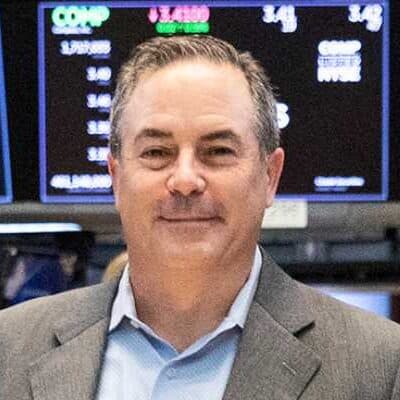
TheStreet Stocks & Markets Podcast #1: Buy the Dips, Sell the Rips With Peter Tchir
In Episode One of our new podcast, Chris Versace and Peter Tchir discuss why trade deals trump tariff deals, Jamie Dimon’s pushback, China changing the rule book, and answer Pro questions.
You've reached your free article limit
You've read 0 of 1 free Pro articles.
In this inaugural episode of TheStreet’s Stocks and Markets Podcast, Pro Portfolio Manager Chris Versace sits down with Academy Securities’ Head of Macro Strategy and TheStreet Pro contributor Peter Tchir.
Learn why Peter thinks trade deals, not tariff negotiations will be a more critical yardstick by which to measure the Trump administration. The two also discuss how China is changing the tariff playbook and how that could impact the redrawing of geopolitics and global trade.
Drawing from TheStreet Pro member questions, Chris asks Peter about trade and tariffs between the U.S. and European Union, CLO equity tranches, and whether investors should sell the market rips.
Transcript
CHRIS VERSACE: Hey folks, welcome to TheStreet's Stocks and Markets podcast. We'll be talking about all things relating to and interconnected with stocks and the market. The idea is to share some of the behind the scenes conversations that we're having, bringing you another layer of insight on your investing journey.
I'm Chris Versace, Portfolio Manager of TheStreets Pro portfolio. And joining me today is Peter Tchir, Head of Macro Strategy at Academy Securities and, of course, a Street Pro contributor. Peter, thank you so much for joining me.
PETER TCHIR: Thanks a lot for having me. Looking forward to this.
CHRIS VERSACE: Well, let me ask you a question that at least out of the gate might seem a little simple, but it's one that will hopefully set the tone for our conversation today. Peter, what does a head of macro strategy do, and how can folks use your observations to improve what they're doing when it comes to investing?
PETER TCHIR: Yeah, so my background's a little bit different. I'm not an economist by trade. I actually wound up trading a lot of structured products, high yield credit derivatives. I actually helped create the CDX suite of indices of Big Short fame.
I traded about $1 trillion of credit throughout my financial career on Wall Street. So I've wound up probably coming at this from much more of a fixed income credit background, that's kind of how I perceive the world. And through trading that the beta products, I met a lot of good contacts elsewhere.
And then I joined Academy Securities about eight years ago, and now I've gone from just advising large asset managers to we spend a lot of time with corporations. And the other really neat thing at academy is, we now have about 30 retired generals, admirals, two CIA people. But you can never tell with the CIA people, who contribute from a geopolitical standpoint. Many of them who've worked in various administrations.
So I think we got a lot of insight there. And I can kind of incorporate their geopolitical view, both from a tactical and a strategic point into my macro strategy and that's how I tend to look at the world.
CHRIS VERSACE: So like most people when they hear macro strategists, they're thinking, oh, boy, here comes a lot of economic data being thrown at me. But it sounds like you add a lot more to that.
PETER TCHIR: Yeah, to me, it's really looking for the narrative and what's changing? As an independent research provider, I don't need to be the thousandth person saying, buy high yield or sell high yield. We're kind of trying to identify what's out there and what could be missing? And there's a lot of huge opportunity.
I think, as Wall Street's become so good big, they're very siloed. So someone's an expert on triple c, someone is an expert on triple B, someone might be an expert on cash bond, CDS. And you have so many different things, it's hard to see these trends. And this ability to kind of sit at a very high level across markets, across asset classes, I think gives you that advantage to be and respond to things quicker than maybe even some of the big firms can.
CHRIS VERSACE: Excellent. Well, let's see what we can distill. Because as you know, Peter, we have a lot of moving pieces right now between tariffs, what their impact is on the economy, corporate earnings. But as well kind of lurking in the background, what does it potentially mean for the fed and monetary policy?
And look, what we learn one day can shift the next day possibly on a tweet. So I'm really kind of curious as you slap on your macro hat, where do you think all of this is headed? What is the message that you're sharing with clients of Academy Securities?
PETER TCHIR: So I think on the one side, I keep going back to what's Trump's legacy? What does he really want to do? And I'm pretty convinced that he really wants his legacy to be a much more robust, stronger middle class.
And he believes two key subcomponents to get there are deficit reduction and bringing jobs back to America. So I think that's his overlying kind of view, his strategy. I'm not 100% sure how he's implementing it is actually going to deliver on that, but he clearly believes very much in tariffs.
And right now I would say, three months ago I was quite optimistic. I liked a lot of the things what Trump was talking about doing, and I felt there was a way you could do this. You could isolate China, you could develop more things internally. Release the CHIP Act, money that's still held back. You could maybe build some long-term contracts for navy ships that have to be built in US shipyards, maybe with us steel. There are a lot of things we could have done.
And then I look at what he's done so far. And one on the geopolitical front, he seems to have isolated a lot of our allies. It's the way he's handled Russia and Ukraine has pushed Europe a little bit away. If you ask me three months ago, if Germany was going to spend hundreds of billions of dollars on military equipment, what would happen to US defense contractors is you'd think they'd skyrocket. But they're trying to avoid that.
I think the messaging around Greenland has made people a little bit uncomfortable. And I am Canadian, but I think the 51st state stuff was funny about the first 1,000 times. But then it went beyond just Trump talking about it. It went to Marco Rubio talking about it. It went to Howard Lutnick talking about it.
And so I think you've kind of pushed people away, have left some degree of confusion there. And then I think this fixation on trade deficits is shortsighted. I think there is-- we don't count the fact that we have services, trade surpluses with most countries. So focusing just on goods seems a mistake. And I think we had a lot of benefits.
And so what I'm kind of concerned about right now is what we've been calling the damage to the American brand. And part of it's geopolitical, part of it's how we've implemented the tariffs. Particularly, rather than trying to isolate China, we went after the entire world. We made up seemingly almost random numbers, which clearly they were because they've had to back them down to say 10%.
CHRIS VERSACE: Well, Peter, you didn't like that formula?
PETER TCHIR: Yeah, that formula was kind of like bizarre. I got in some trouble with some very pro-Trump people. And I'm not anti-Trump. I was just like, this looks like some kid who's trying to sketch something together because his homework is due and they forgot to do it.
And so they've had to walk that back. They've caused a lot of disruptions. I think they've made a lot of mistakes even. First, to me, you should have seen that, hey, anything that's compliant with USMCA should probably be exempted. They didn't do that at first and they had to cut back. Things like potash.
So I'm looking at this and-- and this is going to sound a little bit maybe over the top, but you go back to the Soviet Union and Levi's represented freedom. And to this day, I believe that US brands benefit globally from almost these intangible things. There's a people want to be associated. They want to be affiliated. There's an aspirational quality to US brands.
And I'm really concerned that in this fixation on trade, we've done two things. One, we missed capital flows, which has been bad. Because I think capital flows were one of the things that drove American exceptionalism, and I'm a little bit concerned that you're going to see damage to American brands going forward.
Right now, travel is way down. That might be temporary. You've seen things like Tesla do poorly kind of global sales. Again, have we done something to damage our brand? And I think we got so fixated on these obvious and tangible trade deficits that we missed all these intangible benefits, and that's why I'm kind of worried about the longer term outlook right now.
CHRIS VERSACE: Well, let's talk about that longer term outlook. Because if you take a look at what Trump is trying to do with tariffs and stuff, you could say that OK, maybe there's some near term wins. But when you start messing with historic relationships, redrawing them with our allies, you have to start to wonder about the longer term.
And you really touched on this in a piece earlier at The Street Pro where you wrote, I think Monday earlier this week. It was, and this is a quote, "A generational change in attitude towards global trade and global relations."
PETER TCHIR: Yeah, I think where we are a year from now is going to look dramatically different. One thing, again, that makes-- so I could see maybe this all works out. Right now that's not my base case, but I could see it all working out and then we're going to be up 30 some odd percent.
I'm really concerned, though, that the downside actually plays out. When I look at it, we keep talking-- the administration keeps talking about who has the cards or not. I've watched G in particular. I think Trump 1.0 was so new on the scene, no one knew how to respond to him. I think G has had time.
And if you look Trump 1.0, G was the first one to mar-a-lago. Every time Trump brought up tariffs, G put forward trade delegations. This time it's been yes, sir. May I have another? Yes, sir. May I have another?
And what I'm concerned is China has spent the last four years preparing for the potential of a Trump win, and I think they put a lot of data to work. I think they built a lot of things. I think they've tried to insulate themselves from this risk of a trade war, so I think they're much better prepared for it than us. That's fracturing things.
My other 40% of S&P 500 earnings come from foreign sales. So, again, how are we impacting that? And I did play one neat war game this summer. I was at the US Naval College, and it was about a potential blockade of Taiwan by China. But what was really neat to me was two different teams. One was the US government and one was US corporations.
And at first that didn't make sense. And then as it plays out, China and China Inc are one and the same. There is no real differentiation to me between Chinese companies and China the government. In the US it is. Look at our companies, they are huge global. Every single company in the US, I think had supply chains that were well done a to be efficient, but they also have constituents across the globe that they have to satisfy.
If you're selling something in Italy, well, you might have to have a plant in Italy or some sort of office in Italy to keep the Italians happy with you, and so on and so forth. So this concept of American and foreign, I think, that all made sense 100 years ago when companies were smaller. They weren't necessarily global in stature.
I think that's a big mistake as this. So that's why I think we have more potential downside. I've been very happy he's backed off for the last little while, but I think it was a very simplistic approach that's not going to play out well if we continue down it.
CHRIS VERSACE: Well, he seems to be continuing to taunt the big stick. Just like we saw earlier this week. Yes, he might have-- he might be dialing back some of the tariffs on autos. But then with the new section 232, going after chips, pharmaceuticals, doing something similar to what he did to lumber and to copper.
But I think what stands out though, and you touched on China a moment ago, is kind of how they're shifting the conversation. Over the weekend, while Trump was kind of saying, well, we might give a reprieve to certain chips and solar components and things like that. China is out there going, hey, we are going to stop exporting rare earths.
And then earlier this week, they said, hey, our airlines are going to stop taking planes from Boeing. We're going to tell them to stop taking auto parts from US. Sorry, airline parts from US companies. They're altering the playbook, don't you think?
PETER TCHIR: Yeah, and I think honestly, though, some of this playbook should have been obvious. One of my theories for the last two years, we've written about it in The Street as well, has been that we're seeing a shift from made in China to made by China.
And what I've meant by that is China is no longer content just to make our brands and sell them and let us sell them globally and reap the profits. They are trying to sell their own brands. Go to India, I believe the top three top selling cell phones are all Chinese brands. They are trying to push this.
BYD, I honestly had barely heard of BYD two or three years ago. To me it was still the ticker symbol for Boyd gaming, and now it's like ubiquitous. You can't get rid of it. Temu, never heard of. So I think they're trying to sell their brands, and this airline is another perfect example where you had COMAC. It started flying some domestic flight.
COMAC is the Chinese branded aircraft. There's some domestic flights. I think there's one foreign airline that uses it. It's a fairly poor country and it's in there no frills sort of tourist airline, but this is a perfect opportunity. China's going to apply leverage to countries and say, hey, if you're doing flights to and from China, you're seeing the COMAC come in, why don't you buy this? We can subsidize that.
And what always struck me as somewhat dangerous even with this is they were the last country to free up Boeing after a lot of Boeing planes got grounded with the Super Max crashes. China was the last major airspace to allow them to come back. So I think these are non-tariff barriers and things that China does.
I'm not sure this administration was all prepared for that. So all of a sudden you've got one of the best companies that's trying to rebound. Has some great success, I think, in terms of the military, the fighter jet, the F47, but now this will be a setback in China.
And I hate to take this back to almost geopolitical. But if you're any country in and around China, are you convinced that the US navy is going to be a presence five years from now, 10 years from now? Sometimes Trump and Vance talk that way, and sometimes they talk really about pulling back and that we can't be there.
And so if you're South Korea, Thailand, Vietnam, all countries that have to ship right by China, you probably have to make sure that your relationships with China are stronger than you would have before some of these shifts. So I think it's all playing into countries kind of negotiating with China.
And, again, this I'm not a military expert. I think every kid learns this pretty early on, divide and conquer. Well, the US at $30 trillion has seemingly picked a fight with the $80 trillion global economy. Had we picked and chose, I think we could have done this very differently. But I think we forcing people's hands to look at alternatives.
And finally, when I look at these deals that we may or may not get, I think Wall Street right now is making a mistake. I read too many people talking about tariff deals. I think these are going to be trade deals, and that is going to be much harder to get to.
CHRIS VERSACE: So you're not expecting a lot of clarity in the next couple of weeks then, because trade deals take much longer to hammer out.
PETER TCHIR: Yeah, I think it's going to take very long. I think there's going to be a lot of pushback. I think we are going to talk about requiring import quotas. Going back to my thing. He wants manufacturing to come here. I think tariff barriers alone really don't impact it that much. I think Europe has 10% import tariffs on US cars.
We make some cars there because of that. But I'm not sure that getting rid of that 10% is going to open up a landfill, a huge landslide of people being able to buy US cars. The cars that we make in the domestic market are very big. Ford and GM make a lot of their money from pickups. Those don't sell very well in Europe because of the size of the road, how people park.
So I think he's going to try and do import quotas. And the other thing that I think will be a bigger issue is he may try and force countries not to trade with China or put tariffs on China. Because one concern you would have is China just backdoors everything, and China manufactures most of it.
So I think this could be pretty contentious. And I think EU announced today that they're making scant progress, I think, were their exact words. And that's why because this isn't about tariffs. This is about trade, and we have this agenda that I think doesn't really fit the global agenda very well.
CHRIS VERSACE: Well, I also think too about some of the food products that we have where, it's pretty well known that the food that Americans consume in some cases are littered with GMOs. And the European Union in particular, they are much more stringent on that. Not just for food, but for other products as well.
And I think asking them or telling them that they're going to have to take these products, a, it's going to be a very difficult fight. But to your point, it's going to take a very long time to get that block across all of them to agree to change the types of products they're willing to import. So I don't see it.
This is not going to be a short, you know, duration by any stretch of the imagination. But peter, as you look across key imports into the US or key exports out of the US, are there other areas that you're watching that we could wind up seeing, to your point, a real difficulty as we start to eventually come around and thinking about trade deals?
PETER TCHIR: Yeah, I think, I just don't see a ton of excess capacity in the US. So I don't know how we-- even if we get some good trade deals, how we sell a lot more right away. Ag, I think, is an obvious one, except a lot of the issues you just brought up.
So how are we going to take advantage of that? And again, as China starts clamping down on rare earths critical minerals, where do we get that? There are certain types of steel I've been told for razor blades, for example. Right now the only steel that's good enough quality for razor blades generically is German steel or Japanese steel. So we don't have the ability to make steel that fits into razor blades.
So I think we have all these potential hiccups. I think the tariff policy has been so confusing that we will start seeing some price hikes. We might see some supply shortages. And the one thing when I look at China, I think China's ability to clamp down on its citizens is way, way higher than ourselves.
CHRIS VERSACE: Oh, yeah.
PETER TCHIR: We could barely last two weeks of volatility and we're having to get concerned. So I think we're picking fights in a way that I don't know that we have the consistency to go through, and I just see so many potential issues.
And I've also been talking a lot in my writing and my clients is, we also have to separate low per capita income countries from high per capita income countries. Countries that only make $6,000, $7,000 per person, what are they really going to buy from the US that's going to be meaningful and changing?
I think exporting services, we're great at that. We should keep that. Instead we kind of have alienated people and put tariffs on those potentially on the table. We need AI, we need chips. We're making some progress there. I think we need pharma. We should be all doing that.
But I would have started by doing subsidies or something to encourage investment in the US, giving tax breaks. And let these businesses grow up a year, or two, or three years from now, and then maybe start hitting other countries harder.
Because right now we've kind of hit other countries fairly hard, and we're not necessarily in any position to ramp up production quickly ourselves. And that, to me, I guess, is the biggest disconnect between what the administration seems to be doing and why I don't feel it's fitting their goals right now.
CHRIS VERSACE: So I'm hearing, as you just said a little while ago, the potential for price increases. We know there's a lot of uncertainty. We take a look at around at some of the other data. Consumer spending is slowing. Consumers are trading down increasingly. Given the uncertainty in the environment, businesses are likely retrenching or rethinking some of their spending.
So as you kind of game it out, are you concerned that a recession is in the cards? And if so, do you think the fed has to cut rates? And I'm asking that last part because the last couple of days the CME fed-watch tool has been showing four, maybe five rate cuts, yet we're hearing fed officials say, I don't think so.
PETER TCHIR: Yeah. One, we're at one of the weirdest economic data periods ever. I talked to one midsize bank recently, and they said they had the two highest weeks of auto loan applications. And I think their view is everyone wants if you're going to buy a car, you want to buy it now because you don't understand the uncertainty.
So you've had all this demand pulled forward. So the economic data doesn't look that bad, but it's really hard to decipher how much of that's an ongoing strength, how much of this is pulled forward? And when I take a look at where we were a couple of months ago, I think the underlying trends were already a little bit negative.
You're seeing homes for sale increase in Florida. We're now well above 2016 levels. I think even in Texas you're approaching pre-COVID levels. So some of the areas that everyone was moving to seem to be under a bit of pressure. You're seeing delinquency rates creep higher.
I think the fed is going to be forced to react, but I don't think they can really-- maybe they cut 25 in May just to get something on the table. But you really are struggling with the potential for supply shortages, the potential for inflation shocks.
Because I agree, if you bought in a bunch of stuff, say ahead of the tariffs, you're now sitting here probably not buying any more inventory, hoping that the terrorists go away. But if the tariffs are here, will you be able to order your inventory in time?
So I think we could see a little bit sort of COVID type shocks where we-- you go to the store and all of a sudden there's a run on toilet paper because no one was importing the pulp wood needed to make the toilet paper. And I think that will be very disruptive. And I think China did learn one thing under the Biden administration, the US does not live with inflation very comfortably, very long.
So they kind of have that. And yeah, I think they're going to have to cut three or four times. But I think they're going to be bad cuts because I think the economy is going to slow, and they're going to be somewhat handcuffed because you are going to see these price increases at the same time you're seeing an economic weakening.
So maybe I'm surprised when we get all these good trade deals and this all mellows out or Trump pivots, which he could do into some of those things we talked about earlier. Hey, let's focus on subsidies. Let's focus on guaranteed contracts from the government. Things that are within our hand that don't alienate the rest of the world. Then I'd be positive. Until then, I just don't see this playing out.
CHRIS VERSACE: All right. Well, it sounds kind of worrisome, Peter. I'm not going to lie. But as we gain these things out, one of the things I always try to do is look at different scenarios and weigh the probabilities as new information becomes available.
Is there a way that we could be surprised to the upside? You just mentioned if Trump kind of let's just say it capitulates a little bit and backs off, or the fed cuts rates, or-- are there other things in your scenarios that could kind of surprise us on the upside?
PETER TCHIR: Yeah, I think if he made some changes to the administration and took some of the maybe extreme tariff champions and reduced their role. Either officially or unofficially, you start seeing some of those talking heads like a Peter Navarro who's so gung ho on tariffs as the sole solution. Yeah, I think the markets would start responding positive to that.
I think, the more you give to delays and pauses, some of these things will be nasty and problematic. But if you have a year or two years, people will figure out ways around that. Again, I think if he's already starting to turn on Putin a little bit, so maybe you win NATO and Europe back a little bit more comfortable that you've changed your behavior.
So I think there's possibilities and that could turn fairly quickly. But I do think, it's like those relationships where you say something and there's certain things you know that you're never really going to be able to take back, ever.
And I can't quite tell whether we've had one of those moments or not. I'm a little bit concerned we have. But no one really wanted to deal with China very closely. Everyne understood the IP effect you get from China. Everyone understood China's completely out for themselves, so maybe we can turn this back away from China.
Things like that will look for optimism. And as we're investing, again, I think there are opportunities across the rest of the globe. I think foreigners are going to pull out some of their money back to their domestic markets, and you can see that I think already happening.
And listen, there are Germany-- if Germany is going to spend $300 billion or some number on military, they're trying to figure out a ways around that. They're trying to figure out ways to use things other than Starlink. There are opportunities across the globe, Ex-china, where I think you can like, OK, I should maybe have a much more diversified portfolio.
We really haven't had that in a long time as a strategy that works out. And I think this is just the beginning phases of a much more diversified global economy, where you want to look at those individual things. And again, European banks. If Europe's going to grow and borrow, they could do much better than people have thought.
So I kind of like diversifying away from the US for now. I think that gives you a fair degree of protection. I do think the problems that have been caused by the US, if I'm right, will affect everyone, but they're going to be not hit as bad.
And then as you say, you keep looking. What's a true turning point? Where does it come? I'll say one other thing that I think was a good turning point. Jamie Dimon last week seemed to be the first major CEO who is not afraid to very publicly and vocally come out against what the administration was doing.
You've had people like Ray Dalio and stuff, but there are investors. There are private investors. They're not subject to the government kind of maybe screwing with them. Jamie Dimon came out. It sounds like Apple kind of came out tried to negotiate stuff.
So I think if all these big corporations say, hey, you haven't been listening to us or you kind of kept us to the sidelines, here's what we're telling you and we've got the experience in the field. I think that could, again, be this turning point. And like, oh, we can breathe a sigh of relief. We'll need to it. But I think we almost need to pivot through this administration and who's there representing it to get comfortable with that.
CHRIS VERSACE: I think you're right, though, to the extent that we hear more high level companies kind of talking about the pains of the tariffs. And we're just at the mouth of the March quarter earnings season. I think a lot of folks are very concerned about June quarter guidance, but really about where the S&P 500 earnings could go.
We've seen a lot of firms already cut their S&P 500 targets for the year. I think the latest was Jefferies that took it all the way down to 5,300 as they cut their EPS expectations. I've been talking about this with the portfolio subscribers over the last several weeks.
And to the extent that those numbers from those earnings numbers come down, I think we're going to have a revaluation on the market PE. But the degree to which we'll know all of this is going to play out over the next couple of weeks, not the next couple of days.
But hopefully, we will see more people kind of push back a little bit and fuel that rethink by Trump and potential tariffs. But let's move into the Q&A portion, Peter. Now, one of the things that we've done is we've taken some questions from members of The Street Pro.
And what we'll be looking to do is ask our guests, like Peter, in this case, what are your answers for these questions? So Peter, I'm going to ask you right now. Are ready for the Q&A?
PETER TCHIR: I'm ready as I'm going to be, I guess.
CHRIS VERSACE: All right. First question. What are your thoughts on the reality of achieving a 0% tariff level between the US and the EU?
PETER TCHIR: I think it's possible. Again, you look and I think the average tariff level trade weighted average is only like 3% or 5%. We could see this. And again, I think if you really analyze it. So on autos right they're 10%, we're 2.5%. Sure. Take those both down to zero. I don't think that's going to be what drives it.
I think it's going to be much harder to convince people that, oh, well, it's fake science about GMO food. Those are going to be the things, I think, that are going to be much harder to negotiate away, because I think they are long standing in Europe.
And, again, champagne can only be made in champagne region. So I think getting rid of some actual tariffs relatively easy. Getting to through all the regulations, will be difficult. And I just don't think that'll matter. It'll be one of those moments like, oh, the tariffs are all gone. OK, what have we really accomplished? And I think the answer is going to be, it's not changing the overall sales of each other's countries very much.
CHRIS VERSACE: OK. All right. Let's move on to the next question then. What is your view regarding private credit, in particular CLO equity tranche performance, in this environment and perhaps the near term environment as well?
PETER TCHIR: Every year and this year I forgot to do it during March madness, I put out something about the CLO triple A tranches. That it's easier to get a perfect permanent bracket than it is to break a triple A tranche of a CLO.
So the equity and private credit, I'm a little bit nervous about. I think some of the credit private credit deals, if we do see a recession, they might have some issues. But again, I think people have planned really well within that. I think it's going to be tolerable how it's done. I think there'll be some opportunities there.
So I'm not shying away from private credit. When I look at the CLO equity space, I might be a little bit cautious there. I think if you move up to some of the mezz tranches-- and I haven't looked at JBBB, which is a triple B, double B, sort of CLO tranche. I think those could offer some interesting value because you do have some subordination below you.
I don't think, you know, these things got carried away too much, so I'm not a big-- I'm not worried about private credit. If I had seen a lot of private credit products that incorporated leverage on leverage, then I'd be worried. But I think yeah, some countries-- some companies will do poorly, some won't. But you can restructure, you can move along. So I'm comfortable with that right now.
I would say on the CLOs, I might want to be up from the equity and into the mezz sort of tranches. But again, I'm not seeing this wholesale thing. And BDCs I think are very similar into that. They are still an area that I think you can be comfortable with. Because I think this is going to be more about valuation and a slowing of the economy, but not a complete disaster for most companies.
CHRIS VERSACE: OK, all right. Let's get back with this question into Trump and trade and tariffs. Do you think Trump is simply kicking the can down the road over the next three months kind of like he did with the TikTok ban? And is this just really a pushing out of things? No real changes coming.
And if you're an investor, per the question, should we use things like this when we see a bump in the market maybe to raise some extra cash? What do you think?
PETER TCHIR: Yeah, I think you're supposed to-- my view of Trump all along has been, things are never as good as they seem and they're never as bad. So I should have followed my own advice and been much more bullish last week. I got bullish the weekend before because I thought he might pull back before the tariffs went into place and kind of had to dance around that.
But now that things seem good and it seems all rational. This is where I get worried he's going to lash out at something else. So I would take this recent rip that we've had, reduce exposure. Again, I think one thing that I think is going to try to drive us lower from here is Wall Street keeps talking about tariff deals. And I think this is about trade deals, and trade deals are not going to be anywhere near as simple.
So that's kind of how I would play it. You sell every rep a little bit, reduce your exposure, see where you can play out somewhere else. I think you see a real pivot away from this whole fixation on tariffs.
CHRIS VERSACE: So then what is it then that would get you excited enough to kind of back up the truck and be like, OK, from a technical perspective the market's bottomed. Oh, there's a real turn coming. Is there something where you just draw a line in the sand and you go, OK, I got to put chips in instead of, as you just discussed, maybe pulling some incremental chips out.
PETER TCHIR: If I saw something too that looked like a much more coherent exemption plan. And Canada today announced some exemptions. Anything that's imported that goes into products that then Canada finishes up and sells on, that's now exempted.
So the chips thing is kind of silly almost that you could import a computer now with no tariffs. But if you imported the parts to make a computer, you still had tariffs. So I would like to see something where it's really like a, we're dialing back on tariffs, but we're dialing back in a creative, thoughtful way.
And here's where we're going to spend money. We are going to commit to let's give chips. Again, maybe even start really aggressive income tax reductions for R&D. Things like that that you can say, OK, when I started this, my big belief on Trump was we tried to turn it from drill baby drill to refined baby refined to anything for national security that develops into national production. Let's get back to focusing on that.
We not only need to get the rarest in critical minerals, we need to be able to refine those here. Give subsidies, let that start. And as soon as I see him kind of really going towards a something that's more domestic focused, where we don't have to annoy the rest of the world, then I'll get very bullish. Because that was kind of the plan I thought we'd have all along.
That we become independent, not from just kind of taking it from other countries, but by pushing it on ourselves, giving us that kind of opportunity to grow, be pro-business. I think every businessperson I talk that was the excitement about Trump, pro-business, and all of a sudden it became pro-tariff and too hard.
CHRIS VERSACE: And too much uncertainty. So as you kind of game this out, are there areas that you think, from an investment perspective, that might be a little more insulated and a little more resilient that folks should be taking a look at? Not necessarily specific companies, but just from a sector perspective.
PETER TCHIR: I'm taking a closer look at utilities. Again, I think, they've kind of all sold off pretty hard. They bounced a bit, but we are going to need that. We are going to continue on data centers. And I do think ultimately we are going to do more and more refining and processing here.
So I think you can look at some of the big industrial companies that will benefit from that. Who's going to sell equipment into there? Some of the farm stuff, I think some of the ag, we probably will get the ability to sell more of that. So you can-- so I think I kind of want to own the logistics.
The companies that would be logistics/the builders, I think there's a good opportunity there. If we do get a peace deal somewhere with Russia and Ukraine, it could be an opportunity for our kind of construction companies to go there and help rebuild their energy.
So I would probably stay long energy. I think there's going to be some fluctuation around energy prices. But the people who can kind of extract and process things from the Earth, I think those will do well. So I would not-- I like buying those on dips as opposed to selling on rips. How's that?
CHRIS VERSACE: That's great. That's great. All right. Well, thanks for those questions Street Pro members. And listeners, if you want to hear your question asked and answered on TheStreet's Stocks and Markets podcast, you'll need to be a Street Pro member.
And Peter, thank you so much for joining us this week. But before we get out of here, just two quick things. One, any anything we didn't talk about that we should have? Any parting thoughts that you really want to share with the listeners?
PETER TCHIR: Yeah, I'm a little bit worried about the deficit. Everyone got so carried away last week talking about foreign selling, which I think is gone. We missed the fact that on Thursday at the cabinet meeting, DOGE came out and said the target now for 2026 is $150 billion.
That was down from $2 trillion to a trillion to $150 billion. If that was a big part of our plan, that seems to be gone. The tariff revenue seems to be delayed. And Trump did, I believe, talk last Monday or Tuesday about upping the military budget from $800 billion to a trillion.
So I think we all kind of became a little bit complacent listening to Trump and BESS and say, deficit reduction. The headlines last week had nothing else been going on, would have raised a lot of concerns about the deficit. And I think stuff like that may come back where it goes back, oh, we kind of took this for granted. It was off the radar screen and we just had so many battling headlines, we missed this.
So I think over the coming weeks, we might hear a little bit more discussion about, hey, the deficit is not on the track we were all hoping for. What does that mean for rates? And that again would slow the economy. If the fed can't, we might have to cut. But if the deficit keeps growing, that's problematic.
CHRIS VERSACE: Well, Peter, it sounds--
PETER TCHIR: Want to put back in front of people.
CHRIS VERSACE: Sorry to cut you off there. I was going to say it sounds like you've got some topics for some upcoming articles over at The Street Pro that you'll be able to share your insights and break down what's happening and unfolding as we learn more. So that is great.
And Peter, other than the Street Pro and Academy Securities, any socials or anything like that that folks can kind of get your latest thoughts, your insights, what have you.
PETER TCHIR: Yeah, I'm on Twitter with the handle @tfmkts, so TF Markets basically. So tfmkts out there a fair bit, and do a lot of Bloomberg and FT and lately New York Times for some reason.
CHRIS VERSACE: Excellent. Well, Peter, thank you so much for joining us. And folks that is today's episode of TheStreet's Stocks and Markets podcast. Thanks for tuning in.