Sunday Soup: 5 Food Additives to Avoid, Warehouse Automation and Sustained Demand for Le Creuset
These are the articles, streaming ideas, and books that caught our attention this week.
You've reached your free article limit
You've read 0 of 1 free Pro articles.
We’ve got another round of eyebrow-raising articles and streams to share with you this week, plus a new book to help get you ready for when the market kicks back into gear after the Labor Day holiday.
Did Taylor Swift push podcasts past the tipping point? Did robots pack your groceries? Should we be taking collagen, and what about these five food additives?
The answers to those questions and two deep dives on AI lie ahead.
If you have a recommendation to share, we’d love to hear about it in the Comments section below.
Now enjoy this latest offering of Sunday Soup.
Articles 📰
Taylor Swift Found a New Way to Control Her Narrative: Podcasts
"The transformation of podcasts from a niche audio format to a linchpin of celebrity press tours is complete. Taylor Swift has finally appeared on one. Her guest spot on 'New Heights,' a video podcast about football and pop culture co-hosted by her boyfriend, Travis Kelce, amassed nearly nine million views in about 12 hours on YouTube, setting a record for the show and cementing its place among modern media properties. About 1.3 million people tuned in simultaneously to a livestream of the episode before it was felled by a technical glitch."
Inside the automated warehouse where robots are packing your groceries
"I’m at a warehouse — or customer fulfilment center (CFC) — operated by online grocery company Ocado in Luton, just outside London. You might not have heard of Ocado, but it may still have delivered your groceries. Its technology handles online orders for Kroger across 14 US states, Sobeys in Canada, and both Morrisons and its own delivery brand in the UK, with other clients across Europe and Asia."
Intelligence at scale: Data monetization in the age of gen AI
"CEOs worldwide face a perplexing challenge: Data has become ubiquitous, but monetizing it remains elusive. Their companies have invested heavily to unlock data’s latent value. They have built warehouses, created dashboards, embedded analytics into their operations, and more recently, built data product businesses. These investments have delivered significant value — but far more value remains untapped."
Should you take collagen?
"Collagen is a structural protein that provides shape and support to everything from skin and bones to muscles and tendons. One estimate is that it makes up 25-30% of all protein in the body. And since the body is constantly growing new skin and hair and remodelling its bones, it gets through quite a bit of the stuff every day. Exactly how much it needs—and whether it can get it all from a healthy diet—is hazy."
5 food additives that might be bad for your health — and how to avoid them
"One reason ultra-processed foods might be so hazardous to your health is that they’re often loaded with chemical additives, such as synthetic emulsifiers, preservatives and sugar substitutes. These additives are designed to enhance the flavor, texture, color and shelf life of hot dogs, ice cream, chicken nuggets, sugary cereal, protein bars and other processed food."
What We’re Streaming 📺📲
What We’re Listening To 🎧
"Thinking in Bets: Making Smarter Decisions When You Don't Have All the Facts" by Annie Duke
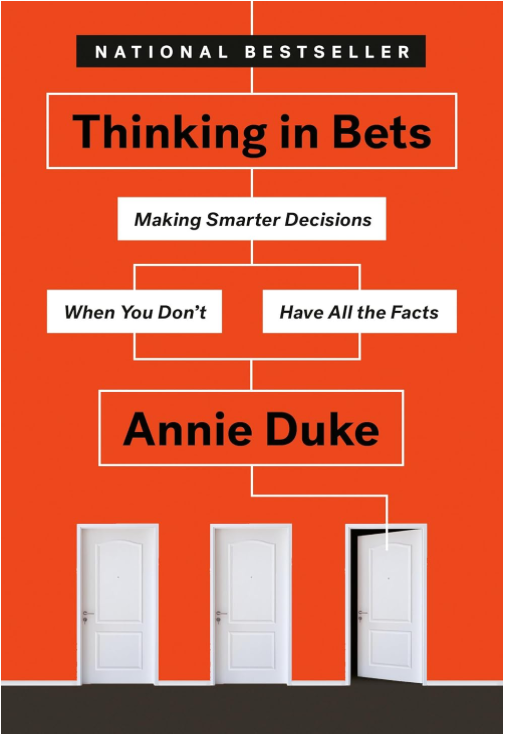
"Even the best decision doesn't yield the best outcome every time. There's always an element of luck that you can't control, and there is always information that is hidden from view. So the key to long-term success (and avoiding worrying yourself to death) is to think in bets: How sure am I? What are the possible ways things could turn out? What decision has the highest odds of success? Did I land in the unlucky 10% on the strategy that works 90% of the time? Or is my success attributable to dumb luck rather than great decision making?
"Annie Duke, a former World Series of Poker champion turned business consultant, draws on examples from business, sports, politics, and (of course) poker to share tools anyone can use to embrace uncertainty and make better decisions. For most people, it's difficult to say 'I'm not sure' in a world that values and, even, rewards the appearance of certainty. But professional poker players are comfortable with the fact that great decisions don't always lead to great outcomes and bad decisions don't always lead to bad outcomes."